When you click on links to various merchants on this site and make a purchase, this can result in this site earning a commission. Affiliate programs and affiliations include, but are not limited to, the eBay Partner Network.
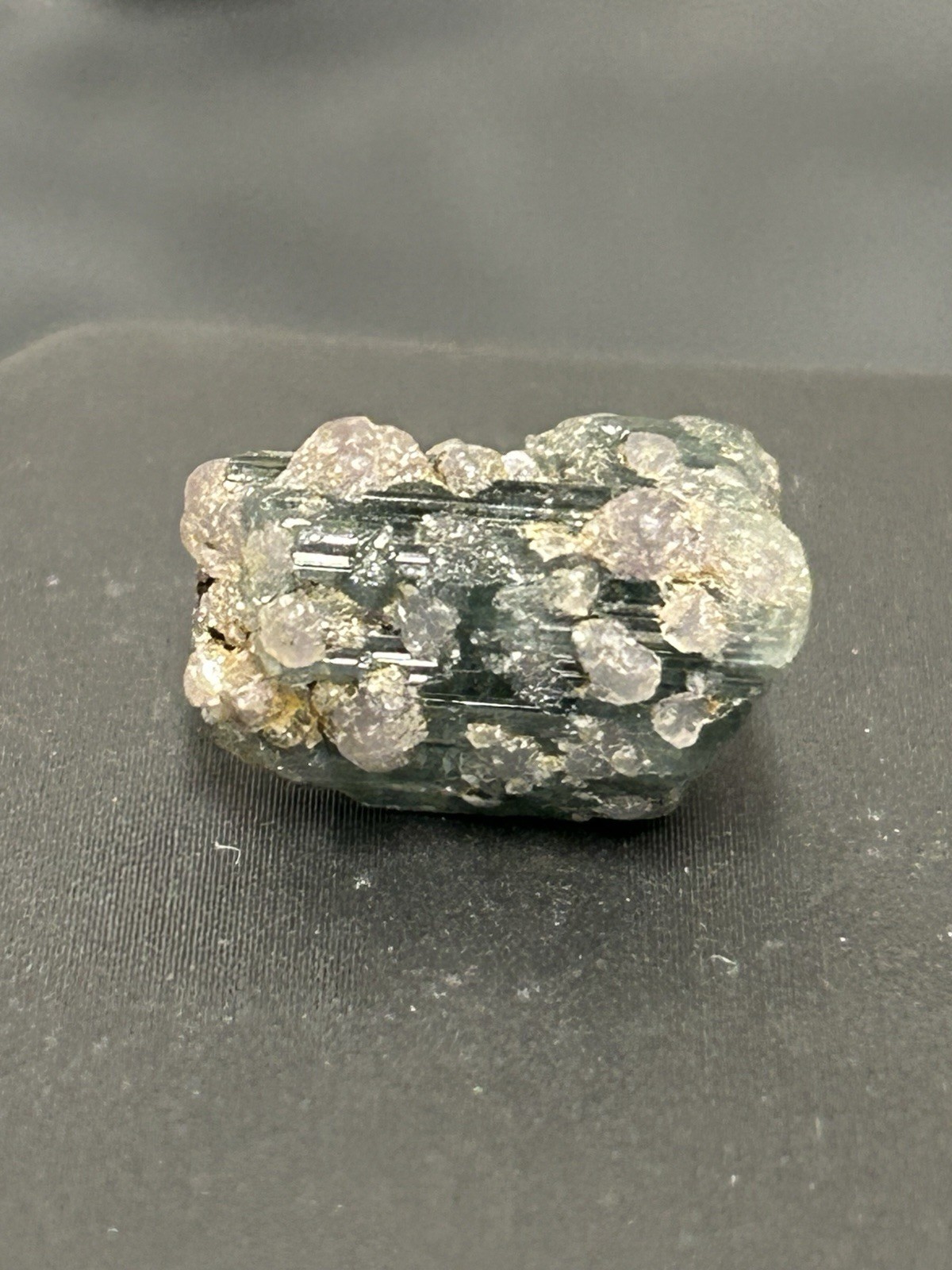
A rare and visually distinctive thumbnail mineral specimen identified on its accompanying original label as Dudgeonite, with the parenthetical notation “Ca-Annabergite,” from Estrie, Québec, Canada. The specimen weighs approximately 14.2 carats, or 0.1 oz, and measures approximately 7/8” × 1/2” × 3/8” (22 × 13 × 10 mm).
This compact specimen has a deep green crystalline body with pronounced longitudinal striations and reflective crystal faces. Across the surface are numerous pale pink to lavender rounded aggregates that create a strong contrast against the darker green matrix. Several faces show especially defined parallel crystal growth, and portions of the green material display attractive translucency under direct light. The combination of color, texture, and crystal form gives the piece a particularly sculptural appearance despite its small thumbnail size.
The original identification label accompanies the specimen and reads “Dudgeonite (Ca-Annabergite), Estrie, QC, CAN,” with the weight recorded as 14.2 ct / 0.1 oz. That label is an important part of the specimen’s history and will be included along with the display box.
This specimen comes from the Kelly Brett Collection. Kelly Brett primarily collected minerals with an artistic purpose in mind, selecting stones and crystals for their color, form, texture, and potential use in decorative artworks or jewelry. This specimen fits that collecting approach particularly well because of its strong visual contrast, unusual rounded formations, and striking green crystalline structure. The specimen was later acquired by Traders Loan & Jewelry in Reseda, California.
Dudgeonite is a historical name used for calcium-bearing Annabergite, also described as Ca-Annabergite or calcian Annabergite. Annabergite is a hydrated nickel arsenate in the Vivianite Group, with the primary formula Ni₃(AsO₄)₂·8H₂O. In calcium-bearing material historically identified as Dudgeonite, calcium substitutes for part of the nickel, giving an approximate formula of (Ni,Ca)₃(AsO₄)₂·8H₂O.
The deep green coloration is consistent with nickel-bearing arsenate minerals in the Annabergite family. The pale pink to lavender rounded material provides an especially unusual visual contrast. Because the individual pink formations have not been separately laboratory analyzed, they are described by their visible appearance rather than assigned a separate mineral identification. Dudgeonite is generally treated today as a historical mineral name rather than a separate recognized species, which makes the original terminology on the collection label especially interesting to collectors of older mineral nomenclature, systematic minerals, nickel arsenates, and Canadian specimens.
Metaphysically, Dudgeonite and Annabergite are associated with transformation, renewal, emotional balance, and personal growth. Their green energy encourages harmony, forward movement, and the release of stagnant patterns, while the softer pink and lavender tones add qualities of compassion, inner peace, emotional understanding, and gentleness. Together, these energies create a balanced mineral presence associated with strength, sensitivity, and greater clarity.
This is a natural mineral specimen with irregular edges, contacts, and crystal formations consistent with natural growth and extraction. The prominent green striated crystalline structure is well displayed, with numerous contrasting pink to lavender rounded aggregates visible across multiple surfaces. The original identification label and display box are included.
Safe Handling: Natural mineral specimen for display. Handle with care, wash hands after handling, avoid creating or inhaling mineral dust, and keep away from children and pets.
Mineral Identification Disclaimer:
Every effort has been made to accurately identify and describe this specimen using available reference materials, labels, provenance, and careful visual examination. While I strive to provide accurate information, I am not a professionally trained mineralogist or gemologist, and inadvertent errors in mineral identification, locality attribution, or other descriptive information may occasionally occur.
For that reason, mineral names, varieties, associations, and locality information should be considered a good-faith identification rather than a professional laboratory determination. Buyers requiring definitive identification or chemical composition should obtain independent laboratory analysis.