When you click on links to various merchants on this site and make a purchase, this can result in this site earning a commission. Affiliate programs and affiliations include, but are not limited to, the eBay Partner Network.
(F248)
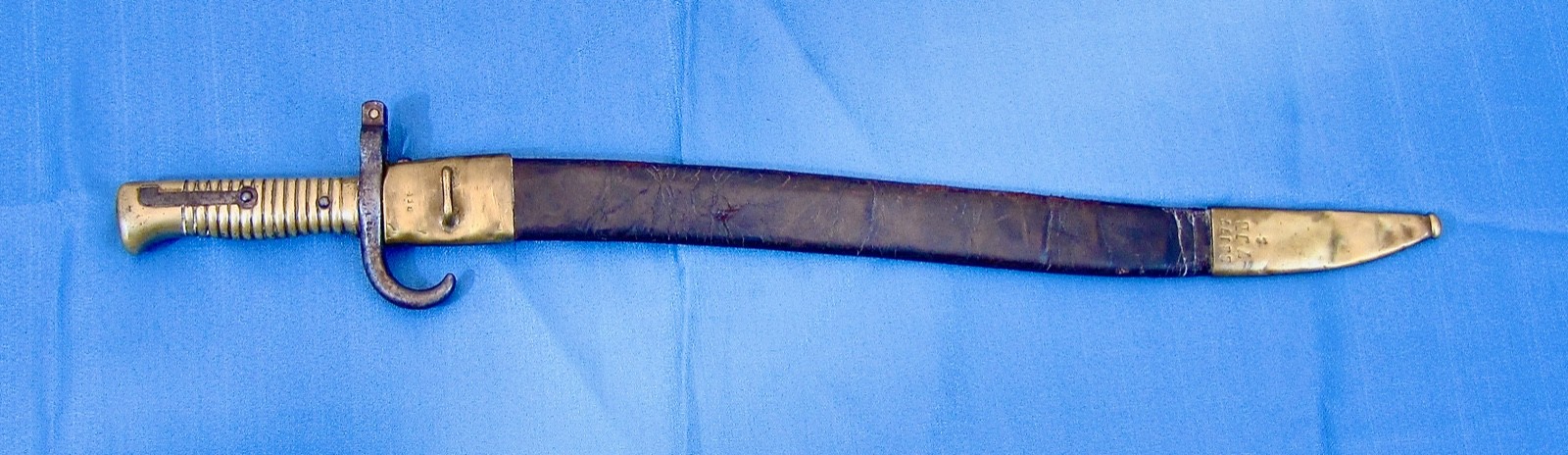
THIS BAYONET, SPECS: This particular bayonet has markings on the ricasso that show it was made byWeyersberg and Stamm of Solingen, Germany; “SOLINGEN, W & ST”. The blade measures 18-3/8 inches (467mm), and overall the length of the bayonet is23-5/16 inches (591mm). The muzzle ring measures 17.7mm. The top of the hilt and the top of the blade are marked with the number 380. The marks on the crossguard are seen in the photos.The scabbard is marked with the serial number of 418.
THIS BAYONET, CONDITION: The blade is in good shape with quite a bit of surface discoloration rust and minor surface pitting, especially on the left side. Thescabbard has its original leather which is in good condition; the end pieces of brass are a bit beat up but whole.Thehilt and the guard are also in good condition, the hilt iscomplete with its spring and side button.
VALUE: These Uruguayan modified Werders are valued about the same as the original German Werders (that is, not counting the First Model Werder which is wider and a bit longer and is extremely rare). In any case, it is very hard to find a Werder in any kind of condition, for that matter it is almost impossible to find a Werder at all.
A LONG AND WINDING ROAD: This is one of the rarer German bayonets.This particular Werder ended up in Uruguay through a rather circuitous route. In 1886 a group of young Uruguayans who had been in exile in Argentina made a quixotic excursion across the Uruguay River to start what became known as the Revolution of the Quebracho (La Revolución del Quebracho). They lost their battle to the better-armed and better-trained government forces and many were taken prisoner, including the later famous President, José Batlle y Ordóñez. It is well known that the Argentine authorities were sympathetic to this cause and supplied the band with part of its armament. Among the arms carried across the river were several hundred German Model 1869 Werder bayonets – however they were carried not as bayonets but rather as short swords. Evidently the Argentines did not want to give up any Werder rifles to this chancy venture. So after the battle when the spoils were counted the Uruguayan military became the new owner of a bunch of German 1869 Werder bayonets. On many of these bayonets they later replaced the original steel crossguard with a different steel or brass crossguard, and the muzzle ring was set higher to fit the 1895 Brazilian Mauser rifle, some of which had been procured for the Uruguayan military. Some of these Uruguayan Werders still have German marks, but all of the marks on the crossguards are Uruguayan. The few modified Werders we have seen in Uruguay almost always have an original scabbard, but we have never seen a set where the scabbard and bayonet numbers match.
This Werder bayonet will be insured for the purchase price when shipped. If you buy more than one item we will try to combine items in the shipping when possible.