When you click on links to various merchants on this site and make a purchase, this can result in this site earning a commission. Affiliate programs and affiliations include, but are not limited to, the eBay Partner Network.
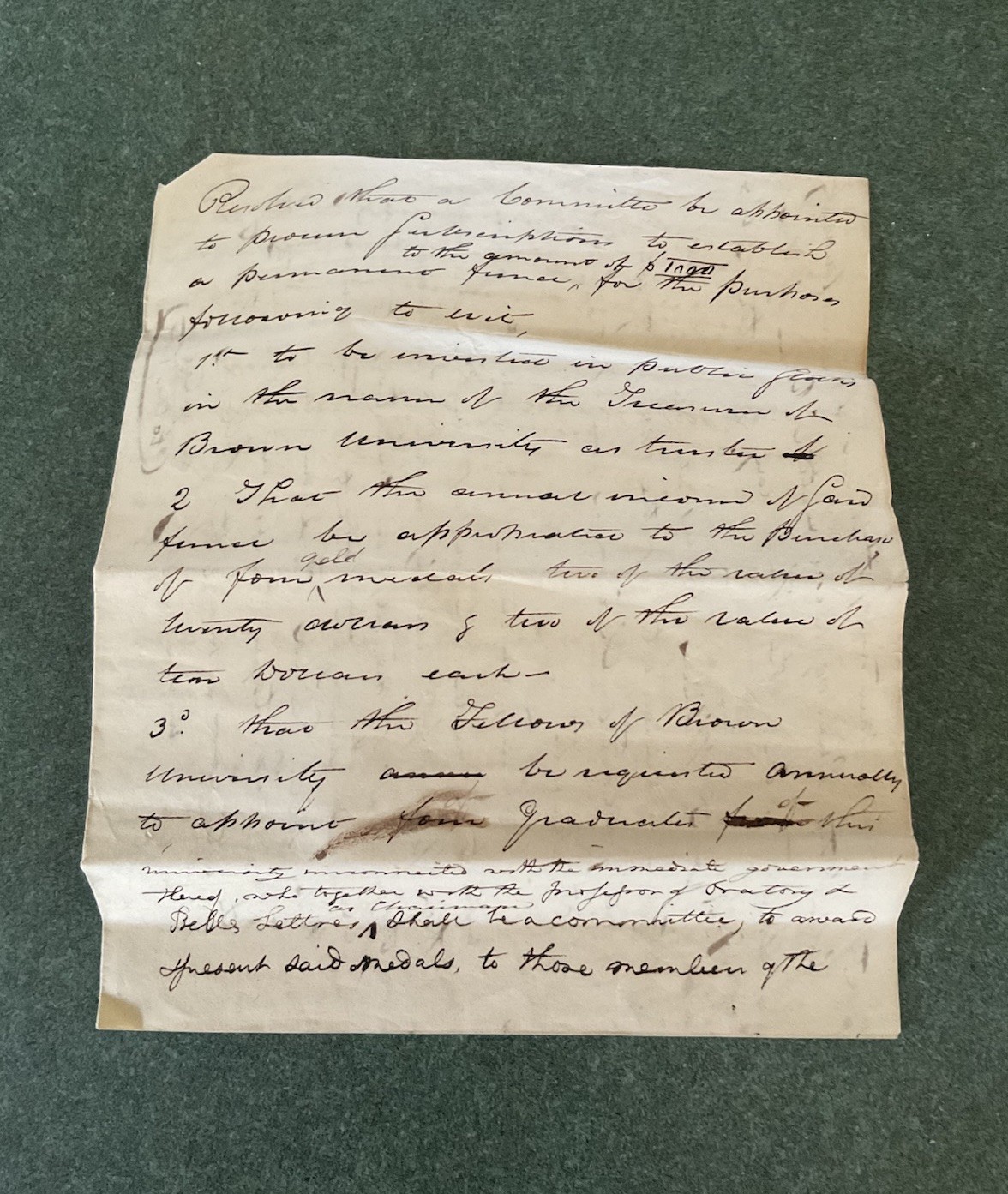
Brown University established the first ever alumni fund in higher education in 1823. The earliest recorded organized effort to secure ongoing financial support from former students. This milestone marked the beginning of modern higher education fundraising and structured alumni philanthropy in the United States. There are several notable gentlemen of Rhode Island mentioned in this document.
The year 1823 is also highly significant in the university's institutional history: September 1823 marked the very first formal meeting of the Brown University Alumni Association. Chaired by William Rogers (from Brown's inaugural class of 1769), this meeting established the university's initial alumni fund to support student awards in composition and declamation.
Brown's first Chancellor, Stephen Hopkins served as a Delegate to the Colonial Congress in Albany in 1754 and to the Continental Congress from 1774 to 1776. He was a signatory to the United States Declaration of Independence on behalf of the state of Rhode Island. At the time of his signature of the Declaration of Independence, Stephen Hopkins served as both the Chief Justice of Rhode Island and Brown's Chancellor.
William Rogers, born in Newport, Rhode Island, enrolled at Rhode Island College (named Brown in 1805) September of 1865, a day before its first president, James Manning, was appointed. Rogers was fourteen years old. The followingJune he was still the only student when President Manning's brother-in-law enrolled. At the college's first commencement in 1769, Rogers delivered an “oration on benevolence.” He then taught in Newport until he was baptized and licensed to preach in 1771. He moved to Philadelphia, where he would remain the rest of his life, and presided over the Baptist Church. During the Revolutionary War he served as chaplain to Pennsylvania's battalions and was promoted to brigade chaplain of the Continental Army by 1778. Upon ending his military service he was offered appointments in three churches, each of a different denomination. He declined all these offers, preferring to preach at Philadelphia's poorest churches. In 1784 he was delegated to the task of procuring a new seal for his alma mater among the craftsmen of Philadelphia; the old seal bore images of the King and Queen of England. In 1789, Rogers received a professorship of English and oratory at the Academy of Philadelphia (later the University of Pennsylvania). He left in 1812, however, protesting the "restless and ambitious spirit of a despotical provost." Rogers was an advocate for the gradual emancipation of slavery and for the improvement of public prisons as well as a member of the Pennsylvania legislature.
Rogers was ultimately granted four honorary degrees: honorary master's degrees from the College of Philadelphia (now the University of Pennsylvania, in 1773), from Yale (in 1780) and from the College of New Jersey (now Princeton, in 1786) and an honorary Doctor of Divinity from the College of Philadelphia (in 1790). He also served as professor of oratory and the English language at the College of Philadelphia and then, after the 1791 union of the College of Philadelphia and the University of the State of Pennsylvania, at the University of Pennsylvania from 1789 to 1811. From 1771 to 1824, Rogers was a Baptist clergyman, serving as pastor of the First Baptist Church of Philadelphia from 1772 to 1775. His resignation from this post in 1775 left a five and a half year vacancy, although he preached on occasion during those years. In April of 1776, Rogers became chaplain to Colonel Samuel Miles' Pennsylvania Rifle Regiment, a position he filled until 1778, when he was appointed a brigade chaplain in the Continental Army. He retired from this second position in 1781 and, although he had opportunities to enter upon other pastorates, there is no evidence that he served in that function again. Rogers held various offices in literary and religious societies. In 1783, he became one of the original members of the Society of Cincinnati. He was chaplain to the Military Legion of Philadelphia in 1805; in 1816 he was sent to the Pennsylvania legislature; and in 1819, he became a member of the Religious Historical Society of Philadelphia. Rogers was known as a writer of moral, religious, and political articles. He died in Philadelphia on April 7, 1824. His family consisted of three daughters, one of whom married William Henry De Wolf of Bristol, R.I.
Danforth was born April 1, 1787, in Providence, Rhode Island, son of Job Danforth. He graduated from Brown University in 1805. He studied law. Danforth was clerk of the Supreme Judicial Court for Providence County from 1807 to 1818 in the Court of Common Pleas. In 1820 he entered journalism as editor and joint owner of the Providence Gazette newspaper. As a journalist, he became known for his wit and political satire. The Gazette often supported the Federalists. He was also affiliated with the publications the Microcosm, the Express, and the Republican Herald. Danforth was an ardent supporter of President Andrew Jackson, who appointed him Collector of Customs in Providence from 1829 until his retirement in 1841. Danforth left retirement in 1853 to become mayor for a single term, and after that he was elected to a single term in the General Assembly. Danforth was also a historian and lecturer on the history of Providence.mHe also led the Providence Association of Mechanics and Manufacturers, which is now known as the Board of Trade and Chamber of Commerce. Danforth died at his home in Providence August 11, 1861 and was buried at Swan Point Cemetery.
Rhode Island Supreme Court Justice William R. Staples. Born in Providence, Rhode Island, Staples graduated from Brown University in 1817, and was admitted to the bar in 1819. In 1832 he was a member of the Common Council of Providence, and later served for two years as Justice of the Police Court. From 1835 to 1854 he was an associate justice of the Supreme Court. While serving on the court, he engaged in historical studies and antiquarian research. In 1843 he published his Annals of Providence, a history of the city from its founding until 1832. He was the author and compiler of several works upon subjects connected with the early history of Rhode Island. At the request of the General Assembly, he prepared a history of the State Convention of 1790 which adopted the Federal Constitution. After the resignation of Chief Justice Richard W. Greene in 1854, Staples was elected chief justice. After holding the office for two years, he resigned as of March 7, 1856, due to health issues.
He wrote few reported opinions, most of which were very short, and are mainly brief statements of the conclusions reached by the court rather than elaborate statements of the reasons upon which the decision rested.
Samuel Y. Atwell served as one of the defense attorneys for John and William Gordon during their high-profile 1844 murder trial. John and William Gordon (along with their brother Nicholas) were Irish-American immigrants accused of murdering prominent Rhode Island industrialist Amasa Sprague. The Crime: Amasa Sprague was beaten and murdered on New Year's Eve in 1843 in Cranston, Rhode Island.The Defense Team: Samuel Y. Atwell and Thomas F. Carpenter represented the Gordon brothers in court, delivering impassioned arguments during the March/April 1844 trial in the Rhode Island Supreme Judicial Court. The Prosecution: Joseph M. Blake, the Attorney General of Rhode Island, prosecuted the case. Outcome and Historical Significance-Despite the defense efforts of Atwell and Carpenter, John Gordon was convicted and ultimately hanged in 1845. The case is a notorious chapter in Rhode Island legal history due to anti-Irish sentiment at the time. Amasa Sprague, a wealthy Rhode Island mill owner and politician, was brutally murdered on New Year's Eve in 1843 in Cranston, Rhode Island. The Murder The Crime: On December 31, 1843, Sprague left his mansion to check on his farm and mill operations. He was ambushed near the Pocasset River, shot through the wrist, and beaten to death with a musket, suffering severe skull fractures and other massive injuries. The Motive: Investigators suspected a grudge. Sprague had recently used his political power to block the renewal of a liquor license for Nicholas Gordon, an Irish immigrant businessman, after arguing that the alcohol hurt factory productivity. The Trial and Execution The Arrests: Nicholas Gordon and his younger brothers, John and William Gordon, were arrested almost immediately amid intense anti-Irish and anti-Catholic local sentiment. The Verdict: Despite a lack of direct physical evidence and heavy reliance on circumstantial testimony, John Gordon was convicted of the murder. The Execution: John Gordon was hanged in 1845, marking the final execution carried out in the state of Rhode Island. Historical Impact Abolishing the Death Penalty: Public outrage and remorse over the strong possibility of John Gordon's wrongful execution fueled a political backlash. In 1852, Rhode Island became the first U.S. state to formally abolish the death penalty. More than 160 years later, in 2011, Rhode Island Governor Lincoln Chafee granted John Gordon a posthumous pardon, officially recognizing the trial as a miscarriage of justice driven by religious and ethnic prejudice.
Specific Donors - Detailed, itemized rosters or individual names of the specific alumni who contributed to that initial 1823 fund are not broadly digitized or publicly detailed in standard historical summaries, as records from early 19th century institutional archives remain internal to the university’s historical collections.
Built in 1770, University Hall was originally known as the College Edifice. The building was constructed on a piece of land that had belonged to the original Brown family ancestor and co-founder of Providence, Chad Brown (c. 1600–1650).
The first reference to the building was made on September 5, 1765, at the second meeting of the Corporation in Newport. Later meetings of the Corporation organized a building committee; among the committee's members were Stephen Hopkins and Joseph Brown. The plans were finalized on February 9, 1770, and on February 17 the building committee placed a notice in the Providence Gazette soliciting donations of timber and other materials. At the time of its construction until the construction of the First Baptist Church in 1775, University Hall was the largest building in Rhode Island.
Prominent Newport merchant and slave trader Aaron Lopez donated timber to the effort, while Nicholas Brown, Sr. and Company led the construction. The workforce involved in the construction of the building was diverse, reflecting the ethnic and social admixture of colonial Providence's population. Slaves, free people of color, indigenous people, and white laborers—both skilled and unskilled—worked to erect the structure.
Construction on the building began on March 26, 1770, and the roof of the structure was raised on October 13, 1770. Construction on the building resumed following the Revolutionary War, continuing into the 1790s.
Lot#5