When you click on links to various merchants on this site and make a purchase, this can result in this site earning a commission. Affiliate programs and affiliations include, but are not limited to, the eBay Partner Network.
Executive Summary: Lower to Early Middle Palaeolithic Gigantolith Processing Platform
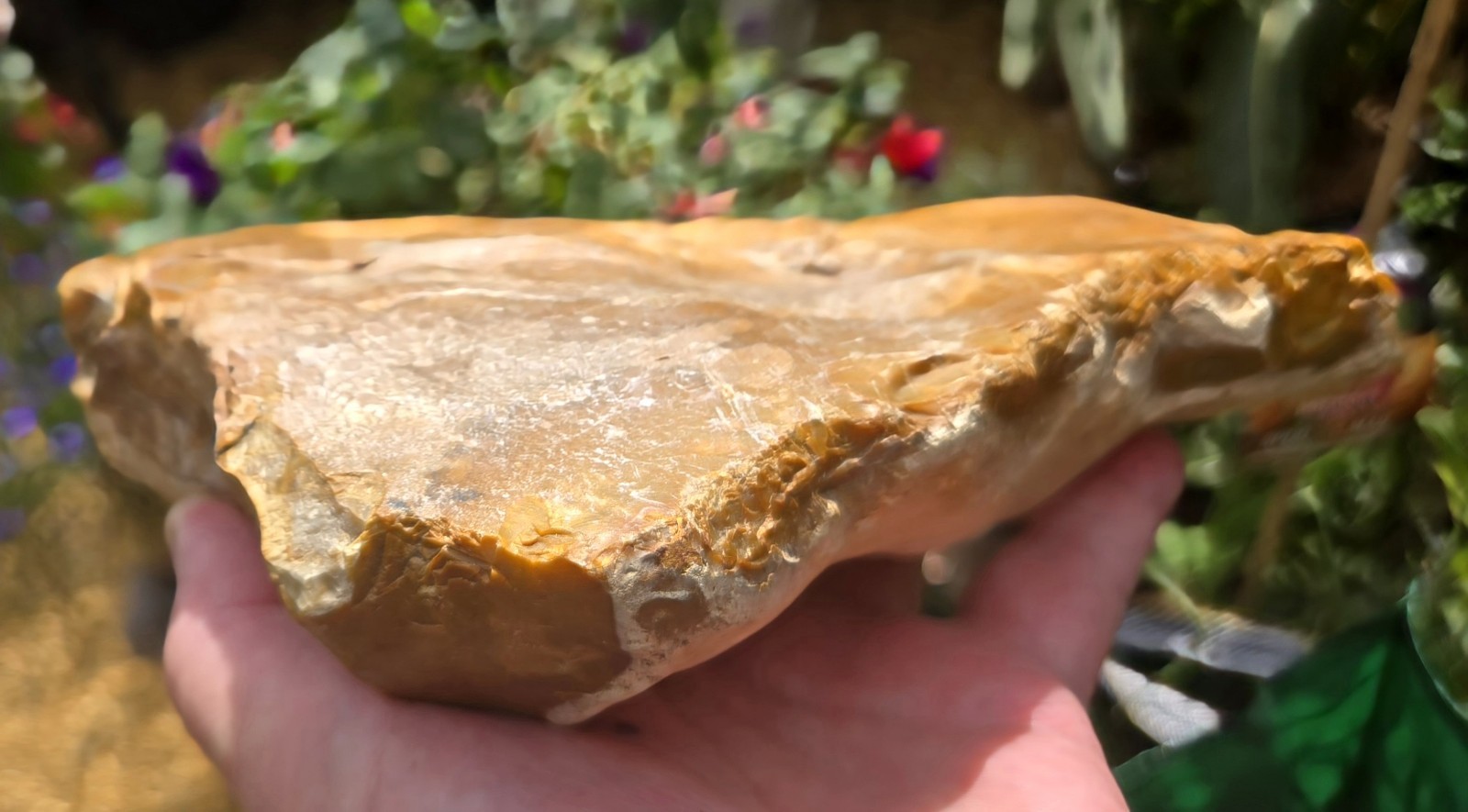
This extraordinary specimen represents a monumental class of Lower Palaeolithic lithic technology—a Gigantolith Processing Platform produced during the transition between Homo heidelbergensis and early/proto-Neanderthal lineages. Combining exceptional physical scale with sophisticated single-face (unifacial) reduction, this piece serves as rare physical evidence of prehistoric \"site furniture\"—a permanent, high-yield processing anchor engineered for heavy mega-fauna exploitation and material preparation.
Created by Homo heidelbergensis or early Homo neanderthalensis.
Object Class: Lithic / Gigantolith Typology
Dimensions & Weight:
- Length: 205 mm
- Max Width: 157 mm
- Thickness: 45 mm - 35 mm (highly uniform tabular profile)
- Weight: 1831 grams - (Gigantolith-class)
Period / Date Range:
Lower to Middle Palaeolithic (Acheulean to early Mousterian transition), approximately 350,000 to 150,000BP. Created by Homo heidelbergensis or early Homo neanderthalensis.
Key Diagnostic & Technological Attributes
Uniform 35 mm–40mm Transverse Profile: Unlike standard Acheulean giant bifaces that taper to a steep central keel, this piece maintains a precise, slab-like thickness across its transverse section. This uniform gauge demonstrates deliberate, highly controlled depth management during reduction.
- Targeted Tabular Raw Material Selection: Sourced from a natural tabular flint slab rather than a standard rolled cobble, utilizing flat upper and lower bedding surfaces for structural stability.
- Primary Impact Mechanics (20cm Flake Scar): The flint face features a deep, broad primary negative bulb of percussion—the result of an immense, high-kinetic blow that drove off a massive 20 cm flake to establish the working face geometry.
- Perimeter Beveling: The outer margins feature targeted reduction to eliminate fragile overhangs, preventing edge collapse under heavy load and anchoring the base into the ground matrix.
Functional Interpretation & Surface Patination
- Stationary Anvil / Integrated Workstation: Designed to rest flat-side-down, using its unworked cortical backing as an ultra-stable foundation. The upper flint surface functioned as a stationary cutting, pounding, and scraping platform for processing mega-fauna hides, cartilage, and dense plant/wood fibers.
- Evidence of Multi-Generational Use: The central working face displays localized, differential micro-stippling and frosted patina [please see plan and sectional pictures A through D]. This distinct surface wear represents thousands of individual impacts and high-friction contact points that crushed the micro-ridges of the flint during active use. Subsequent geochemical weathering locked this ancient wear pattern permanently into the stone.
- Landscape Infrastructure: As heavy site furniture, this artifact represents the Economy of Dynamics—an investment in permanent, localized processing infrastructure situated at key resource sites, intended for repeated use across generations.
Commercial & Historical Significance
An exceptional rarity within the global corpus of giant lithics, this piece bridges the gap between raw physical force and advanced cognitive planning. Its preserved use-wear, distinct unifacial architecture, and sheer mass make it an anchor piece of immense historical value and academic interest.
Site Context & Provenance
Legal Compliance & Provenance Disclaimers
- Land Status: Recovered with full landowner consent during a controlled surface scrape on private land in Northern Cambridgeshire.
Lithic Reference Specific.
- Butler, Chris (2005). Prehistoric Flintwork.
- Andrefsky, William (2005). Lithics: Macroscopic Approaches to Analysis (Cambridge Manuals in Archaeology).
- Martingell, Hazel and Saville, Alan (1988). The Illustration of Lithic Artefacts: A Guide to Drawing Stone Tools for Specialist Reports.
General Reference material and further reading:
Where possible ancient artifacts may be referenced to similar material observed in the following publications within my collection:
- British Artefacts Vol.1, 2 and 3: Brett Hammond [Greenlight Publishing 2010]:
- Celtic & Roman Artefacts: Nigel Mills [Greenlight Publishing 2007]:
- SPQR: A History of Ancient Rome: Mary Beard [Profile Books 2015]:
- 50 Bronze Age Artefacts: Portable Antiquities Scheme: Dot Boughton [Amberley Publishing 2021]:
- Pottery in Britain 4000BC to AD 1900: Lloyd Laing [Greenlight Publishing 2003]:
- British Iron Age Coins In The British Museum: Richard Hobbs [British Museum 1996]:
- Swords of The Viking Age: Ian Peirce: [The Boydell Press 2003]:
- Proceedings of the Prehistoric Society Volume 85: [Cambridge University Press 2019].
- Mesolithic Europe: Geoff Bailey / Penny Spikins [Cambridge University Press 2008]
- Viking Art: James Graham-Campbell: [Thames & Hudson, London 2018]
- Roman Coins Vol. 1, 2 & 3: David R Sear: [Spink London 2000]:
- The Roman Cavalry: Karen R. Dixon: [B. . Batsford 1997]:
- Amulets of Ancient Egypt: Carol Andrews: [University of Texas Press / British Museum Press 1994]:
The Uniforms of the Roman World: Military dress, weapons, artillery, ships, siege engines and fortifications: Kevin F. Killey: [Anness Publishing 2017]:
Where possible finger rings may be referenced to similar material observed in the following publications within my collection:
- Victorian and Albert Museum CATALOGUE OF FINGER RINGS 1930: C.C.Oman [Anglia Publishing. 1991 – Now out of print]:
- Finger Rings: Diana Scarisbrick / Martin Henig: [Ashmolean Museum Oxford. 2003]:
- Ancient Rings An Illustrated Collectors Guide: T. N. Polio: [McFarland & Co Inc. 2018:
- 1000 Rings: Inspiring Adornments of the Hand: Le Van, Marthe; Ebendorf, Robert [W: Lark Books 2004]:
Copyright AncientPasts 2026 | All rights reserved