When you click on links to various merchants on this site and make a purchase, this can result in this site earning a commission. Affiliate programs and affiliations include, but are not limited to, the eBay Partner Network.
Size: 3 x 1.5 inches
Could This Be the Most Extraordinary Piece of British Pharmacy History You'll Ever Hold? 🧪
There is something genuinely remarkable about holding a piece of paper that was once destined to be pressed flat against a glass bottle filled with opium tincture and alcohol — a bottle that a white-coated chemist would have pulled down from a dark wooden shelf somewhere along Grove Street in Wilmslow, Cheshire, and handed across a polished mahogany counter to a customer whose cough simply would not quit. That moment happened, countless times over decades. Those bottles existed. And this label, impossibly, is still here — New Old Stock, never pasted to a bottle, never dampened by a wet thumb, never torn away by impatient fingers. A survivor from a world that has almost entirely vanished. It connects you, in one small rectangle of cream paper and crimson ink, to the whole extraordinary story of Victorian pharmacy, opioid medicine, a celebrated physician's lasting legacy, and one of the most sought-after independent chemist's names in the entire antique pharmacy label hobby. I have been collecting in this space a long time, and I can tell you plainly: pieces like this one do not linger.
🏷️ What Exactly Is This Piece?
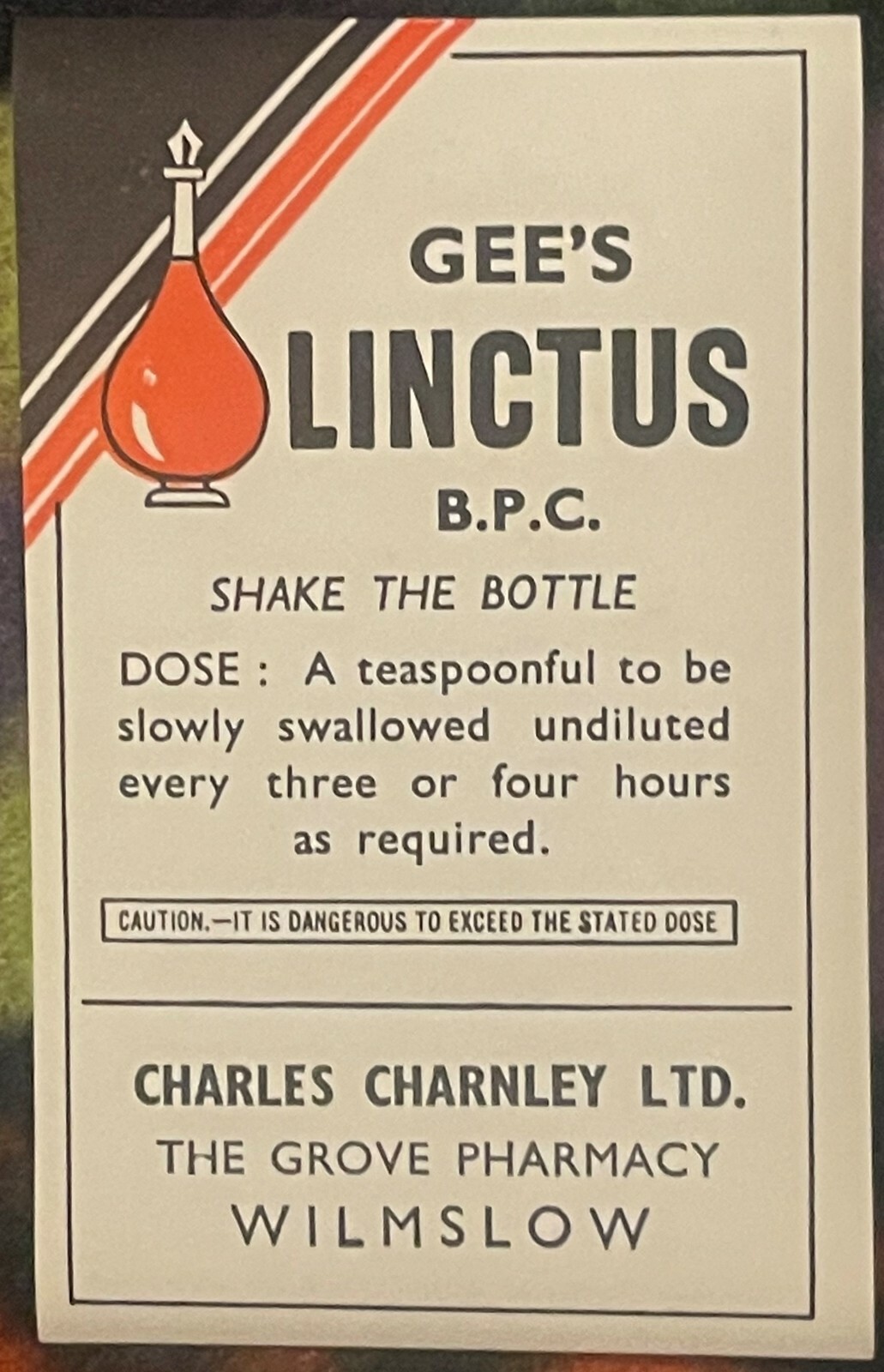
This is an original pharmacy dispensing label for Gee's Linctus B.P.C., produced by Charles Charnley Ltd., The Grove Pharmacy, Wilmslow, Cheshire, England. It is a tall rectangular bottle label in the classic format sized to wrap around a standard glass dispensing bottle of the era. The printing is a beautifully executed lithograph — crisp, clean, and bold — rendered in a striking palette of cream, black, red, and orange, with dramatic diagonal stripe accents cutting across the upper-left corner in red and black. In that same upper corner sits a charming, stylized illustration of a round-bottomed apothecary's decanter or bottle, drawn in warm red-orange, complete with a stopper — a small but evocative piece of graphic design that speaks directly to the trade it served.
The label carries its full original text verbatim: "GEE'S LINCTUS B.P.C. — SHAKE THE BOTTLE — DOSE: A teaspoonful to be slowly swallowed undiluted every three or four hours as required. — CAUTION.—IT IS DANGEROUS TO EXCEED THE STATED DOSE — CHARLES CHARNLEY LTD. THE GROVE PHARMACY WILMSLOW." Every word of that is still sharp. The "B.P.C." designation — British Pharmaceutical Codex — confirms this was not a house concoction or a nostrum cooked up in a back room; it was a standardized, officially recognized British preparation, formulated to national pharmaceutical standards and dispensed with the full authority of a licensed chemist. This is New Old Stock — a label that lived its entire life in storage, waiting.
The era: the label is vintage, mid-century in character. No manufacture date appears on the label itself, and I will not fabricate one. What I can tell you is that the "Charles Charnley Ltd." designation — indicating full incorporation as a limited company — places this label in a later chapter of the pharmacy's long history, almost certainly well into the 20th century, as the business matured from a single chemist's practice into a properly constituted commercial enterprise. That distinction matters to the dating, and I'll explain exactly why below.
⚗️ Gee's Linctus: A Victorian Remedy with a Famous Name
Let's talk about what was inside the bottle this label dressed. Gee's Linctus is one of the great old British cough remedies — its proper pharmaceutical name is squill linctus opiate, and it is exactly what that sounds like. The formulation is a viscous, syrup-like liquid — a linctus, designed specifically to be swallowed slowly so it coats and soothes the throat as it goes down. Hence the instruction on the label: "to be slowly swallowed undiluted." You did not knock this back like a shot. You let it do its work.
The active ingredients are a fascinating window into Victorian and early 20th-century pharmacology. At the heart of the preparation is tincture of opium — an alcoholic extract whose principal active compound is morphine, long recognized for its effectiveness in suppressing cough. Alongside it sits squill, a plant extract with expectorant properties, and the whole thing is carried in an alcohol base at roughly the strength of a fortified wine. The label's solemn warning — "CAUTION.—IT IS DANGEROUS TO EXCEED THE STATED DOSE" — reflects that opium content with complete seriousness. This was real medicine, with real pharmacological power, and the chemist who dispensed it understood exactly what he was handing over the counter.
The name itself belongs to Dr. Samuel Jones Gee (1839–1911), one of the most eminent London physicians of the Victorian era. Gee was assistant physician at Great Ormond Street from 1866, then at St. Bartholomew's Hospital from 1868, where he rose to full physician in 1878 — and he was appointed Physician to the Prince of Wales, later King George V, in 1901. In the history of medicine, Gee is most often remembered as the physician who first identified and described coeliac disease. But in the history of pharmacy, his name lived on in every bottle of this linctus dispensed across Britain for well over a century. The preparation carrying his name became a staple of British chemists' shelves from the Victorian period onward, and it remains in production today — current NHS records list Gee's Linctus from Thornton & Ross Ltd. as an active product. That is a remarkable span of commercial life for any medicine.
For scale: the Science Museum holds in its collections a tin carton of Gee's Linctus Pastilles B.P.C. — containing opium tincture — made by Smith Kendon Ltd. of London, dated 1950–1965. The brand was that durable, that trusted, that woven into the fabric of British domestic medicine. And lore passed down among collectors holds that the Charnley version — specifically, a Gee's Linctus label from The Grove Pharmacy — is among the rarest and most intensely hunted pieces in the entire British pharmacy label field. When they surface, they do not stay available long.
🏛️ Charles Charnley Ltd. — A Chemist's Legacy Written in Prescription Books
The backstory of Charles Charnley and his pharmacy is not guesswork — it is documented in one of the world's great medical archives. The Wellcome Collection in London holds the actual recipe and prescription books of this very pharmacy, and they are remarkable primary documents. The first volume (Wellcome MS.8438) is a book of pharmacy recipes — medical, household, cosmetic, and culinary preparations, handwritten in assorted hands — inscribed "Charles Charnley, 16 May 1866," with entries spanning 1866 to 1940. The second volume (MS.8437) is a pharmacy register and recipe book containing a register of actual prescriptions dispensed to named individuals, dated 1869 to 1925.
Think about what that means. Somewhere in those pages, a Victorian-era pharmacist wrote down formulas — including, almost certainly, preparations closely related to what ended up on labels just like this one. The 1866 inscription anchors the founding of the Charnley chemist business firmly in the mid-Victorian period, the same era in which Dr. Samuel Gee was rising to prominence in London and the linctus that bore his name was becoming a fixture of British pharmacy. The two histories run in exact parallel.
Other surviving Charnley labels confirm the pharmacy's name, address, and its long trade in recognized medicinal preparations. A documented example — an Asthma Powder label, dated to the 1920s — reads "C. Charnley Dispensing Chemist, The Grove Pharmacy, Wilmslow," and instructs the user to burn half a teaspoonful and inhale the fumes every three or four hours. That wording — "every 3 or 4 hours" — is identical in cadence to the dosing instruction on your Gee's Linctus label. The house style was consistent across the product range.
The evolution from "C. Charnley" to "Charles Charnley Ltd." is itself a story. The earlier labels carry only the unincorporated tradesman's name. Your label, bearing the "Ltd." designation, represents a later chapter — the pharmacy having been formally incorporated as a limited company, a step that typically came as a business matured, expanded, or passed into a second generation. That shift almost certainly places this label later in the business's arc — likely mid-20th century, well past the simpler "C. Charnley" era of the 1910s and 1920s. I have seen online sellers date Charnley Gee's Linctus labels to the 1910s–1920s, but the "Ltd." wording on this specific piece pushes that dating later, and I will always tell you plainly what the evidence actually supports rather than what makes a tidier story.
🌿 Wilmslow, Cheshire — A Town Grown on Victorian Ambition
The town behind the label is worth knowing. Wilmslow is a market town in Cheshire, sitting south of Manchester in the gently rolling country between the city and the Cheshire plain. Before the railway arrived in 1842, Wilmslow was little more than scattered farms, a church, and a handful of cottages. The railway changed everything. The Victorian era transformed it into one of the most desirable addresses in the North West of England — a place where prosperous Manchester merchants, mill owners, and professionals built their villas and raised their families, able to commute to the commercial heart of the city while living in leafy, respectable Cheshire. The population was 7,361 in 1901 and had grown to 10,536 by 1951, a steady expansion that tracked precisely the working life of the Charnley pharmacy.
The commercial center of Wilmslow focused on Bank Square, Grove Street, and Water Lane — and Grove Street remains the town's principal shopping thoroughfare to this day, more or less pedestrianized, with its Victorian and Edwardian shopfronts still visible in historic photographs from around 1910–1919. A pharmacy named The Grove Pharmacy fits naturally into this streetscape — named for the road and neighborhood that formed the commercial heart of the town it served.
Wilmslow carries two remarkable pieces of wider history worth recording here. In Lindow Moss, a peat bog on the edge of the town, workers discovered in 1984 the preserved body of a man who had died approximately 2,000 years ago. Lindow Man, as he became known, is one of the most significant Iron Age archaeological finds ever made in Britain — a window, preserved in peat, into a world utterly remote from the Victorian pharmacist dispensing cough syrup on Grove Street, yet both are part of the same place's long story. And Wilmslow was the final home of Alan Turing (1912–1954) — mathematician, logician, the driving intellectual force behind the Bombe machine that cracked the German Enigma cipher at Bletchley Park, and a founding father of computer science. Turing lived and died in Wilmslow. The town that produced this small paper label also sheltered one of the 20th century's most consequential minds.
🖼️ Display Ideas
- 🪟 Frame it alone against a dark mat in a small shadowbox — the cream, red, and black palette is bold enough to anchor a wall display without any supporting pieces at all.
- 🧴 Pair it with an antique glass dispensing bottle of the right era and proportion, displayed on a shelf alongside other British apothecary pieces for an authentic chemist's-shop vignette.
- 📚 Mount it in a collector's album alongside other British pharmacy labels from the B.P.C. era — it becomes an anchor piece for any Cheshire or Northern England chemist's label collection.
- 🏥 Display it in a medical or pharmacy history context — alongside period medical texts, a portrait or print of Dr. Samuel Jones Gee, or other Great Ormond Street or St. Bartholomew's Hospital memorabilia.
- 🎨 Use it as a centerpiece in a Victorian domestic history display — alongside period household items, medicine chests, or apothecary bottles, evoking the world of the Victorian family medicine cabinet.
- 🏡 Gift it framed to anyone with a connection to Wilmslow, Cheshire, or the history of British pharmacy — it is a genuinely rare piece of local and national heritage wrapped in one small rectangle of paper.
🎁 Who Collects These?
Antique pharmacy labels occupy a wonderfully specific corner of the collector's world, and the people drawn to them are exactly the kind of collectors I most enjoy meeting. British apothecary and pharmacy label collectors are the obvious first audience — and among them, a Charnley Gee's Linctus label is considered a serious find. The combination of a nationally recognized product name, a documented independent chemist with a traceable archive at the Wellcome Collection, and a specific Cheshire town address makes this a reference-quality piece, not a filler item.
Medical and pharmaceutical historians will recognize the B.P.C. designation and the opium tincture history immediately — this label sits at the intersection of the history of opioid medicine, Victorian pharmacy regulation, and the codification of British pharmaceutical standards. Victoriana and Edwardiana collectors are drawn to the visual language — the lithographed apothecary's bottle, the bold stripe, the formal typography — that speaks so clearly of an era when the design of a medicine bottle's label was a matter of professional pride. Cheshire and Wilmslow local history enthusiasts will find in this label a tangible artifact of their town's commercial past, a piece of Grove Street's history that you can hold in your hand. And ephemera collectors of every stripe understand that paper survives against all odds — that New Old Stock like this, never used, never damaged by its intended purpose, represents exactly the kind of impossible survival that makes the hobby thrilling.
❓ Frequently Asked QuestionsWhat does "B.P.C." mean on the label, and why does it matter?
"B.P.C." stands for British Pharmaceutical Codex, the official reference work that defined standardized formulations for medicines dispensed by pharmacists across the United Kingdom. First published in 1907 and used throughout the 20th century, the Codex was the pharmacist's bible for compound preparations — it specified ingredients, proportions, and methods so that a preparation dispensed in Wilmslow would be formulated to the same standard as one dispensed in Edinburgh or Bristol. When a label says "B.P.C.," it is telling you that this was not a house remedy or a proprietary nostrum; it was a nationally standardized formula made to an officially recognized specification. For collectors, the B.P.C. designation is both a dating anchor — placing the label within the era of the Codex's authority — and a mark of pharmaceutical legitimacy that separates dispensing chemist labels from patent medicine advertising.
What was actually in Gee's Linctus, and is that why the label has a caution warning?
Yes, directly. Gee's Linctus is properly described as squill linctus opiate — its active components include tincture of opium (an alcoholic extract of opium whose principal alkaloid is morphine), squill (a plant-derived expectorant), and an alcohol carrier. The morphine component is genuinely effective at suppressing cough, which is why the preparation remained in use for well over a century. But morphine is also a potent opioid, and the caution warning on the label — "IT IS DANGEROUS TO EXCEED THE STATED DOSE" — is not boilerplate. It reflects the pharmacist's professional and legal duty to warn patients of real risk. The medicine's documented history includes later concerns about misuse — New Zealand, for example, produced a Ministry of Health report in 2010 noting the use of over-the-counter products including Gee's Linctus by people maintaining opioid dependence. That history gives the label a moral and social dimension beyond its graphic beauty: this small piece of paper was part of a very long, very complicated story about opioids, regulation, and the line between medicine and harm.
How do I know Charles Charnley Ltd. and The Grove Pharmacy were real, documented businesses?
As thoroughly as any independent chemist in the British pharmacy label field. The Wellcome Collection in London holds two manuscript volumes from the pharmacy: a recipe book (MS.8438) inscribed "Charles Charnley, 16 May 1866," with entries to 1940, and a prescription register and recipe book (MS.8437) dated 1869–1925. These are primary archival documents — handwritten books recording actual prescriptions dispensed to named patients and formulas prepared by the pharmacist. That is not advertising copy or a trade directory entry; that is the pharmacy's own working record, preserved in one of the world's leading medical archives. The address, "The Grove Pharmacy, Wilmslow," is confirmed by multiple surviving labels. This is a documented business with a traceable history spanning from the mid-Victorian era well into the 20th century.
Why does the label say "Charles Charnley Ltd." rather than just "C. Charnley," and what does that tell us about when it was made?
It tells us quite a lot, actually. Other surviving Charnley pharmacy labels — including a documented Asthma Powder example from the 1920s — carry only the unincorporated style "C. Charnley Dispensing Chemist." The shift to "Charles Charnley Ltd." on this label indicates that the business had been formally incorporated as a limited company — a legal step that typically came as a family business matured, grew, or passed to a new generation requiring a more formal structure. That incorporation almost certainly places this label in a later phase of the business's life than the simpler "C. Charnley" labels, and points toward a mid-20th-century production date rather than the Edwardian or early interwar period. I cannot give you a precise year — no manufacture date appears on the label, and the exact date of Charnley's incorporation is not something I have been able to verify from available sources. What I can tell you is that the "Ltd." wording is a meaningful dating indicator, and I will always be straight with you about what the evidence supports.
Is this label genuinely New Old Stock, and what does that mean for a piece like this?
New Old Stock — NOS — means exactly what it says: this label was produced for commercial use, stored rather than applied to a bottle, and has never served its intended purpose. It was never dampened, never pasted, never torn from glass by a patient or a dustman or a historian. It arrived here directly from a stock of unused pharmacy supplies rather than from the surface of a bottle. For a paper label of this age and character, that is a remarkable thing. Lithographed paper labels of this era were working materials — they were consumed by their purpose, pressed against wet glass and destroyed when the bottle was emptied and washed. The ones that survive unused do so by accident: a chemist's drawer not opened for decades, a job lot purchased and never fully used, a business wound down with stock still on the shelf. NOS pharmacy labels are the ones that give you the printing at its full sharpness, the colors at their full saturation, and the graphic design in its full intended form. That is what you are looking at here.
Who was Dr. Samuel Jones Gee, and why is his name still on a cough remedy a century after his death?
Dr. Samuel Jones Gee (1839–1911) was one of the most distinguished London physicians of the Victorian era. He served as assistant physician at Great Ormond Street Hospital from 1866, then at St. Bartholomew's Hospital from 1868, rising to full physician in 1878. In 1901 he was appointed Physician to the Prince of Wales, later King George V. In the history of medicine he is most often remembered as the first physician to identify and describe coeliac disease — a contribution that earns him a permanent place in medical history entirely apart from the linctus. The cough preparation carrying his name became one of those Victorian-era remedies that proved durable enough to outlast the man himself, the empire he served, and the pharmaceutical world that first formulated it. The B.P.C. standardized its formula; generations of British chemists dispensed it; and the name Gee's Linctus remained in active use through the 20th century and into the 21st, with current NHS-listed products still carrying it. A label from a specific independent chemist — The Grove Pharmacy, Wilmslow — represents one node in that very long chain of dispensing history.
Is Wilmslow a place with any other historical significance beyond this pharmacy?
Considerably. Wilmslow sits in Cheshire south of Manchester, a town that grew from a quiet agricultural settlement into a prosperous Victorian suburb after the railway arrived in 1842 — the same railway-driven expansion that gave Charles Charnley a customer base substantial enough to sustain a pharmacy for three-quarters of a century. But the town carries two stories that reach far beyond its Victorian shopfronts. In Lindow Moss, a peat bog on the town's edge, the remarkably preserved body of an Iron Age man — Lindow Man — was discovered in 1984, one of the most significant archaeological finds in British history, offering a direct physical connection to life in Britain approximately 2,000 years ago. And Alan Turing (1912–1954) — the mathematician whose Bombe machine broke the German Enigma cipher at Bletchley Park and whose theoretical work laid the foundations of modern computer science — lived and died in Wilmslow. The town that this label names on its bottom line is a place with layers of history that stretch from the Iron Age to the digital age, and this small piece of lithographed paper is one artifact among many in that long story.