When you click on links to various merchants on this site and make a purchase, this can result in this site earning a commission. Affiliate programs and affiliations include, but are not limited to, the eBay Partner Network.
Remember When a Plane Ticket Felt Like an Invitation to the World? ✈️
There was a time when the words "Pan Am" on anything — a ticket sleeve, a flight bag, a stock certificate like this one — meant you were holding a piece of the good life. Old-timers who flew Pan Am in its heyday still talk about the white uniform caps, the "Clipper" names painted on the nose of every aircraft, and that unmistakable blue globe logo that told you, wherever you were in the world, you were home. This certificate is a piece of that story — not a souvenir menu or a luggage tag, but an actual corporate stock issue from Pan American World Airways, Inc., the airline that quite literally shrank the globe for two generations of American travelers.
This is an original, never-issued-to-a-shareholder capital stock certificate from Pan American World Airways, Inc., engraved and printed by the American Bank Note Company — the same house that engraved currency-grade work for railroads, oil companies, and the great American corporations of the 20th century. The certificate measures approximately 12" x 8" and dates to Pan Am's long run of capital stock issues spanning the 1950s through the 1970s, the decades when the airline was at the absolute height of its power and prestige. This is an original certificate that went through a holder's hands, was registered and countersigned, and was punch-cancelled when it came back in.
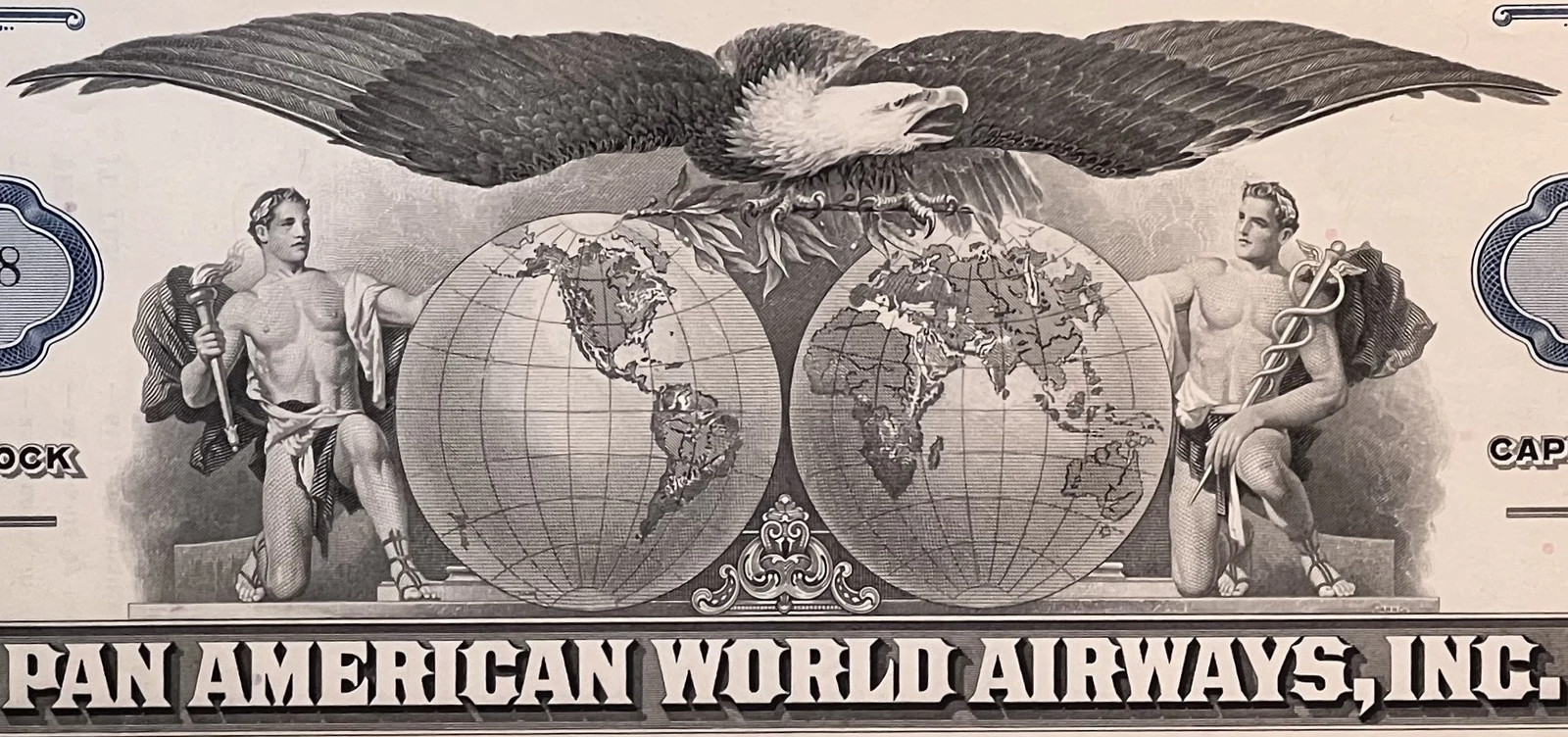
The artwork alone earns its keep on a wall. A great American bald eagle spreads its wings fully across the top of the certificate, talons gripping a laurel branch, its head turned in profile in that fierce, watchful pose engravers loved to render on financial documents of this era. Below the eagle sit two classical figures rendered in the same neoclassical style you'd find on old currency and bonds — one holding a torch, the other a caduceus, the ancient staff of Mercury, messenger of the gods and patron of travelers and commerce. Between them rest twin globes shown as full hemispheres — the Americas on one side, Europe, Africa, and Asia on the other — a visual signature of Pan Am's identity as a truly global carrier. Bold engraved lettering spells out "PAN AMERICAN WORLD AIRWAYS, INC." across a ribboned banner beneath the vignette, with ornate scrollwork corners, guilloché border patterns, and the fine engine-turned engraving lines that only a security printer like American Bank Note Company could produce.
✈️ The Airline That Invented International Air Travel
Pan American Airways began life in 1927 as a scrappy operation born out of Cold War-style anxiety a full generation before the Cold War existed — U.S. Army Air Corps officers, including a young Henry "Hap" Arnold (who would later command the entire Army Air Force in World War II), were worried about a German-backed airline gaining a foothold in Colombia and pushed to charter an American competitor. At the same time, a Yale-educated entrepreneur named Juan Trippe was building his own airline dreams around Caribbean routes. In 1927 the two efforts merged into Pan American Airways, with Trippe installed as president — a position he would hold, and use to reshape global aviation, for the next four decades.
The airline's very first flight left Key West, Florida, for Havana, Cuba, in a chartered floatplane that had actually been on its way to deliver mail to the Dominican Republic — Pan Am basically borrowed someone else's airplane to launch an empire. Collectors and aviation buffs love that origin story precisely because it's so unglamorous compared to what came next. Trippe brought on Charles Lindbergh — at the time the most famous young man alive — as a technical advisor, and used that star power and his own relentless ambition to build the airline into the dominant force in international travel. By 1930, Pan American was already the largest air transport company on earth. In 1950 the company formally renamed itself Pan American World Airways — the exact name engraved on this certificate — a change that reflected just how far its route map had spread.
Pan Am kept setting the pace for the whole industry: first to order commercial jets in 1955, first scheduled transatlantic jet service in 1958 (a Boeing 707 named Clipper America, flying JFK to Paris), and in 1966 the launch customer for the Boeing 747 — the jumbo jet that changed air travel forever. Old airline hands still say Trippe personally leaned on his friend Bill Allen at Boeing to build a plane bigger than anything flying, and Pan Am put up the order that made the 747 real. The airline's "Clipper" naming convention, borrowed from the great sailing ships of an earlier age of exploration, and its pilots' white uniform caps became instantly recognizable symbols of postwar glamour.
🗽 A New York Company With a Global Reach
Pan American World Airways was headquartered in New York City, its name forever tied to the Pan Am Building towering over Park Avenue — a skyscraper so identified with the airline that New Yorkers navigated by it for decades before it quietly became the MetLife Building. It's a small irony collectors like to point out: the company that connected the world from that address doesn't even get to keep its name on the door anymore, but the building itself is still one of the most recognizable in the Manhattan skyline. This certificate's registrar was Chemical Bank of New York, with Bankers Trust Company of New York serving as transfer agent — both blue-chip Manhattan financial institutions of their own era, adding another layer of New York pedigree to a document already dripping in it.
🌍 The People and the Pop Culture Orbit
Juan Trippe remains the name most tied to Pan Am's rise — a founder whose facsimile signature appeared on stock certificates like this one across decades of issues, a man who quite literally shaped how the world traveled by air. But the airline's cultural footprint went far beyond its boardroom. The Beatles landed at JFK in 1964 aboard a Pan Am 707 named Clipper Defiance, and that image — mop-tops descending the stairs beneath the Pan Am logo — is now one of the most reproduced photographs of the 20th century. During the Apollo era, Pan Am famously sold "reservations" for future flights to the moon, a marketing stunt so perfectly of its moment that those old moon-flight tickets are now collector's items in their own right. And in one of aviation's strangest footnotes, a young con artist named Frank Abagnale Jr. spent years in the 1960s impersonating a Pan Am pilot, deadheading around the globe in the cockpit jump seat — a story later told in the book and film Catch Me If You Can, forever linking the airline's crisp uniforms to one of the great impersonation capers in American folklore.
🕊️ Why the Story Still Resonates Today
Pan Am's fall was as dramatic as its rise. Deregulation in 1978 opened the skies to fierce new competition just as Pan Am — a pure international carrier with no domestic route network of its own — bought National Airlines in 1980 to plug that gap, taking on debt it never fully shed. The bombing of Pan Am Flight 103 over Lockerbie, Scotland, in December 1988 was a tragedy that also became a body blow to public confidence in the airline, arriving just as fuel costs spiked with the Gulf War. Pan American World Airways filed for bankruptcy in January 1991 and, after a brief, failed attempt to relaunch from Miami, ceased all operations on December 4, 1991, after 64 years in the sky. When the company's globe trademark was finally saleed off in bankruptcy court in 1993, it fetched $1.3 million — proof that even in defeat, the brand still meant something. To an entire generation, Pan Am's closure marked the symbolic end of the golden age of air travel, and it's exactly that bittersweet ending that makes pieces like this certificate so collected today — tangible, engraved evidence of a company that once WAS the way the world flew.
🖼️ Display Ideas
- ✈️ Frame it for a home office or den alongside other aviation ephemera for an instant "golden age of flight" gallery wall
- 🌍 Pair it with a vintage globe or world map for a travel-themed reading nook or study
- 💼 A conversation-starting gift for a retired airline employee, pilot, or lifelong Pan Am flyer
- 🏙️ Perfect for a mid-century modern or Manhattan-skyline-inspired interior
- 📚 A meaningful addition to a finance or business history collection alongside other engraved stock certificates
- 🎓 A distinctive graduation or retirement gift for anyone with ties to aviation, finance, or travel
🎁 Who Collects These
Scripophily — the hobby of collecting stock and bond certificates — draws in aviation history buffs, financial history collectors, and Pan Am nostalgists in roughly equal measure. Because the airline's story is so wrapped up in the romance of postwar travel, its certificates cross over into aviation memorabilia circles the way few other old stock issues do. Collectors of American Bank Note Company engraving work seek these out for the artistry alone, while others simply want a real, tangible link to a company their parents or grandparents flew, worked for, or watched disappear. It's a piece that rewards both the serious paper-collectibles collector and the casual aviation enthusiast looking for something with real weight behind it.
❓ FAQIs this a real, genuine Pan Am stock certificate?
Yes — this is an authentic capital stock certificate issued by Pan American World Airways, Inc., engraved by the American Bank Note Company.
What condition is it in?
This is an original certificate that was issued to a holder of record and preserved after it was cancelled.
Does this certificate have any monetary or financial value as a stock?
No — Pan American World Airways ceased operations in 1991 and the stock itself has no redeemable financial value. These certificates are collected purely as historical paper collectibles and pieces of aviation and business history.
What size is the certificate?
It measures approximately 12" x 8" (about 30 x 20 cm).
What era is this certificate from?
This design and issue style corresponds to Pan Am's capital stock certificates from roughly the 1950s through the 1970s, the era when the company was operating under the Pan American World Airways name.
Who printed and engraved it?
The American Bank Note Company, a leading security printer of the era known for engraving currency, bonds, and corporate stock certificates.
Is it suitable for framing and display?
Absolutely — the detailed eagle, globe, and classical-figure engraving make it a striking standalone display piece for aviation, travel, or business history collections.
These are issued instruments rather than blanks. Certificates of this type were filled in for a holder in ink, countersigned by the transfer agent and registered by the registrar, then punch- or cut-cancelled when they were redeemed and retired. Expect financial writings, markings, stamps, hole punches and staple holes as part of the life of the instrument: endorsements and signatures, transfer-agent and registrar stamps, revenue or documentary tax stamps, cancellation punches, staple holes from being bound into a transfer book, pencil ledger notations. That is the paper trail of a security that actually did its job, and it is what separates a document that lived from a blank that never did. No two are alike: holder details, serial numbers, dates, signatures, stamps and punch patterns vary from example to example, so the photographs show the type rather than the exact sheet that ships.