When you click on links to various merchants on this site and make a purchase, this can result in this site earning a commission. Affiliate programs and affiliations include, but are not limited to, the eBay Partner Network.
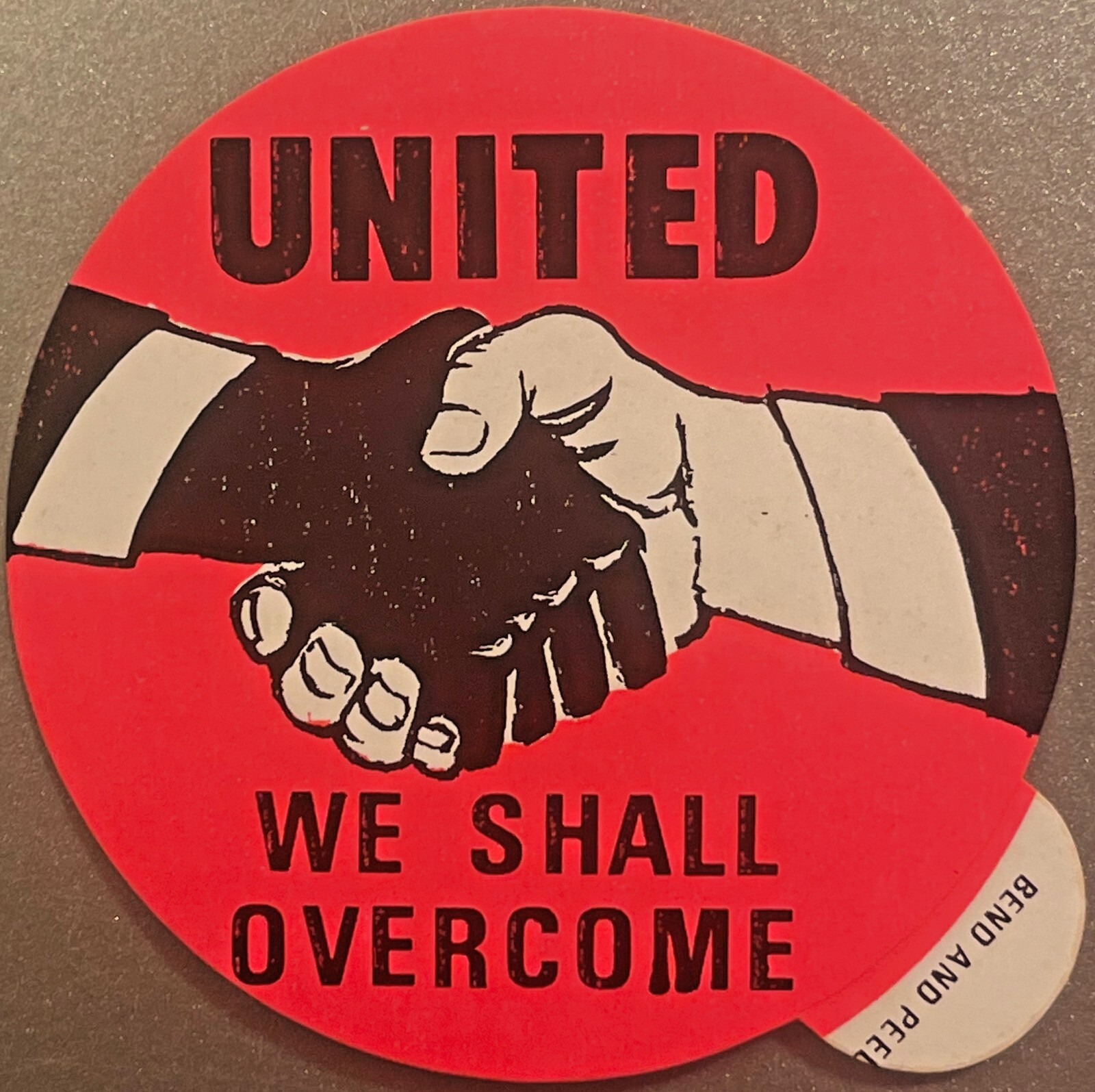
🤝 United · We Shall Overcome — 1960s Civil Rights Handshake Decal, Unused
Black and white hands clasped on a red circle, with the anthem that began on a Charleston cigar factory picket line. Unpeeled, on its original backing.
SPECIFICATIONS
- Printed: UNITED / WE SHALL OVERCOME
- Image: interracial handshake — black hand from a white cuff, white hand from a black sleeve
- Tab: BEND AND PEEL
- Type: round self-adhesive decal on release paper; back unprinted
- Colors: red, black, cream
- Size: 3.25 inches (8.3 cm) across
- Era: 1960s
CONDITION
New old stock — never peeled, never applied. Please see the photos.
THE STORY
The picket line. The American Tobacco Company's Cigar Factory on East Bay Street, Charleston, South Carolina, made Certified Cremo cigars from 1903 to 1973. Its workers, in Local 15 of the Food, Tobacco, Agricultural & Allied Workers union, struck from October 1945 into March 1946 and closed each day of picketing with a song; striker Lucille Simmons led it slow and made the old hymn's "I" into "we." The hymn itself, "I'll Overcome Some Day," was published in 1901 by the Rev. Charles Albert Tindley of Philadelphia.
Highlander. Zilphia Horton carried it to the Highlander Folk School near Monteagle, Tennessee. Pete Seeger learned it from her and in 1947 made "will" into "shall" because "We shall" opens the mouth wider. Guy Carawan, Highlander's music director from 1959, taught it at SNCC's founding meeting in Raleigh, North Carolina, in April 1960. Segregationists called Highlander a "Communist Training School" on billboards across the South; Tennessee padlocked it in 1959, and it reopened in Knoxville in 1961.
The handshake. The black-and-white handshake was one of the movement's most common symbols. SNCC put it on a button with its name, and it appeared on buttons for the 1963 March on Washington. A pin-back button with the same UNITED / WE SHALL OVERCOME slogan over a handshake was marked by AAA Novelty of Washington, D.C.
"And we shall overcome." On March 15, 1965, a week after Bloody Sunday in Selma, President Lyndon B. Johnson spoke the words to Congress. The story John Lewis told afterward became part of the song's legend: Martin Luther King Jr., watching beside him, began to cry. Johnson signed the Voting Rights Act five months later, and the song's legacy went on to Prague's Velvet Revolution in 1989, and a 2018 settlement placed it in the public domain; the Cigar Factory became a National Historic Landmark in 2024.
GOOD FOR
- Civil rights, Black history and labor history collections
- Classroom and library displays on the movement
- Framing intact with its backing and peel tab
- A meaningful gift for anyone who lived through the 1960s