When you click on links to various merchants on this site and make a purchase, this can result in this site earning a commission. Affiliate programs and affiliations include, but are not limited to, the eBay Partner Network.
What Did It Feel Like to Hold a Piece of the Gulf Coast Oil Boom?🛢️
There was a moment in the early 1970s when the Gulf Coast oil business felt unstoppable — offshore rigs marching further out into open water, refineries running around the clock, and a handful of enormous corporations financing all of it with paper like the certificate in front of you.This is a bond, not a stock — a promise on heavy engraved paper that someone, somewhere, had loaned real money to a real company, and that company had promised, in writing, to pay it back with interest. Hold one of these and you're holding the paperwork behind the boom itself.
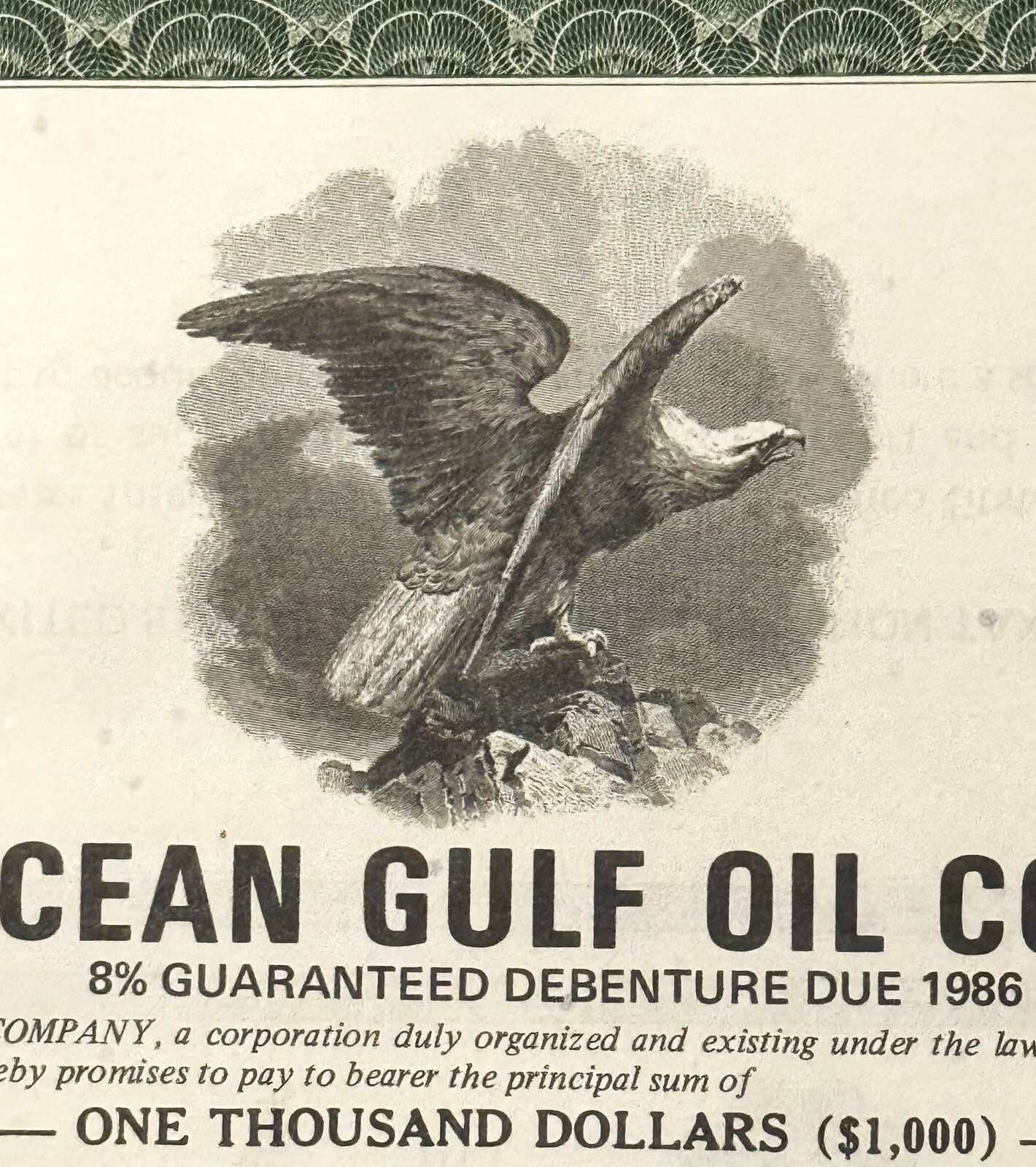
This is an authentic Transocean Gulf Oil Company 8% Guaranteed Debenture, Due 1986, a $1,000 bearer bond certificate dated March 1, 1971 on its face.Transocean Gulf Oil Company was organized as a corporation under the laws of the State of Delaware, and this debenture issue was guaranteed by Gulf Oil Corporation — the parent company standing behind the debt. The certificate was printed by the American Bank Note Company, and it shows all the hallmarks of genuine security engraving: a deep green intaglio border worked in fine geometric lace patterning, ornate scrollwork corners, and a striking steel-engraved vignette of an American eagle, wings spread, perched on rock, set against a stippled cloud-textured sky.The company name and denomination are set in bold black block lettering across a cream certificate body, with the "$1000" denomination echoed inside twin green rosette medallions flanking the eagle. As a bearer instrument, the bond "promises to pay to bearer" — meaning whoever physically held it, held the claim — and it was issued with an attached panel of engraved interest coupons, each worth $80.00 (8% of the $1,000 face value), running annually through the March 1986 maturity date.The trustee overseeing the issue was First National City Bank of New York, whose officer's countersignature and seal appear on the Trustee's Certificate of Authentication. The certificate measures approximately 13.5 x 9.5 inches, and what you're getting is a genuine issued debenture — executed, trustee-authenticated, and punch-cancelled at redemption.
🦅 The Engraver's Eagle: American Bank Note Company
By 1971, the American Bank Note Company had already spent more than a century as one of the most trusted names in American security printing — the firm behind currency, postage stamps, and the vast majority of blue-chip stock and bond certificates that moved through Wall Street.Their engravers worked in steel-die intaglio, the same raised, hand-cut printing process used for U.S. paper money, which is exactly why bonds like this one carry that unmistakable dimensional, richly inked quality no ordinary printing press could replicate. The eagle vignette on this certificate is a recycled piece of that engraving tradition — a stock image drawn from ABNCo's vast library of allegorical and patriotic art, deployed across countless different corporate certificates over the decades, always meant to project strength, permanence, and trust to the investor holding the paper.
⛽ Gulf Oil Corporation: One of the Seven Sisters
Gulf Oil Corporation, the guarantor standing behind this debenture, was one of the giants of twentieth-century American energy — a company whose roots traced back to the legendary Spindletop gusher in Texas at the turn of the century, and whose corporate headquarters in Pittsburgh, Pennsylvania made it one of the most recognizable names in the country, largely on the strength of the Mellon family's long financial backing.For decades Gulf's bright orange disc logo marked filling stations across the eastern half of the country, and the company ranked among the so-called "Seven Sisters" — the small handful of vertically integrated oil majors that dominated global petroleum production, refining, and marketing through most of the mid-twentieth century.Companies like Gulf routinely organized finance subsidiaries — often Delaware corporations just like Transocean Gulf Oil Company — specifically to issue guaranteed debt on the parent's behalf, sometimes to raise capital from international bond markets rather than solely domestic ones. Old-timers in the oil patch still talk about Gulf as one of the last of the truly independent majors before the industry consolidated: in 1984, Gulf Oil Corporation was absorbed into Standard Oil of California, forming what was at the time the largest corporate merger in American history and giving rise to the modern Chevron.A bond like this one, dated more than a decade before that merger, is paperwork from Gulf's independent era — before its name disappeared from the corporate map.
💵 Bearer Bonds, Coupon Clipping, and the Trustee's Seal
There's a reason bonds like this one carry their own small folklore among collectors.In the era before electronic recordkeeping, a bearer bond was as good as cash to whoever held it — no name was registered anywhere, and the certificate itself was the only proof of ownership. Investors literally clipped the printed coupons off the sheet as each interest date arrived and presented them for payment, which is why surviving examples are often found with some coupons already cut away and others still intact.Lore passed down among scripophily collectors holds that bearer debentures like this one were especially popular with international investors who valued the anonymity bearer paper afforded, and that a great many Gulf Coast oil company bonds from this era found their way into vaults across Europe before working their way back into the American collector market decades later.The presence of First National City Bank — the institution that would rename itself Citibank in 1976 — as trustee added an extra layer of institutional weight, its officer's countersignature and embossed seal a guarantee that the bond had been properly authenticated against the corporate indenture governing the whole issue.
🌊 The Boom Before the Rules
1971 sat right at the front edge of the great offshore drilling expansion in the Gulf of Mexico — rigs pushing further from shore every year, new fields coming online, and oil majors racing to finance the next round of exploration.It was also a moment just before the ground shifted permanently under the industry: the 1973 oil embargo was still two years away, and the wave of federal environmental law that would reshape offshore drilling — permitting, safety oversight, and liability regimes — was only beginning to take shape. A financing instrument like this debenture is a small time capsule from that in-between decade: an oil major still operating largely under the old rules, raising capital the old way, on paper engraved the old way, for a boom that was about to collide head-on with a very different future.
🖼️ Display Ideas
- 🖋️ Framed alone under glass to let the eagle vignette and green engraved border carry the whole piece
- 🛢️ Paired with other oil-and-energy ephemera for a themed wall of American industrial history
- 💼 Displayed open with the coupon panel fanned out, showing the annual interest dates and engraving detail
- 📚 Matted alongside a short write-up on Gulf Oil Corporation for a conversation-starting desk or office piece
- 🎓 Used as a teaching piece on corporate finance history — bearer bonds, trustees, and coupon clipping explained in one object
🎁 Who Collects These
Scripophily collectors — people who collect historic stock and bond certificates for their engraving artistry and corporate history rather than any surviving financial value — are the natural home for a piece like this.It also draws interest from collectors of oil and energy memorabilia, fans of American Bank Note Company engraving work specifically, and anyone drawn to Gulf Coast industrial history from the era before the majors consolidated. Because it's genuinely striking on a wall and comes with a real story attached, it also appeals to gift-givers looking for something with substance for a collector, a retired oilman, or anyone with ties to the Gulf Coast energy industry.
❓ FAQ
Is this a real financial instrument or a reproduction?
This is an authentic issued bond certificate from the original printing — genuine security-engraved paper from the Transocean Gulf Oil Company debenture issue, never a modern reproduction.
What should I expect on the certificate?
It is an original issued instrument from that print run: expect ink signatures and a trustee's authentication, an embossed seal, and the cancellation punches struck when the debenture was redeemed.
Are the interest coupons still attached?
Certificates in this series were issued with a panel of engraved annual coupons running through the 1986 maturity date; because coupon counts can vary from copy to copy depending on individual history, we can't promise an exact count, but the coupon panel is part of the certificate's design.
Coupons were made to be clipped away, and most bonds of this age lost theirs one payment at a time until only the certificate was left, so a sheet that came through the decades still attached is the exception rather than the rule.When a road went under, holders commonly taped the last coupon back onto the bond and held on in hope of collecting what they were owed, so a bond that still carries that taped final coupon is the better one to end up with.
Is this connected to a modern offshore drilling company?
Transocean Gulf Oil Company was a Delaware corporation guaranteed by Gulf Oil Corporation and tied to the 1970s oil industry of that era — we describe it strictly on those documented terms.
Does this certificate have any remaining monetary/redemption value?
No — bonds like this are collected today for their history and engraving artistry, not for any financial redemption value; the debenture matured in 1986.
Is it suitable for framing?
Very much so — the green engraved border, eagle vignette, and bold lettering were designed to be visually striking, and at 13.5 x 9.5 inches it displays well on its own or matted with other pieces.
Who guaranteed this debt?
The debenture was guaranteed by Gulf Oil Corporation, the parent company behind the Transocean Gulf Oil Company finance subsidiary that issued it.
These are issued instruments rather than blanks. Bonds and debentures of this type were registered to a holder, authenticated by the trustee, and punch- or cut-cancelled when they were finally redeemed. Expect financial writings, markings, stamps, hole punches and staple holes as part of the life of the instrument: endorsements and signatures, trustee and registrar stamps, revenue or documentary tax stamps, cancellation punches, staple holes from being bound into a transfer book, pencil ledger notations. That is the paper trail of a security that actually did its job, and it is what separates a document that lived from a blank that never did. No two are alike: holder details, serial numbers, dates, signatures, stamps and punch patterns vary from example to example, so the photographs show the type rather than the exact sheet that ships. The coupon count can run a few more or a few fewer than pictured.