When you click on links to various merchants on this site and make a purchase, this can result in this site earning a commission. Affiliate programs and affiliations include, but are not limited to, the eBay Partner Network.
🎩 Remember When a Dime Bought You Relief From a Cough — and a Little Vaudeville Theater Besides? 🎭
There was a time when a proprietary remedy didn't just promise to fix what ailed you — it entertained you while it did it. Long before pharmaceutical branding meant sterile white boxes and clinical typefaces, a druggist's counter was a little stage of its own: bold color, bold type, and a cast of cartoon characters standing in for the product's personality. This little tin is exactly that kind of survivor — a pocket-sized piece of American drugstore theater that has come down to us looking every bit the part it was made to play.
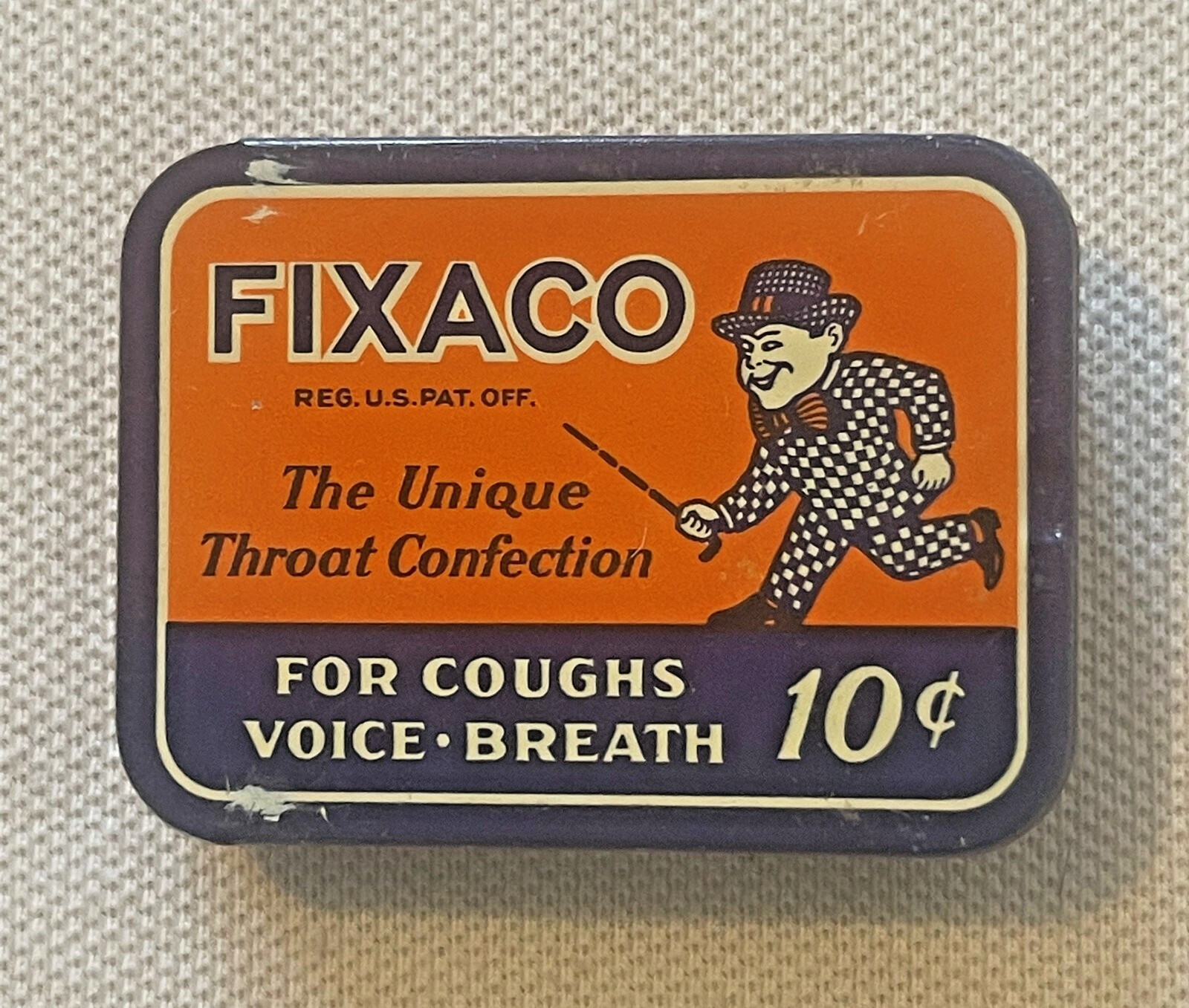
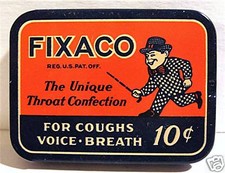
This is a New Old Stock (NOS) FIXACO "The Unique Throat Confection" pocket tin, produced by The Fixaco Co. of St. Louis, Missouri, and sold for a dime at drugstore counters in the 1930s–1940s. It measures 2¾ x 2 inches — a genuine pocket or handbag piece, small enough to travel unnoticed and just large enough to carry a full sales pitch on its face. The hinged lid lifts on two folded blue tabs at the back, and both halves are finished inside in a warm gold lacquer, with a faint "FIXACO" impression still visible pressed into the base rim — a small trace of the tooling that stamped these out by the thousands. The front panel is a striking two-color composition in flat orange and dark navy-violet with crisp cream line work: FIXACO in bold outlined block capitals across the top, REG. U.S. PAT. OFF. beneath it in small print, then "The Unique Throat Confection" in a flowing italic script. Striding across the orange field, cane in hand, is a grinning little dandy in a head-to-toe checkered suit, matching checked top hat, striped bow tie, and spatted shoes — a jaunty, mid-stride mascot who gives the whole tin its personality. The bottom banner spells out the pitch plainly: FOR COUGHS · VOICE · BREATH — 10¢. The back panel keeps talking in the plain-spoken, confident language of the era: "FIXACO is something different... highly concentrated and effective... For Coughs, Colds, Sore Throat, Hoarseness. Excellent for Children's coughs. For Singers, Speakers, Teachers, Etc. After smoking, Fixaco moistens mouth and throat, also sweetens the breath. Fixaco contains no harmful ingredients." This is a genuinely excellent surviving example of early American proprietary-remedy advertising — small commercial art doing the work of a full storefront display.💊 A Concentrated Cure With a Trademark to Its Name
The "REG. U.S. PAT. OFF." line beneath the FIXACO name isn't decoration — it's a federal trademark claim, meaning the company had gone through the process of registering the FIXACO word mark as its own before ever printing it on a tin. That single line tells you this was a business serious enough to protect its name, not a fly-by-night operation slapping ink on tin. The back panel's copywriting is equally telling of its era: no hedging, no fine print about "consult your physician," just a flat, confident promise — "highly concentrated and effective," "contains no harmful ingredients," "excellent for children's coughs." That was the voice of proprietary medicine advertising before more rigorous federal oversight reshaped the industry — plain talk, big claims, and a mascot to make you smile while you read them.
Fixaco tins are known to survive in two distinct closures — a slide-top style and this hinged-lid style, this piece being the latter. Whether one preceded the other in the company's production run isn't something the historical record settles, but the existence of both tells you this was a formula the company kept making and packaging over a real stretch of years, not a single limited run. One dealer who has handled a lot of surviving Fixaco stock has recounted that a cache of unused tins was said to have turned up in the old factory building itself in St. Louis — the kind of story passed down among sellers of small-town proprietary remedies, and one that would neatly explain why so many Fixaco tins surface today looking essentially untouched: not survivors of decades of pocket use, but old unsold stock that simply sat boxed in a warehouse, waiting.
🏙️ St. Louis: America's Drugstore Crossroads
The Fixaco Co. didn't set up shop in St. Louis by accident — the city was, by the era this tin comes from, one of the great wholesale drug and proprietary-medicine hubs in the country. The Meyer Brothers Drug Company, founded by Christian F. G. Meyer, had grown into one of the largest drug wholesalers in the United States, helping cement St. Louis's reputation as one of the nation's leading drug and chemical markets. A dense community of German-American druggists and wholesale houses had built up around that trade over decades, giving a small proprietary maker like Fixaco exactly the kind of distribution machinery it needed to get a ten-cent tin onto counters across the Midwest.
St. Louis's drugstore fame runs deeper still — it was, quite literally, the birthplace of one of the most famous proprietary remedies in American history. Listerine was first formulated there in 1879 by Dr. Joseph Lawrence and Jordan Wheat Lambert, founders of what became the Lambert Pharmacal Company. A little throat confection promising relief for coughs and sore throats was following in genuinely well-worn local footsteps.
The city's other great trades show up in this tin's own wording, too. Its first ingredient across the Fixaco line was licorice — and St. Louis had its own licorice dynasty in Switzer's, founded there in 1888, its story beginning with carts of licorice pushed along the riverfront district now called Laclede's Landing; Switzer's made licorice candy in the city for well over a century. And that line "after smoking, Fixaco moistens mouth and throat" was written in a city that was also a tobacco powerhouse — Liggett & Myers built a sprawling St. Louis plant complex and was, in its heyday, the largest manufacturer of plug tobacco in the world. A St. Louis-made lozenge promising to soothe a smoker's throat was speaking directly to its own hometown.
🎩 The Dapper Little Mascot — A Stage-Door Story
The checkerboard-suited fellow striding across this tin's face, cane swinging, was clearly meant to catch the eye — and his costume wasn't random. A loud, all-over check suit was recognized stage comedy dress in the vaudeville era; the famous comedy duo Weber & Fields built part of their act around exactly that kind of exaggerated checked costuming for contrast and laughs. More broadly, "the swell" — a fashionable, cane-carrying man of leisure — was a stock comic figure of the music-hall stage, a character audiences found both funny and a little enviable for his fine clothes. Given that this tin's own back panel speaks directly to "Singers, Speakers, Teachers, Etc.," a stage-dandy mascot on a throat lozenge tin reads as a coherent, deliberate piece of advertising design rather than a coincidence — though it should be said plainly that no company record survives naming this little fellow or confirming the company's exact intent behind him.
Worth noting for collectors: at least one dealer listing this same tin has mistakenly labeled the mascot the "Monopoly Man" — an identification that doesn't hold up, since the Monopoly board game's own mascot, Rich Uncle Pennybags, wasn't added to the game until 1936 and was drawn as a portly man in a plain three-piece suit, not a checkerboard one. It's a good reminder that even experienced dealers can read the same unnamed house mascot two very different ways — and that this dapper little gentleman belongs to Fixaco alone.
St. Louis in this era had no shortage of stages for a mascot like this to have stepped off of. The Orpheum Theatre opened downtown on Labor Day 1917, a $500,000 house that joined the Orpheum Circuit, one of the country's largest vaudeville chains, before Warner Brothers converted it to a movie house in the mid-1930s — right around the years this tin was likely on drugstore shelves. The Muny in Forest Park, built in a stunning forty-nine days in 1917, remains the oldest and largest outdoor musical theatre in the country, and the Saint Louis Symphony, founded in 1880, is the second-oldest orchestra in the nation. A city that loved its singers, speakers, and stage performers that much was exactly the kind of place where a throat lozenge aimed at professional voices would find its audience.
🖼️ Display Ideas
- 🎩 Set it open beside a small collection of other vintage drugstore and proprietary-remedy tins for a shelf of Americana advertising history
- 🕰️ Display it closed on a small stand or easel to let the checkerboard mascot and bold lettering take center stage
- 💊 Pair it with vintage pharmacy or apothecary bottles for a themed drugstore-counter vignette
- 🎭 Group it with vaudeville or theater memorabilia to play up its dapper stage-dandy mascot
- 📦 Tuck it into a curio cabinet or shadow box among other pocket-sized advertising tins for scale and contrast
- 🖋️ Use it as a small keepsake box on a desk or vanity, letting its own history be the conversation piece
🎁 Who Collects These
Advertising tin collectors prize small proprietary-remedy pieces like this one precisely because they were never meant to last — most were used up, tossed, or recycled for scrap, and only unsold or carefully kept examples like this survive with their color and lettering this intact. St. Louis history collectors are drawn to it for its tie to the city's great drug, candy, and tobacco trades, while pharmacy and medical-advertising collectors seek out lozenge and cough-remedy tins as a specific sub-category of early American proprietary medicine ephemera. Vaudeville and early theater collectors will appreciate the mascot's stage-dandy costuming, and anyone who loves small-format graphic design — bold two-color lithography, hand-lettered display type, a character illustration doing all the selling — will find this a satisfying little piece of commercial art in miniature.
❓ FAQWhat era is this Fixaco tin from?
The flat two-color lithography, heavy outlined block lettering, italic script tagline, cartoon mascot style, and 10¢ price panel are all consistent with drugstore proprietary-remedy tins of the 1930s–1940s. No exact production year is documented for this piece.
Is the mascot the Monopoly Man?
No — despite a passing resemblance in silhouette, the Monopoly game's own mascot wasn't introduced until 1936 and was drawn in a plain suit, not a checkerboard one. This mascot is Fixaco's own unnamed house character, styled after the checked-suit "stage dandy" look common to vaudeville-era advertising art.
Is this tin new old stock?
Yes — this is genuine New Old Stock, unused drugstore inventory that never made its way into a customer's pocket in its own era.
What was Fixaco actually used for?
Per its own printed label, Fixaco was marketed as a concentrated lozenge to be dissolved in the mouth for coughs, colds, sore throat, and hoarseness, and specifically pitched to singers, speakers, and teachers, as well as smokers wanting to freshen mouth and throat afterward.
Why is it a hinged-lid tin instead of a slide-top?
Surviving Fixaco tins are documented in both a slide-top and a hinged-lid closure. This example is the hinged-lid style; which variant came first, or whether they were produced concurrently, isn't settled by any surviving company record.
Was Fixaco a nationally known brand?
The Fixaco Co. operated out of St. Louis, a city that was itself a major national hub for the wholesale drug trade, which would have given a proprietary maker like this real reach through drugstore distribution networks — though no advertising or company records beyond the tin itself and its trademark claim have surfaced to confirm the full scope of its distribution.
What does the gold interior finish tell us?
Both halves of the tin are finished inside in a gold lacquer, a common and practical treatment for tins meant to hold a food-grade confection — helping protect the lozenges' flavor and keep the metal from reacting with the product inside.