When you click on links to various merchants on this site and make a purchase, this can result in this site earning a commission. Affiliate programs and affiliations include, but are not limited to, the eBay Partner Network.
🚗 What Happens When Two Old Detroit Rivals Try to Save Each Other?
There's a particular kind of American nostalgia bound up in this piece — the kind that isn't about a shiny new car rolling off a lot, but about the last, desperate handshake between two proud old names trying to survive together. Every time I handle one of these Studebaker-Packard certificates, I think about that. It's a piece of paper that was worth real money once, backed by real shares, real shareholders, and a company that genuinely believed it could take on Detroit's Big Three. It didn't work out. But the paper survived, and that's exactly why we collect it.
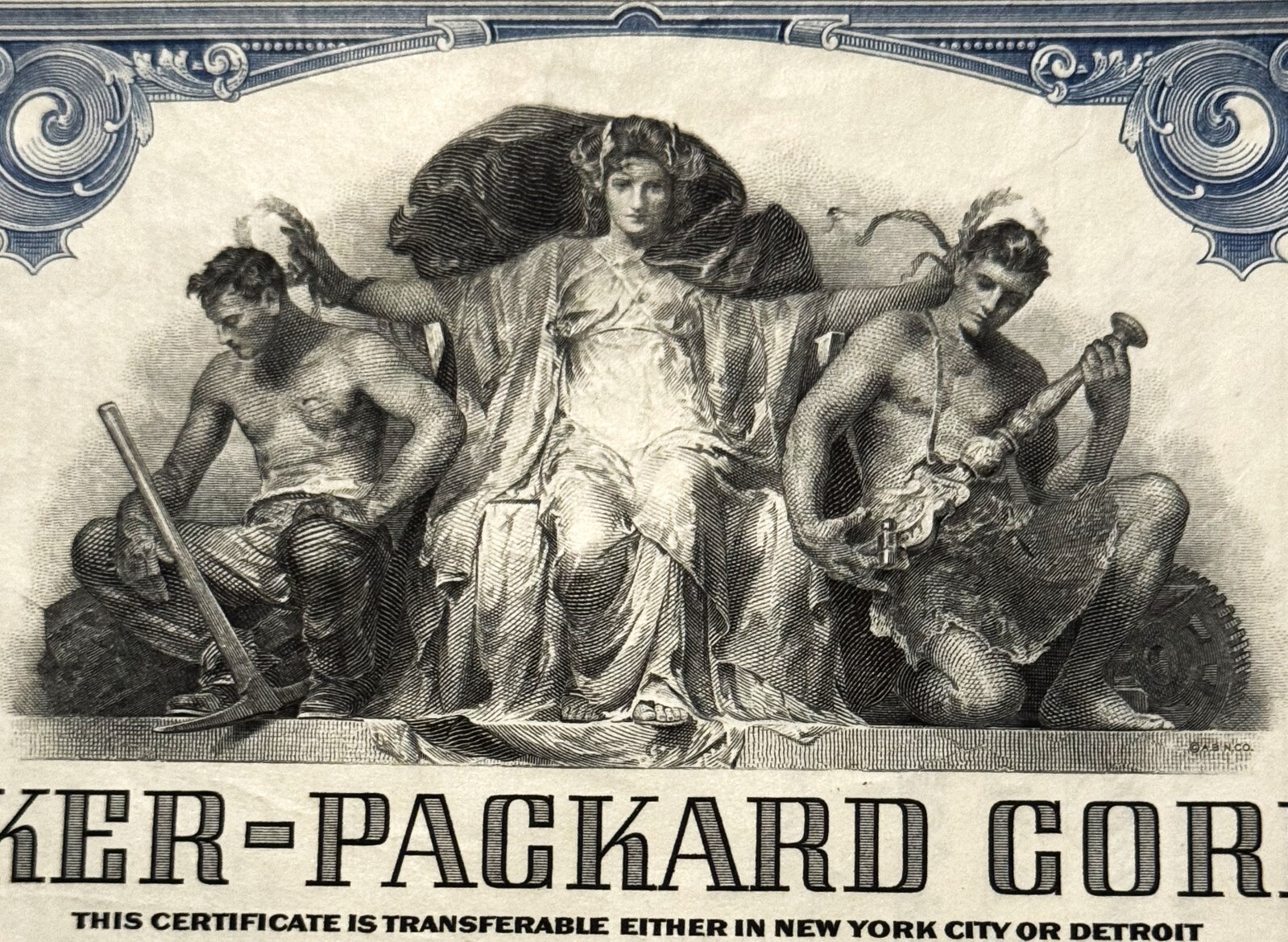
This is an original Studebaker-Packard Corporation stock certificate for 100 shares of common stock, par value $10 per share, issued out of Detroit, Michigan in 1954 — the very year Studebaker-Packard came into existence. It measures 12 x 8 inches (about 30.5 x 20.3 cm), a substantial, wall-worthy size. The engraving was executed by the American Bank Note Company, and it shows — front and center at the top of the certificate — a beautifully rendered allegorical vignette: a seated female figure representing Industry or Commerce, draped in flowing classical robes, flanked on either side by two shirtless laborers, one gripping a pickaxe, the other a hammer, with mechanical gears worked into the composition beside them. It's the kind of high Victorian/industrial-age allegory that American Bank Note Company engravers had been perfecting for a century by the time this certificate rolled off their presses, printed in rich blue and black ink on cream/ivory stock, framed by ornate blue scrollwork borders with bold "100 SHARES" counters worked into each corner. The corporate seal, reading "STUDEBAKER-PACKARD CORPORATION CORPORATE SEAL — INCORPORATED MICHIGAN," is embossed into the lower field, and the certificate carries the printed facsimile signature of company president James J. Nance. A cancellation perforation pattern is punched through the body of the document — the standard, honest mark of a certificate that lived its working life, was properly registered and eventually retired from circulation, rather than a blank that never saw a shareholder's hands.
🏭 The Merger That Was Supposed to Save the Independents
To understand what you're holding, you have to understand just how much hope — and how much desperation — was riding on the name "Studebaker-Packard." Packard Motor Car Company had been Detroit's preeminent luxury marque since brothers James Ward and William Doud Packard built their first car in Warren, Ohio in 1899, then moved operations to Detroit and built a reputation, especially after the 1915 "Twin Six" V12, as America's answer to Rolls-Royce. Studebaker, meanwhile, traced its roots all the way back to 1852 in South Bend, Indiana, where it had started building wagons — yes, actual horse-drawn wagons — before it ever built a car, and had grown into one of the country's most important independent automakers.
By the early 1950s, both companies could see the writing on the wall. The "Big Three" — GM, Ford, and Chrysler — were squeezing every independent automaker in the country, and Packard's president, James J. Nance, believed survival meant consolidation. Nance and Nash-Kelvinator's George W. Mason cooked up an ambitious plan: merge Packard, Studebaker, Nash, and Hudson into a single giant that would leapfrog Chrysler to become America's third major automaker. On October 1, 1954, Packard completed its purchase of Studebaker, forming Studebaker-Packard Corporation — the very company named on this certificate. But the grander four-way vision collapsed just days later, on October 8, 1954, when George Mason died suddenly of pancreatitis and pneumonia. His successor at Nash, George Romney, pulled the plug on any further consolidation, and Studebaker-Packard was left standing alone, holding a company — Studebaker — that turned out to be in far worse financial shape than Packard's own leadership had realized. One industry veteran, as later recalled by the Studebaker National Museum, put it best: it was "two drunks helping each other across the road."
What followed was a slow, sad unwinding that any classic car collector today knows well. Packard's Detroit plant closed in the spring of 1956, with the last true Packards built at Studebaker's South Bend facility using President-model bodies dressed up with Packard trim — cars longtime Packard loyalists affectionately, and a little sadly, nicknamed "Packardbakers." Nance resigned in 1956 after a disastrous sales year, and the company entered into a management arrangement with Curtiss-Wright Corporation. The last Packard ever built rolled off the line on July 25, 1958. In the spring of 1962, the company quietly dropped "Packard" from its name altogether, reverting to plain "Studebaker Corporation." Studebaker automobile production in the U.S. ended in 1963, with the Hamilton, Ontario plant carrying the name forward until 1966 — the very last Studebaker ever built. A year later the company merged into Studebaker-Worthington. This certificate was printed and issued right at the beginning of that whole saga, in 1954, when the merger was brand new and hope for the "independents" was still very much alive.
✍️ James J. Nance and the Craftsmen of the American Bank Note Company
The facsimile signature on this certificate belongs to James J. Nance, the man who engineered the Packard-Studebaker merger and served as Studebaker-Packard's president. Nance had come to Packard in 1952 on a five-year contract, and he was the driving force behind the consolidation dream — a dream that, through no real fault of his own, never got to play out the way he and Mason had envisioned. Nance stayed at the helm until 1956, when he found the struggling company a lifeline in Curtiss-Wright, then went on to executive roles at Ford's Mercury-Edsel-Lincoln division and later a career in banking.
The certificate itself — the fine engraving, the allegorical vignette, the ornate lathe-work borders — is the work of the American Bank Note Company, a firm whose roots stretch back to 1795 as Murray, Draper, Fairman & Company, and which took its modern name in an 1858 merger of several prominent security printers. By the mid-20th century, when this Studebaker-Packard certificate came off their presses, American Bank Note Company was among the largest security engravers in the world, printing everything from stock certificates to foreign currency to U.S. food stamps. It's a company whose own fortunes tracked the very industries it served — as physical stock certificates gave way to electronic registration, American Bank Note's business shrank right along with them, and the firm filed for bankruptcy in 1999 before continuing on in a smaller form as ABCorp. In a strange bit of symmetry, both the company on this certificate and the company that printed it were casualties of the same relentless mid-century march toward consolidation and modernization.
🏙️ Detroit's Long Shadow — The Packard Plant
The Detroit named on this certificate carried the Studebaker-Packard story long after the corporation itself faded away. Packard's massive former manufacturing complex in Detroit sat abandoned for decades after production ended, becoming one of the most photographed ruins in America — a haunting symbol of the city's industrial decline. Detroit Mayor Mike Duggan, announcing the plant's demolition, put it plainly: "For 68 years, the ruins of this building have been a weight around the neck of Detroit's recovery." That the Packard name could carry that kind of weight, decades after the last car left the line, says everything about how deeply this company mattered to the city — and it's part of why paper like this, small and portable as it is, still feels like it's carrying something much bigger.
🏁 Why It Still Resonates Today
Studebaker-Packard occupies a special place in American automotive lore precisely because it was a near-miss — a company that could have become a genuine fourth major automaker had circumstances broken differently, and instead became a cautionary tale that historians and gearheads still discuss. Scripophily collectors — people who collect old stocks and bonds as historical artifacts in their own right — prize certificates like this one for exactly that reason: they're tangible, framable evidence of a real turning point in American industrial history, complete with an actual corporate seal, an actual president's signature, and the ornate engraving craft of a bygone era that no modern printing process replicates. It's not a reproduction or a replica of that story. It's the actual paper that changed hands when Studebaker-Packard was real, and solvent, and full of promise.
🖼️ Display Ideas
- 🖼️ Framed on its own as a conversation piece in a home office, den, or garage
- 🚘 Paired with model Studebakers or Packards on a shelf or display case
- 📚 Grouped near classic car books, Detroit history titles, or automotive photography
- 🎁 Given as a gift to the classic-car enthusiast who still smiles at a Studebaker on the road
- 🏢 Displayed in a business or bank lobby as a piece of American industrial and financial history
- 🛠️ Hung in a man-cave alongside other mid-century automotive memorabilia
🎁 Who Collects These
Studebaker-Packard certificates draw interest from several directions at once: classic car collectors and Studebaker/Packard marque enthusiasts who want a piece of the company's actual paper trail, scripophily collectors who build collections of historic American stock and bond certificates for the engraving art and corporate history alone, Detroit and Michigan industrial history buffs, and collectors of American Bank Note Company engraving work specifically. It's also a favorite gift for anyone with a soft spot for mid-century American automobiles and the independents that fought so hard to survive against the Big Three.
❓ FAQ
Is this a real, issued stock certificate or a reproduction?
This is an original Studebaker-Packard Corporation certificate from the company's own 1954 issue, engraved and printed by the American Bank Note Company, complete with embossed corporate seal and printed officer signatures.
What does "CANCELLED" mean on the certificate?
The perforated cancellation mark simply shows the certificate completed its working life as a registered security and was formally retired — a normal, expected feature of old stock certificates that reached the end of their transfer history, and part of what makes them authentic collectible artifacts rather than blank specimens.
What year was this certificate issued?
1954, the founding year of the Studebaker-Packard Corporation itself, formed when Packard Motor Car Company acquired the Studebaker Corporation.
Does this represent real shares, and is it still valid as stock?
It represents 100 shares of common stock at $10 par value from the original 1954 issue. Studebaker-Packard Corporation has long since dissolved through subsequent mergers, so this certificate today holds historical and collectible value rather than financial value.
How big is the certificate?
It measures 12 x 8 inches (about 30.5 x 20.3 cm), a substantial size that displays beautifully framed.
Who signed the certificate?
It bears the printed facsimile signature of Studebaker-Packard president James J. Nance, the executive who orchestrated the 1954 Packard-Studebaker merger.
What happened to Studebaker-Packard after this certificate was issued?
The company struggled through the late 1950s, dropped "Packard" from its name in 1962, ended U.S. production in 1963, built its last car in Hamilton, Ontario in 1966, and merged into Studebaker-Worthington the following year — bringing a century-plus of Studebaker history to a close.
These are issued instruments rather than blanks. Certificates of this type were filled in for a holder in ink, countersigned by the transfer agent and registered by the registrar, then punch- or cut-cancelled when they were redeemed and retired. Expect financial writings, markings, stamps, hole punches and staple holes as part of the life of the instrument: endorsements and signatures, transfer-agent and registrar stamps, revenue or documentary tax stamps, cancellation punches, staple holes from being bound into a transfer book, pencil ledger notations. That is the paper trail of a security that actually did its job, and it is what separates a document that lived from a blank that never did. No two are alike: holder details, serial numbers, dates, signatures, stamps and punch patterns vary from example to example, so the photographs show the type rather than the exact sheet that ships.