When you click on links to various merchants on this site and make a purchase, this can result in this site earning a commission. Affiliate programs and affiliations include, but are not limited to, the eBay Partner Network.
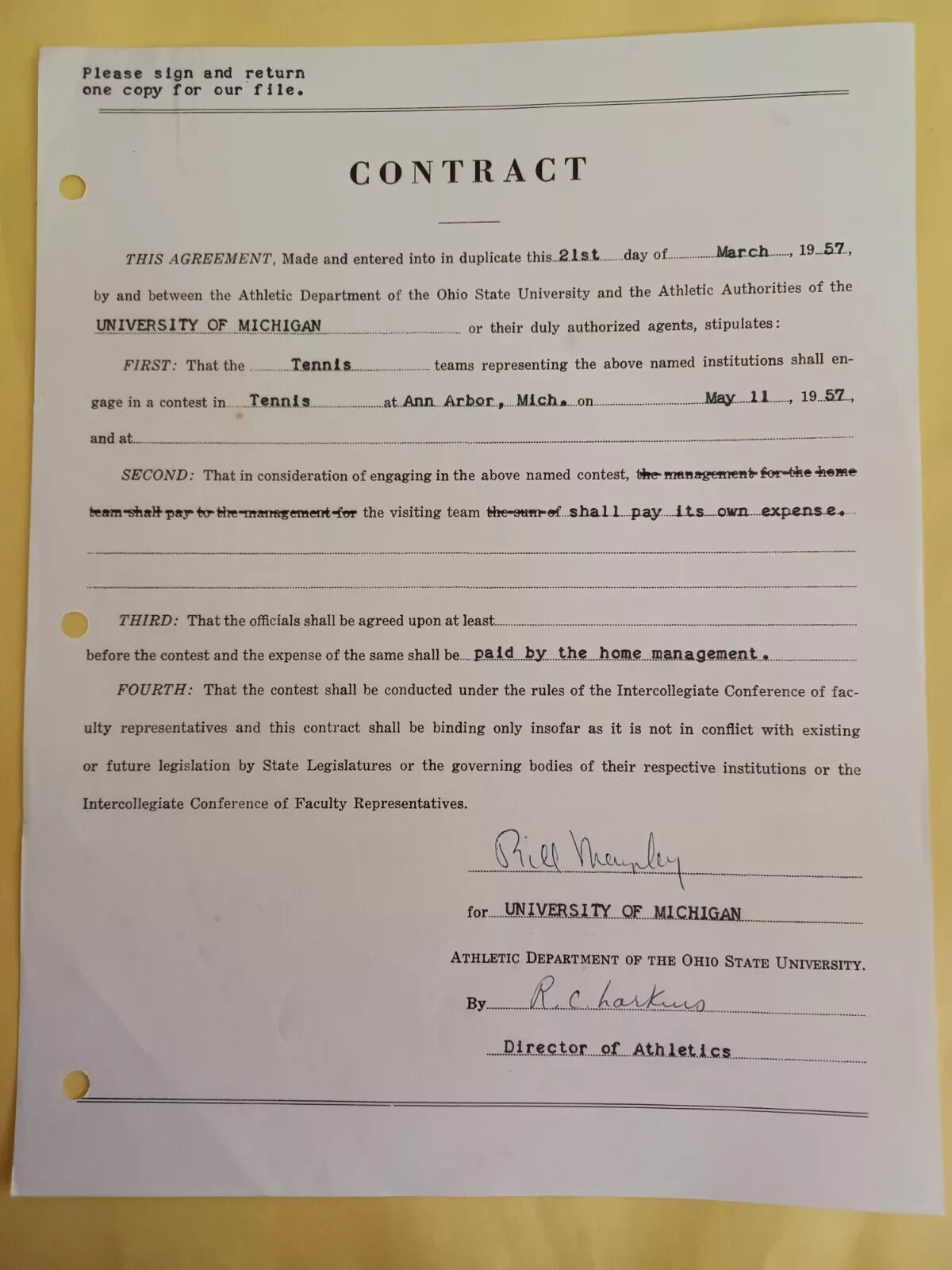
Signed William Murphy & Dick Larkins Signed Contract University of Michigan Ohio State Tennis vintage original contract. Extremely scarce
Richard C. Larkins was the athletic director at the Ohio State University from July, 1946 to 1970.William Murphhy ...As tennis coach at Michigan from 1949 to 1970, Bill Murphy established himself as one of the nation\'s finest tennis instructors. Under his direction, the Wolverines captured 11 Big Ten championships and the NCAA title in 1957. His Michigan squads took 198 dual matches against only 45 defeats. Over the years, Murphy can be credited not only with his outstanding record but with what he has done through individual instruction. His coaching clinics have been extremely popular throughout the United States, Mexico and Canada. In 1973, Murphy was the recipient of the National Tennis Education Foundation Award for \"Outstanding Contributions to Tennis Teaching Methods.\"_________________
As tennis coach at Michigan from 1949 to 1970, Bill Murphy established himself as one of the nation\'s finest tennis instructors. Under his direction, the Wolverines captured 11 Big Ten championships and the NCAA title in 1957. His Michigan squads took 198 dual matches against only 45 defeats. Over the years, Murphy can be credited not only with his outstanding record but with what he has done through individual instruction. His coaching clinics have been extremely popular throughout the United States, Mexico and Canada. In 1973, Murphy was the recipient of the National Tennis Education Foundation Award for \"Outstanding Contributions to Tennis Teaching Methods.\"
William E. Murphy (November 15, 1917 – May 16, 2005) was a Navy Cross winner in World War II, an American Championship tennis player and university coach.
Early lifeIn 1941, he earned a Master\'s Degree in Physical Education from George Williams College in Chicago. In World War II as a dive bomber pilot in the Pacific, landing a bomb that helped sink the world\'s largest Japanese battleship Yamato, earning Navy Cross.
CareerIn 1948, he became the coach of the University of Michigan tennis team, where he remained for 21 years until 1969. He led Michigan to Eleven Big Ten Team Championships and the NCAA Team Championship in 1957. In 1970, he became the tennis coach at the University of Arizona until retiring in 1981. He remained in Tucson and died in 2005 at age 87. His wife, Mimi, died in June 2011. Chet passed away in 2016.[1]
PlayerA native of Chicago, Illinois, Murphy and twin brother, Chet, played for the University of Chicago from 1937 to 1939. They led the school to three Big Ten Conference Tennis Championships.[2] As a doubles team, they were undefeated in collegiate meets,[3] including wins at the Big Ten Conference Doubles Championships in 1938 and 1939.[4] They were the Finalist team at the 1939 NCAA Doubles Championship.[4]
In 1938, the Murphy brothers helped their undefeated team score the first clean sweep in the history of the Big Ten Conference Tennis Championships by winning all nine finals matches.[5][6] The brothers won the doubles title over the Northwestern team, 5–7, 6–4, 7–5. John Shostrom won the No. 1 singles and the Murphy brothers won No. 2 and No. 3 singles. Bill beat Northwestern\'s Harry O\'Neil, 6–0, 6–3.[5] At the National level, the Murphy brothers were ranked as the #10 Doubles pair by the United States Lawn Tennis Association in 1938.[7]
In May 1939, the brothers led the university to its third straight Big Ten Conference Tennis Championship. The Associated Press wrote, \"The University of Chicago, where the athletic habit of recent years has leaned toward defeat, now has a new complex well established – tennis championships.\"[8] The Murphy brothers won their second consecutive Doubles Championship, and Chet won the No. 1 singles.[8] Bill qualified to play for the No. 2 Singles title, but defaulted to save himself for the doubles competition.[8] In June 1939, the brothers were runners up in the NCAA Doubles Championship to Bob Peacock and Doug Imhoff, of the University of California-Berkeley, and Chet was runner up in the NCAA Singles Championship to Frank Guernsey of Rice University.
In July 1939, Murphy won the singles title at the Western Tennis Association tournament in Chicago. The Associated Press reported that he won his Championship \"the hard way,\" defeating top-ranked Wilbur F. Coen, Jr., aka Junior Coen, of Kansas City in the semifinals, and then defeated #2 seeded Jack Tidball of Los Angeles, 6–8, 6–1, 6–1, 9–7 in the finals.[9][10] The following week, he won the mixed doubles at the Longwood Cricket Club tennis tournament in Brookline, Massachusetts with Mary Arnold.[11]
In August 1939, at the Meadow Club Invitation tournament in Southampton, New York, the brothers beat the team of Peacock and Imhoff, but lost a close doubles match against Wimbledon champions Bobby Riggs and Elwood Cooke. They won two of the first three sets but ultimately lost, 13–11, 3–6, 7–5, 4–6, 0–6.[12] At Seabright, they beat Riggs and Bitsy Grant.
CoachMurphy was the tennis coach at the University of Michigan for 21 years from 1948–1969. His Michigan tennis teams won 11 Big Ten Conference Championships and the NCAA Team Championship in 1957.[1] His career coaching record at Michigan was 198–45–0, an .821 winning percentage.[13][14] In 1953, he recruited three outstanding junior players: Mark Jaffe, Barry MacKay and Dick Potter. They formed the core of his teams for three years. MacKay and Potter broke the Big Ten record held by Bill and Chet for most Big Ten Conference Doubles Championships with three. MacKay and Potter won the Big Ten Conference Doubles Championships in 1955, 1956, and 1957.
In 1970, Bill was hired by Dave Strack, Athletic Director at University of Arizona and former basketball coach at Michigan, as the tennis coach. He retired there in 1981, and lived in Tucson until his death in 2005 at age 87.[15]
Coaching record at Michigan:[14]
Year Team Overall Conference Standing Bowl/playoffs Rank#University of Michigan (Big Ten Conference) (1948–1969)1948–49 Michigan 8–0 2nd 1949–50 Michigan 9–0 3rd 1950–51 Michigan 6–2 2nd 1951–52 Michigan 6–4 5th 1952–53 Michigan 8–3 3rd 1953–54 Michigan 11–3–1 2nd 1954–55 Michigan 13–0 1st 5th 1955–56 Michigan 12–0 1st 1956–57 Michigan 12–0 1st 1st 1957–58 Michigan 8–2 3rd 1958–59 Michigan 9–1 1st 1959–60 Michigan 7–4 1st 1960–61 Michigan 9–3 1st 1961–62 Michigan 8–2 1st 1962–63 Michigan 7–6 2nd 1963–64 Michigan 9–4 2nd 1964–65 Michigan 10–4 1st 1965–66 Michigan 10–0 1st 1966–67 Michigan 9–3 2nd 1967–68 Michigan 13–0 1st 1968–69 Michigan 15–2 1st Total: 198–45–0 National championship Conference title Conference division title or championship game berth†Indicates Bowl Coalition, Bowl Alliance, BCS, or CFP / New Years\' Six bowl.#Rankings from final Coaches Poll.AuthorBill Murphy wrote books about tennis together with Chet. They wrote Tennis Handbook, published in 1962, Championship Drills, Advanced Tennis, Tennis for Thinking Players, and Tested Tennis Tips. The two were recognized for their books with an International Tennis Hall of Fame Educational Services Award in 1973.[16]
RecognitionIntercollegiate Tennis Association Hall of Fame in 1984 (Chet followed in 1985).[17]University of Michigan Athletic Hall of Honor (1983)[18]Joint inductiong into the University of Chicago Athletics Hall of Fame (2003).[4]Member of the USPTAPresident and Chairmen of the National Collegiate Tennis Coaches Association and National Collegiate Tennis Committee (1965 and 1966)Navy Cross for 72 combat missions in the Pacific and sinking Yamato BattleshipDistinguished Flying CrossFour Air Medals during WarHelped sink the Japanese Battleship Yamato, largest in the worldSee alsoUniversity of Michigan Athletic Hall of Honor in 1983Barry MacKay, Michigan\'s star player on Murphy\'s teams from 1955–57
Richard C. Larkins (April 19, 1909 – April 5, 1977)[1] was the athletic director at the Ohio State University from July, 1946[2] to 1970.
College YearsLarkins played on the varsity football team and varsity basketball team in his time at OSU. Larkins received a bachelor\'s degree in business administration 1931, then later in 1935, a master\'s degree in commerce. He was a member of both Beta Gamma Sigma and Phi Delta Theta.[2] In his senior year, he was awarded with the Western Conference Medal for scholastic achievement.[1]
CareerIn one of his first acts as Ohio State athletic director, Larkins hired his old teammate, Wes Fesler, to take over as Ohio State\'s football coach.[3] Larkins also became involved in a public feud with legendary coach Paul Brown in 1948. A story in the Minneapolis Times quoted Larkins as saying: \"Brown has started a terrific drive in Columbus and all around Ohio to return as football coach at Ohio State. Brown is not happy in the pro atmosphere. He has a good bank account and wants to coach college kids again.\"[4] Larkins was also quoted as saying that Brown has been \"stealing football players off our campus by the dozen\" and that Brown had \"done everything in his power to hurt Ohio State.\"[4] Brown accused Larkins of conducting a smear campaign, and Larkins claimed he had been mis-quoted.[4]
He is also remembered as the Ohio State athletic director who made the decision to proceed with the historic Snow Bowl game against Michigan in 1950. Despite extraordinarily inclement weather, Larkins decided to play the game \"due to the number of people who attended, and the mess it would have created to refund the tickets.\"[5] Ohio State lost the game 9-3.
Larkins drew national media attention for his comments in 1951 criticizing big-time college football as a Frankenstein monster. In the remarks, Larkins said:
\"Football is being ruined. It\'s getting completely out of hand. It\'s a Frankenstein, a monster. Football is killing itself. ... College football is too big for its breeches. ... These 80,000-90,000 Roman holidays are not good for college athletics. They\'re killing it. You\'ll never know the pressures on us in this coaching situation. The outside pressures, the outside interference! It\'s just terrific. I don\'t know how much longer educators can put up with this stuff. We\'re educational institutions, we\'re not the New York Yankees or Chicago Bears.\"[6]
However, Larkins is best remembered as the driving force behind the 1951 hiring of Woody Hayes as Ohio State\'s football coach. Ironically, Larkins\' decision to hire the little-known Hayes, over former Buckeyes\' coach Paul Brown, led to petitions being circulated on campus calling for Larkins\' removal; the petition claimed that Larkins \"has lost confidence of the Ohio State student body\" over his opposition to Brown\'s return as football coach.[7] Larkins became Hayes\' strongest supporter at the university and protected Hayes after numerous clashes and against efforts by university administrators to fire him.[8] Larkins and Hayes became close friends; in 1979, Hayes recalled: \"My greatest friends are always people that I fight with. Bo [Schembechler] was one of those. .... That was true with Dick Larkins (former athletic director at Ohio State). We were always arguing but agreed on everything.\"[9]
Larkins also hired Marty Karow to coach the Ohio State baseball team and Fred Taylor to coach the basketball team. Taylor led his basketball team to the NCAA championship in 1960 and Karow did the same with the baseball team in 1966. Those remain the university\'s only national titles in those sports.
In 1970, Larkins became the fourth recipient of the James J. Corbett Memorial Award, presented by the National Association of Collegiate Directors of Athletics \"to the collegiate administrator who through the years has most typified Corbett\'s devotion to intercollegiate athletics and worked unceasingly for its betterment.\"
LegacyLarkins Hall on the Ohio State Campus was named for Dick Larkins. The building served as the recreation and physical activity center for a number of years. It was torn down in the early-2000s to build the new Recreation and Physical Activity Center (RPAC). The Richard C. Larkins Plaza was named after the completion of the RPAC. The Plaza is located at the conjunction of the four physical education buildings on campus.
Head coaching recordYear Team Overall Conference Standing Bowl/playoffsRochester Yellowjackets (Independent) (1935–1936)1935 Rochester 1–6 1936 Rochester 2–5 Rochester: 3–11 Total: 3–11 The Ohio State University (Ohio State or OSU) is a public land-grant research university in Columbus, Ohio, United States. A member of the University System of Ohio, it was founded in 1870. It is one of the largest universities by enrollment in the United States, with nearly 50,000 undergraduate students and nearly 15,000 graduate students. The university consists of sixteen colleges and offers over 400 degree programs at the undergraduate and graduate levels.[7]
It is classified among \"R1: Doctoral Universities – Very high research activity\". As of 2024, the university has an endowment of $7.9 billion. Its athletic teams compete in NCAA Division I as the Ohio State Buckeyes as a member of the Big Ten Conference for the majority of fielded sports.
It is a member of the Association of American Universities. Past and present alumni and faculty include 6 Nobel Prize laureates, 9 Rhodes Scholars, 7 Churchill Scholars, 1 Fields Medalist, 7 Pulitzer Prize winners, 64 Goldwater scholars, 7 U.S. senators, 15 U.S. representatives, 104 Olympic medalists, and 1 foreign head of state.
HistoryMain article: History of Ohio State UniversityOverview1870–1899 Foundational era
University Hall was the first building on campus, built in 1873 and reconstructed in 1976The proposal of a manufacturing and agriculture university in central Ohio was initially met in the 1870s with hostility from the state\'s agricultural interests and competition for resources from Ohio University, which was chartered by the Northwest Ordinance and Miami University.[8] Championed by the Republican governor Rutherford B. Hayes, the Ohio State University was founded in 1870 as a land-grant university under the Morrill Act of 1862 as the Ohio Agricultural and Mechanical College.[8]
The university opened its doors to 24 students on September 17, 1873. In 1878, the first class of six men graduated. The first woman graduated the following year.[9] Also in 1878, the Ohio legislature recognized an expanded scope for the university by changing its name to \"the Ohio State University.\"[10][11]
1900–1980 Middle era
A view of The Oval green space in the early 20th centuryIn 1906, Ohio State segregationist[12] president William Oxley Thompson, along with the university\'s supporters in the state legislature, put forth the Lybarger Bill with the aim of shifting virtually all higher education support to the continued development of Ohio State while funding only the \"normal school\" functions of the state\'s other public universities. Although the Lybarger Bill failed narrowly to gain passage, in its place the Eagleson Bill was passed as a compromise, which determined that all doctoral education and research functions would be the role of Ohio State, and that Miami University and Ohio University would not offer instruction beyond the master\'s degree level – an agreement that would remain in place until the 1950s. In 1916, Ohio State was elected into membership in the Association of American Universities.[13]
In 1911, president Thompson wrote in a letter, \"the race problem is growing in intensity every year, and I am disposed to doubt the wisdom on the part of the colored people of taking any move that practically forces the doctrine of social equality.\"[14] At the same time, Ohio State \"practiced racial segregation\" that was widespread across the country at the time against Black students, and \"there is no known evidence [Thompson] saw benefits in addressing it\".[14] In 2024, after attempts were made to remove Thompson\'s statue from the Oval, university spokesperson Ben Johnson stated \"the naming review process is thoughtful and thorough and therefore could take several years\", but the statue has not been removed.[12]
With the onset of the Great Depression, Ohio State would face many of the challenges affecting universities throughout America as budget support was slashed, and students without the means of paying tuition returned home to support families. By the mid-1930s, however, enrollment had stabilized due in large part to the role of the Federal Emergency Relief Administration and later the National Youth Administration.[15] By the end of the decade, enrollment had still managed to grow to over 17,500. In 1934, the Ohio State Research Foundation was founded to bring in outside funding for faculty research projects. In 1938, a development office was opened to begin raising funds privately to offset reductions in state support.
In 1952, Ohio State founded the interdisciplinary Mershon Center for International Security Studies, which it still houses. The work of this program led to the United States Department of Homeland Security basing the National Academic Consortium for Homeland Security at the university in 2003.
1980–present Modern eraOhio State had an open admissions policy until the late 1980s. Since the early 2000s, the college has raised standards for admission, and been increasingly cited as one of the best public universities in the United States.[16][17][18][19][20][21][22] The main campus in Columbus has grown into the fifth-largest university campus in the United States.[23]
On January 12, 2015, OSU claimed the first-ever College Football Playoff National Championship by defeating Oregon 42–20.[24][25][26]
On June 22, 2022, the United States Patent and Trademark Office granted the university a trademark on the word \"the\" in relation to clothing, such as T-shirts, baseball caps and hats distributed and/or sold through athletic or collegiate channels.[27][28] Ohio State and its fans, in particular those of its athletics program, frequently emphasize the word \"THE\" when referring to the school.[29]
Main article: List of presidents of Ohio State UniversityMichael V. Drake became the 15th president of Ohio State in 2014.[30] In 2020, Kristina M. Johnson took office as the 16th president.[31] And in 2023, Walter E. Carter Jr. took office as the 17th president.[32]
Significant events1969–1970 Vietnam War protestsThroughout 1969, anti-Vietnam War protest tensions grew on Ohio State\'s campus. What is now Bricker Hall was occupied by students, but after being told they had \"five minutes to leave, or they\'d be arrested\", students departed from the building. In late April 1970, anti-war riots ensued on Ohio State campus, leading to nearly 300 arrests, over 60 injuries, and seven gunshot wounds.[33] Students began \"boycotting classes with a student strike, protesting the university\'s rejection of a list of demands presented the week before. Specific demands included adding black and women\'s studies to the university\'s courses.\" On April 29, 1970, five days before the Kent State shootings, students picketed buildings, but this initially peaceful protest \"started to spiral out of control\" after Ohio State Highway Patrol troopers arrived in riot gear. When a man was assaulted by three students, tear gas was deployed, in response to which protesters threw rocks at the National Guard. Seven students were struck with a shotgun blast near the Student Union. There were no casualties, and the shooter was not identified.
1978–1998 Richard Strauss sexual abuse scandalThis section is an excerpt from Ohio State University abuse scandal.[edit]The Ohio State University abuse scandal centered on allegations of sexual abuse that occurred between 1978 and 1998, while Richard Strauss was employed as a physician by Ohio State University (OSU) in the Athletics Department and in the Student Health Center. An independent investigation into the allegations was announced in April 2018 and was conducted by the law firm Perkins Coie.
In July 2018, several former wrestlers accused former head coach Russ Hellickson and U.S. representative Jim Jordan, who was an assistant coach at OSU between 1987 and 1994, of knowing about Strauss\'s alleged abuse but failing to take action to stop it. Jordan has denied that he had any student-athlete report sexual abuse to him.
The report, released in May 2019, concluded that Strauss abused at least 177 male student-patients and that OSU was aware of the abuse as early as 1979, but the abuse was not widely known outside of athletics or student health until 1996, when he was suspended from his duties. Strauss continued to abuse OSU students at an off-campus clinic until his retirement from the university in 1998. OSU was faulted in the report for failing to report Strauss\'s conduct to law enforcement.
In May 2020, the university entered into a settlement and agreed to pay $40.9 million to 162 sexual abuse survivors.[34] Five lawsuits against the university are pending.[35]2016 terrorist attackThis section is an excerpt from 2016 Ohio State University attack.[edit]
Police presence on the OSU campus, view from Curl Market
This article may be excessively based on contemporary reporting. Please use newer secondary sources; articles on events that lack lasting impact may be merged, redirected, or deleted. (March 2024) (Learn how and when to remove this message)On November 28, 2016, a terrorist vehicle-ramming and stabbing attack occurred at 9:52 a.m. EST at Ohio State University\'s Watts Hall in Columbus, Ohio. The attacker, Somali refugee Abdul Razak Ali Artan, was shot and killed by the first responding OSU police officer, and 13 people were hospitalized for injuries.
Authorities began investigating the possibility of the attack being an act of terrorism. On the next day, law enforcement officials stated that Artan was inspired by terrorist propaganda from the Islamic State of Iraq and the Levant (ISIL) and the late radical Muslim cleric Anwar al-Awlaki. Amaq News Agency released a statement claiming the attacker responded to an ISIL call to attack coalition citizens, though there is no evidence of direct contact between the group and Artan.2024 pro-Palestinian campus protestsDuration: 34 seconds.0:34Officers move into the South Oval to arrest protesters while protesters defend praying Muslim students, chanting \"let them pray\", April 25, 2024.This section is an excerpt from 2024 Ohio State University pro-Palestinian campus protests.[edit]A series of protests at Ohio State University by pro-Palestinian demonstrators occurred on-campus in response to the Israel-Palestine conflict beginning on October 7, 2023. A solidarity encampment was constructed on OSU\'s South Oval on April 25, 2024, during which there were at least 36 arrests,[36] making for the largest en masse arrests on campus since the 1969–1970 Vietnam War protests.[37]
The protester demands of OSU include \"financial divestment, academic boycott, financial disclosure, acknowledging the genocide, and ending targeted policing\".[38]
Pro-Palestinian groups have been critical of the university\'s responses to the protests, which have included allowing state troopers to aim long-range rifles at students during the dispersal of the Gaza Solidarity Encampment,[39] suspending a pro-Palestinian student organization,[40] and suppressing the Undergraduate Student Government\'s attempts at passing legislation for financial divestment from Israel after receiving pressure from officials in Zionist organization Hillel International.[41]
The university has insisted their actions are politically neutral, with President Walter E. Carter Jr. stating the \"university\'s long-standing space rules are content neutral and are enforced uniformly\".[42]CampusSee also: List of buildings at Ohio State UniversityMapWikimedia | © OpenStreetMapInteractive map of the university\'s main campus in ColumbusOhio State\'s 1,764-acre (7.14 km2) main campus is about 2.5 miles (4.0 km) north of Columbus\' downtown. The historical center of campus is the Oval, a quad of about 11 acres (4.5 ha).[43] The original campus was laid out in the English country style with University Hall overlooking what would become the Oval. From 1905 to 1913, the Olmsted brothers, who had designed New York City\'s Central Park, were contracted as architectural consultants. Under their leadership, a more formal landscape plan was created with its center axis through the Oval. This axis shifted the university\'s street grid 12.25 degrees from the City of Columbus\' street grid. Construction of the main library in 1915 reinforced this grid shift.[44]The East Atrium at the William Oxley Thompson Memorial LibraryOhio State\'s research library system has a combined collection of over 5.8 million volumes. Along with 21 libraries on its Columbus campus, the university has eight branches at off-campus research facilities and regional campuses, and a book storage depository near campus. In all, the Ohio State library system encompasses 55 branches and specialty collections. Some more significant collections include the Byrd Polar Research Center Archival Program, which has the archives of Admiral Richard E. Byrd and other polar research materials; the Hilandar Research Library, which has the world\'s largest collection of medieval Slavic manuscripts on microform; the Ohio State Cartoon Library & Museum, the world\'s largest repository of original cartoons; the Lawrence and Lee Theatre Research Institute; and the archives of Senator John Glenn.
Anchoring the traditional campus gateway at the eastern end of the Oval is the 1989 Wexner Center for the Arts. Designed by architects Peter Eisenman of New York and Richard Trott of Columbus, the center was funded in large part by Ohio State alumnus Les Wexner\'s gift of $25 million in the 1980s. The center was founded to encompass all aspects of visual and performing arts with a focus on new commissions and artist residencies. Part of its design was to pay tribute to the armory that formerly had the same location. Its groundbreaking deconstructivist architecture has resulted in it being lauded as one of the most important buildings of its generation. Its design has also been criticized as proving less than ideal for many of the art installations it has attempted to display. The centerpiece of the Wexner Center\'s permanent collection is Picasso\'s Nude on a Black Armchair, which was purchased by Wexner at sale for $45 million.[citation needed]Aerial view of the main campus, with Drinko Hall and the South Oval in the foregroundTo the south of the Oval is another, somewhat smaller expanse of green space commonly referred to as the South Oval. At its eastern end, it is anchored by the Ohio Union. To the west are Hale Hall, the Kuhn Honors House, Browning Amphitheatre (a traditional stone Greek theatre) and Mirror Lake.
Knowlton Hall, dedicated in October 2004, is at the corner of West Woodruff Avenue and Tuttle Park Place, next to Ohio Stadium. Knowlton Hall along with the Fisher College of Business and Hitchcock Hall form an academic nucleus in the northwestern corner of North campus. Knowlton Hall was designed by Atlanta-based Mack Scogin Merrill Elam along with WSA Studio from Columbus. The Hall is home to the KSA Café, the disciplines of architecture, landscape architecture, city and regional planning, and about 550 undergraduate and graduate students. Knowlton Hall stands out from the general reddish-brown brick of Ohio State\'s campus with distinctive white marble tiles that cover the building\'s exterior. This unique wall cladding was requested by Austin E. Knowlton, the namesake of and main patron to the creation of Knowlton Hall. Knowlton also requested that five white marble columns be erected on the site, each column representing one of the classical orders of architecture.[45]
The Ohio State College of Medicine is on the southern edge of the central campus. It is home to the James Cancer Hospital, a cancer research institute and one of the National Cancer Institute\'s 41 comprehensive cancer centers, along with the Richard M. Ross Heart Hospital, a research institute for cardiovascular disease.
The campus is served by the Campus Area Bus Service.
Regional campusesThe university also operates regional campuses in five areas:
Ohio State University at Lima – Lima, Ohio, established in 1960Ohio State University at Mansfield – Mansfield, Ohio, established in 1958Ohio State University at Marion – Marion, Ohio, established in 1957Ohio State University at Newark – Newark, Ohio, established in 1957Ohio State University Agricultural Technical Institute (ATI) – Wooster, Ohio, established in 1969AcademicsUndergraduate admissionsUndergraduate admissions statistics2021 enteringclass[46]Change vs.2016Admit rate 57.2%(Neutral increase +3.1)Yield rate 25.3%(Decrease −7.4)Test scores middle 50%SAT Total 1260–1420(among 21% of FTFs)ACT Composite 26–32(among 64% of FTFs)Ohio State is considered a selective public university.[47] Undergraduate admissions selectivity to Ohio State is rated as 91/99 by The Princeton Review (meaning \"highly selective\")[48] and \"more selective\" by U.S. News & World Report;[49] according to the data, it is the most selective for any public university in the state of Ohio. The New York Times classifies Ohio State as a \"highly selective public college\".[47]
For the Class of 2025 (enrolled fall 2021), Ohio State received 58,180 applications and accepted 33,269 (57.2%). Of those accepted, 8,423 enrolled, a yield rate (the percentage of accepted students who choose to attend the university) of 25.3%. OSU\'s freshman retention rate is 93.9%, with 88% going on to graduate within six years.[46]
Of the 21% of the incoming freshman class who submitted SAT scores; the middle 50 percent Composite scores were 1260–1420.[50][46] Of the 64% of enrolled freshmen in 2021 who submitted ACT scores, the middle 50 percent Composite score was between 26 and 32.[46][51][52] In the 2020–2021 academic year, 26 freshman students were National Merit Scholars.[53][54]
Fall First-Time Freshman Statistics [46][55][56][57][58][59]2021 2020 2019 2018 2017 2016Applicants 58,180 49,087 47,703 48,077 47,782 44,845Admits 33,269 33,619 25,634 24,988 22,964 24,265Admit rate 57.2 68.5 53.7 52.0 48.1 54.1Enrolled 8,423 8,679 7,716 7,944 7,209 7,938Yield rate 25.3 25.8 30.1 31.8 31.4 32.7ACT composite*(out of 36) 26–32(64%†) 26–32(80%†) 28–32(78%†) 27–32(80%†) 27–31(86%†) 27–31(84%†)SAT composite*(out of 1600) 1260–1420(21%†) 1230–1390(36%†) 1300–1420(39%†) 1240–1450(35%†) 1260–1450(29%†) —* middle 50% range† percentage of first-time freshmen who chose to submitRankings and recognitionAcademic rankingsNationalForbes[60] 72U.S. News & World Report[61] 43Washington Monthly[62] 68WSJ/College Pulse[63] 99GlobalQS[64] 208THE[65] 99=U.S. News & World Report[66] 55National program rankings[67]Global program rankings[68]The Public Ivies: America\'s Flagship Public Universities (2000) by Howard and Matthew Greene listed Ohio State as one of a select number of public universities offering the highest educational quality.[17] In its 2023 edition, U.S. News & World Report ranked Ohio State as tied for 43rd among all national universities. They ranked the college\'s political science, audiology, sociology, speech–language pathology, finance, accounting, public affairs, nursing, social work, healthcare administration and pharmacy programs as among the top 20 programs in the country.[49] The Academic Ranking of World Universities placed Ohio State 39-51 nationally and 101–150 globally for 2023. In its 2024 rankings, Times Higher Education World University Rankings ranked it tied for 99th in the world. In 2024, QS World University Rankings ranked the university 151st in the world.[69] The Washington Monthly college rankings, which seek to evaluate colleges\' contributions to American society based on factors of social mobility, research and service to the country by their graduates, placed Ohio State 61st among national universities in 2023.[70]The Ohio Union was the first student union at a state university in the United States.[71]In 1916, Ohio State became the first university in Ohio to be extended membership into the Association of American Universities, and remains the only public university in Ohio among the organization\'s 60 members. Ohio State is also the only public university in Ohio to be classified among \"R1: Doctoral Universities – Highest Research Activity\" and have its undergraduate admissions classified as \"more selective\".[72]
Ohio State\'s political science program is ranked among the top programs globally. Considered to be one of the leading departments in the United States, it has played a particularly significant role in the construction and development of the constructivist and realist schools of international relations.[18][73] In 2004, it was ranked as first among public institutions and fourth overall in the world by British political scientist Simon Hix at the London School of Economics and Political Science,[74][75] while a 2007 study in the academic journal PS: Political Science & Politics ranked it ninth in the United States.[18] It is a leading producer of Fulbright Scholars.[76]
Bloomberg Businessweek ranked the undergraduate business program at Ohio State\'s Fisher College of Business as the 14th best in the nation in its 2016 rankings.[77]
The Ohio State linguistics department was recently ranked among the top 10 programs nationally, and top 20 internationally by QS World University Rankings.[78]
The college is the only school in North America that offers an ABET-accredited welding engineering undergraduate degree.[79][80]
ResearchOSU colleges and schoolsCollege of DentistryCollege of Education and Human EcologyCollege of EngineeringCollege of Food, Agricultural, and Environmental SciencesCollege of MedicineCollege of NursingCollege of OptometryCollege of PharmacyCollege of Public HealthCollege of Social WorkCollege of Veterinary MedicineCollege of Arts and SciencesGraduate SchoolJohn Glenn College of Public AffairsMax M. Fisher College of BusinessMoritz College of Law
The Wexner Medical Center campusThe National Science Foundation ranked Ohio State University 12th among American universities for research and development expenditures in 2021 with $1.23 billion.[81][82]
In a 2007 report released by the National Science Foundation, Ohio State\'s research expenditures for 2006 were $652 million, placing it seventh among public universities and 11th overall, also ranking third among all American universities for private industry-sponsored research. Research expenditures at Ohio State were $864 million in 2017. In 2006, Ohio State announced it would designate at least $110 million of its research efforts toward what it termed \"fundamental concerns\" such as research toward a cure for cancer, renewable energy sources and sustainable drinking water supplies.[83] In 2021, President Kristina M. Johnson announced the university would invest at least $750 million over the next 10 years toward research and researchers.[84] This was announced in conjunction with Ohio State\'s new Innovation District, which will be an interdisciplinary research facility and act as a hub for healthcare and technology research, serving Ohio State faculty and students as well as public and private partners.[85] Construction of the facility was completed in 2023, as one of the first buildings in the District.[86]
Research facilities include Aeronautical/Astronautical Research Laboratory, Byrd Polar Research Center, Center for Automotive Research, (OSU CAR), Chadwick Arboretum, Biomedical Research Tower, Biological Sciences Building, CDME, Comprehensive Cancer Center, David Heart and Lung Research Institute, Electroscience Laboratory, Large Binocular Telescope (LBT, originally named the Columbus Project), Mershon Center for International Security Studies, Museum of Biological Diversity, National Center for the Middle Market, Stone Laboratory on Gibraltar Island, Center for Urban and Regional Analysis and Ohio Agricultural Research and Development Center.
Endowment and fundraisingOhio State was among the first group[87] of four public universities to raise a $1 billion endowment when it passed the $1 billion mark in 1999. At the end of 2005, Ohio State\'s endowment stood at $1.73 billion, ranking it seventh among public universities and 27th among all American universities.[88] In June 2006, the endowment passed the $2 billion mark.
In recent decades, and in response to continually shrinking state funding, Ohio State has conducted two significant multi-year fundraising campaigns. The first concluded in 1987 and raised $460 million, a record at the time for a public university. The \"Affirm Thy Friendship Campaign\" took place between 1995 and 2000. With an initial goal of raising $850 million, the campaign\'s final tally was $1.23 billion, placing Ohio State among the small group of public universities to have successfully conducted a $1 billion campaign.[89] At his welcoming ceremony, returning President E. Gordon Gee announced in the fall of 2007 that Ohio State would launch a $2.5 billion fundraising campaign. In 2019, celebrating the university\'s 150th year, President Michael V. Drake announced the \"Time and Change Campaign\"[90] with a goal of raising $4.5 billion from 1 million individual donors.[91]
Student life
The Recreation and Physical Activity Center and Scarlet SkywayThe Office of Student Life has partnership affiliations with the Schottenstein Center, the Blackwell Inn and the Drake Events Center. Services supporting student wellness include the Wilce Student Health Center, named for university physician John Wilce, the Mary A. Daniels Student Wellness Center and the Counseling and Consultation Service.
The RPAC is the main recreational facility on campus. The Wellness Center within the RPAC offers services such as nutrition counseling, financial coaching, HIV and STI testing, sexual assault services, and alcohol and other drug education.[92]
Ohio State\'s \"Buckeye Bullet\" electric car broke the world record for the fastest speed by an electric vehicle on October 3, 2004, with a maximum speed of 271.737 mph (437.318 km/h) at the Bonneville Salt Flats in Utah.[93] The vehicle also holds the U.S. record for fastest electric vehicle with a speed of 314.958 mph (506.876 km/h), and peak timed mile speed of 321.834 mph (517.942 km/h). A team of engineering students from the university\'s \"Center for Automotive Research-Intelligent Transportation\" (CAR-IT) designed, built and managed the vehicle. In 2007, Buckeye Bullet 2 was launched. This follow-up effort was a collaboration between Ohio State engineering students and engineers from the Ford Motor Company and will seek to break the land speed record for hydrogen cell powered vehicles.[94]
DiversityStudent body composition as of May 2, 2022Race and ethnicity[95] TotalWhite 66% Asian 8% Black 7% Foreign national 7% Other[a] 7% Hispanic 5% Economic diversityLow-income[b] 18% Affluent[c] 82% Sexual harassment handlingFurther information: Ohio State University abuse scandalIn June 2018, Ohio State dissolved its Sexual Civility and Empowerment unit and eliminated four positions in the unit due to concerns about mismanagement and a lack of support for survivors of sexual assault.[96] This occurred after the unit was suspended in February 2018 and following an external review.[97] The Columbus Dispatch and the school newspaper, The Lantern, reported that \"[SCE] failed to properly report students\' sexual-assault complaints\" and that some victims were told that they were \"\'lying\', \'delusional\', \'suffering from mental illness\', \'have an active imagination\', that they \'didn\'t understand their own experience\', and also \'fabricated their story\'\".[98][99] With help from the Philadelphia law firm Cozen O\'Connor, the university will be creating[when?] a new framework to handle sexual assault cases and reevaluating its Title IX program.
On July 20, 2018, BBC News reported that over 100 male students, including athletes from 14 sports, had reported sexual misconduct by a deceased university team physician, Richard Strauss.[100] The reports dated back to 1978, and included claims that he groped and took nude photographs of his patients. Four former wrestlers filed a lawsuit against Ohio State for ignoring complaints of \"rampant sexual misconduct\" by Strauss. U.S. representative Jim Jordan was named in the lawsuit and has since denied the former wrestlers\' claims that he knew about the abuse while he was an assistant coach for eight years at the university.[101][better source needed] In May 2020, the university entered into a settlement and agreed to pay $40.9 million to the sexual abuse survivors.[102]
Activities and organizations
Hale Hall was the original home of the Ohio Union.The Ohio Union was the first student union built by an American public university.[71] It is dedicated to the enrichment of the student experience, on and off the university campus. The first Ohio Union, on the south edge of the South Oval, was constructed in 1909 and was later renamed Enarson Hall. The second Ohio Union was completed in 1950 and was prominently along High Street, southeast of the Oval. It was a center of student life for more than 50 years, providing facilities for student activities, organizations and events, and serving as an important meeting place for campus and community interaction. The union also housed many student services and programs, along with dining and recreational facilities. The second Ohio Union was demolished in February 2007 to make way for the new Ohio Union, which was finished in 2010. During this time, student activities were relocated to Ohio Stadium and other academic buildings.[103]
The university has over 1,000 student organizations; intercollegiate, club and recreational sports programs; student media organizations and publications, fraternities and sororities; and three student governments.
Student organizationsStudent organizations at Ohio State provide students with opportunities to get involved in a wide variety of interest areas including academic, social, religious, artistic, service-based, diversity and many more. There are over 1,000 registered student organizations that involve many thousands of students.[104] The university\'s forensics team has won the state National Forensics Association tournament several times.[105]
Block \"O\" is currently the largest student-run organization on the campus of Ohio State. With over 2,400 annual members, Block \"O\" serves as the official student cheering section at athletic events for the university. According to the Student Organization Office in the Ohio Union, Agricultural Education Society is the oldest student organization on campus. The Men\'s Glee Club often disputes the claim, but after consultation with Ohio Union Staff, Agricultural Education Society was named as the university\'s oldest organization.Fans celebrating Ohio State\'s victory in the 2019 Rose Bowl with the Ohio State University Marching BandEach year, students may sign up to participate in BuckeyeThon, Ohio State\'s student-led philanthropy. The organization hosts events throughout the year to support the hematology/oncology/bone marrow transplant unit[106] at Nationwide Children\'s Hospital in Columbus.[107] Each February, thousands of students and community members attend BuckeyeThon\'s signature event, a Dance Marathon consisting of two separate 12-hour shifts. In the past 15 years, students have raised over $5 million to support treatment, research, and various therapies at the hospital.[108] Unique to BuckeyeThon is the use of an operational fund separate from the main philanthropic cancer fund. As a registered non-profit, BuckeyeThon is subject to university audit and issues gift receipts through the Foundation.[109]
Ohio State has several student-managed publications and media outlets. The Makio is the official yearbook.[110] The Makio\'s sales plummeted by 60% during the early 1970s; the organization went bankrupt and stopped publication during the late 1970s. The book was revived from 1985 to 1994 and again in 2000, thanks to several student organizations. The Lantern is the school\'s daily newspaper and has operated as a laboratory newspaper[clarification needed] in the School of Communication (formerly the School of Journalism) since 1881. Mosaic is a literary magazine published by Ohio State, which features undergraduate fiction, poetry and art. The Sundial is a student-written and -published humor magazine. Founded in 1911, it is one of the oldest humor magazines in the country, but has not been published without large interruptions.[111][112] Ohio State has two improvisational comedy groups that regularly perform around campus and across the U.S.[113][114] There are two student-run radio stations: AROUSE, the music station, is home to over 100 student DJs, streaming music and independent content,[115] and Scarlet and Gray Sports Radio.[116] Students also operate a local cable TV channel known as Buckeye TV, which airs primarily on the campus closed cable system operated by the Office of the Chief Information Officer (OCIO).
Student governmentAt the Ohio State University, three recognized student governments represent their constituents.[117]
Undergraduate Student Government (USG), which consists of elected and appointed student representatives who serve as liaisons from the undergraduate student body to university officials. USG seeks to outreach to and work for the students at Ohio State.Council of Graduate Students (CGS), which promotes and provides academic, administrative and social programs for the university community in general and for graduate students in particular. The council provides a forum in which the graduate student body may present, discuss and set upon issues related to its role in the academic and non-academic aspects of the university community.Inter-Professional Council (IPC), which is a representative body of all professional students in the colleges of dentistry, law, medicine, optometry, pharmacy and veterinary medicine. Its purpose is to act as a liaison between these students and the governing bodies of the university.Residential life
South Campus GatewayOhio State operates 41 on-campus residence halls divided into three geographic clusters: South Campus (site of the university\'s original dormitories), North Campus (largely constructed during the post-war enrollment boom) and West Campus (\"The Towers\").[118] The residence hall system has 40 smaller living and learning environments defined by social or academic considerations.
Separate housing for graduate and professional students is maintained on the Southern tier of campus within the Gateway Residential Complex and the William H. Hall Student Residential Complex. Family housing is maintained at Buckeye Village at the far northern edge of campus beyond the athletic complex.
Student Life University Housing also administers student residential housing on the OSU Newark, OSU Mansfield and OSU Agricultural Technical Institute (ATI) campuses.
The Residence Hall Advisory Council (RHAC), which is a representative body of all students living in the university\'s residence halls, helps evaluate and improve the living conditions of the residence halls.[119]
North Campus: Archer House, Barrett House, Blackburn House, Bowen House, Busch House, Drackett Tower, Halloran House, Haverfield House, Houck House, Houston House, Jones Tower, Lawrence Tower, Mendoza House, Norton House, Nosker House, Raney House, Scott House, Taylor Tower, Torres HouseSouth Campus: Baker Hall East, Baker Hall West, Bradley Hall, Canfield Hall, Fechko House, German House, Hanley House, Mack Hall, Morrison Tower, Neil Avenue, Park-Stradley Hall, Paterson Hall, Pennsylvania Place, Pomerene House, Scholars East, Scholars West, Siebert Hall, Smith-Steeb Hall, The Residence on Tenth, Worthington BuildingWest Campus: Lincoln Tower, Morrill TowerOff-campus: South Campus Gateway Apartments, Veterans\' HouseAthleticsMain article: Ohio State BuckeyesSee also: Ohio State Buckeyes football, Ohio State Buckeyes men\'s basketball, Ohio State Buckeyes women\'s basketball, Ohio State Buckeyes baseball, and Ohio State Buckeyes men\'s ice hockey
Ohio Stadium is the fifth largest stadium in the world.Ohio State\'s intercollegiate sports teams are called the \"Buckeyes\" (derived from the colloquial term for people from the state of Ohio and after the state tree, the Ohio Buckeye, Aesculus glabra),[120] and participate in the NCAA\'s Division I in all sports (Division I FBS in football) and the Big Ten Conference in most sports. (The women\'s hockey program competes in the Western Collegiate Hockey Association.) The school colors are scarlet and gray. Brutus Buckeye is the mascot. Ohio State currently has 36 varsity teams. As of 2017, the football program is valued at $1.5 billion, the highest valuation of any such program in the country.[121] The team\'s rivalry against the University of Michigan has been termed as one of the greatest in North American sports.[122]Men\'s basketball against Duke at Value City Arena in 2021Ohio State is one of six universities – the University of Michigan, the University of Florida, Stanford University, UCLA and the University of California at Berkeley being the others – to have won national championships in all three major men\'s sports (baseball, basketball and football).[123] Ohio State is also one of only two universities to appear in the national championship games in both football and men\'s basketball in the same calendar year (the other being the University of Florida). Ohio State has also won national championships in wrestling, men\'s volleyball, men\'s swimming and diving, men\'s outdoor track and field, men\'s golf, men\'s gymnastics, men\'s fencing, women\'s rowing, co-ed fencing and multiple synchronized swimming championships.[124] The Ohio State equestrian team has won eight Intercollegiate Horse Show Association national championships.[125] Since the inception of the Athletic Director\'s Cup, Ohio State has finished in the top 25 each year, including top-six finishes in three of the last five years.[126] During the 2005–2006 school year, Ohio State became the first Big Ten team to win conference championships in football, men\'s basketball and women\'s basketball. Ohio State repeated the feat during the 2006–2007 school year, winning solo championships in all three sports. In 2007, Sports Illustrated nicknamed Ohio State\'s athletic program as being \"The Program\" due to the unsurpassed facilities, an unparalleled number of men\'s and women\'s sports teams and their success, and the financial support of an impressive fan base.[127]
Traditions
The 1976 University Hall is one of the most prominent buildings on campus.The Ohio State University Marching Band is famous for \"Script Ohio\", during which the band marches single-file through the curves of the word \"Ohio\", much like a pen writes the word, all while playing the French march \"Le Regiment de Sambre et Meuse\".[128]
\"Across the Field\", a fight song used by teams of all sports, has been played at events since 1915.[129] \"Buckeye Battle Cry\", the second fight song which was first performed in 1928, is played as the marching band enters via the Ohio Stadium ramp.[130]
Affiliated mediaOhio State operates a public television station, WOSU-TV (virtual channel 34/DT 16, a local PBS TV station), as well as two public radio stations, WOSU-FM 89.7(NPR/BBC news/talk) and WOSA-FM 101.1 (classical, \"Classical 101\") in Columbus.
Notable peopleMain article: List of Ohio State University peopleAlumni
This section contains an unencyclopedic or excessive gallery of images. Please help improve the section by removing excessive or indiscriminate images or by moving relevant images beside adjacent text, in accordance with the Manual of Style on use of images. (April 2024) (Learn how and when to remove this message)Ohio State has 580,000 living alumni around the world.[131] Past and present students and faculty include 5 Nobel Prize laureates, nine Rhodes Scholars, seven Churchill Scholars, 64 Goldwater scholars, one Fields Medalist and seven Pulitzer Prize winners, as well as seven U.S. Senators, 15 U.S. Representatives and 104 Olympic medalists.[132][133][134] Also included are UFC champions, Medal of Honor recipients, ambassadors, Fortune 500 CEOs and members of the Forbes 400 list of the world\'s wealthiest individuals. Numerous graduates have gone on to become U.S. governors, senators and members of Congress. Ohio State alumni have appeared on the cover of Time magazine 12 times, with the artwork of alumnus Roy Lichtenstein featured on an additional two Time covers. George Steinbrenner, former owner of the New York Yankees who won seven World Series with the team, earned his master\'s degree from Ohio State. Larry Sanger, one of the founders of Wikipedia, and Steve May, chief technology officer at Pixar, both graduated from Ohio State. Roboticist James S. Albus was named a \"Hero of US Manufacturing\" by Fortune magazine in 1997.[135] Howard Tucker, who as of April 2023 was the world\'s oldest living practicing doctor at 100, attended for both his undergraduate work and medical school.[136]
Ohio State alumni have been inducted into the Baseball Hall of Fame in Cooperstown, New York, the NFL Hall of Fame and the Basketball Hall of Fame. Its athletes have won a combined 83 Olympic medals and three times have received the Sullivan Award as the nation\'s top amateur athlete.
Sherrod Brown, U.S. Senator from Ohio since 2007Sherrod Brown, U.S. Senator from Ohio since 2007R. L. Stine, children\'s book authorR. L. Stine, children\'s book authorTom Carper, U.S. Senator from Delaware since 2001Tom Carper, U.S. Senator from Delaware since 2001Richard Lewis, comedianRichard Lewis, comedianHarlan Ellison, science fiction authorHarlan Ellison, science fiction authorJesse Owens, American track and field athlete and four-time gold medalist in the 1936 Olympic GamesJesse Owens, American track and field athlete and four-time gold medalist in the 1936 Olympic GamesMarcia Fudge, U.S. Secretary of Housing and Urban DevelopmentMarcia Fudge, U.S. Secretary of Housing and Urban DevelopmentRoy Lichtenstein, pop artistRoy Lichtenstein, pop artistArchie Griffin, former NFL running back and two-time winner of the Heisman TrophyArchie Griffin, former NFL running back and two-time winner of the Heisman TrophyLes Wexner, billionaire businessmanLes Wexner, billionaire businessmanKirk Herbstreit, analyst for ESPN\'s College GameDayKirk Herbstreit, analyst for ESPN\'s College GameDayTyler Joseph, frontman for the musical duo Twenty One PilotsTyler Joseph, frontman for the musical duo Twenty One PilotsJack Nicklaus, former professional golferJack Nicklaus, former professional golferBrian Sandoval, 29th Governor of Nevada, served from 2011 to 2019Brian Sandoval, 29th Governor of Nevada, served from 2011 to 2019Patricia Heaton, actressPatricia Heaton, actressBob Knight, former college basketball coachBob Knight, former college basketball coachEddie George, former NFL running back and winner of the Heisman TrophyEddie George, former NFL running back and winner of the Heisman TrophyJohn Kasich, politician, author, and television news host who served as the 69th Governor of Ohio from 2011 to 2019John Kasich, politician, author, and television news host who served as the 69th Governor of Ohio from 2011 to 2019Cris Carter, Hall of Fame football wide receiverCris Carter, Hall of Fame football wide receiverGeorge Steinbrenner, former owner of the New York YankeesGeorge Steinbrenner, former owner of the New York YankeesJD Vance, U.S. Senator from Ohio since 2023JD Vance, U.S. Senator from Ohio since 2023Jack Buck, sportscasterJack Buck, sportscasterDwight Yoakam, singer-songwriter, musician, and actor, known for his pioneering style of country musicDwight Yoakam, singer-songwriter, musician, and actor, known for his pioneering style of country musicLarry Sanger, Wikipedia co-founderLarry Sanger, Wikipedia co-founderGeorge Voinovich, former United States senator from OhioGeorge Voinovich, former United States senator from OhioFacultyAs of 2008, Ohio State\'s faculty included 21 members of the National Academy of Sciences or National Academy of Engineering, four members of the Institute of Medicine[137] and 177 elected fellows of the American Association for the Advancement of Science. In 2009, 17 Ohio State faculty members were elected as AAAS Fellows. Each year since 2002, Ohio State has either led or been second among all American universities in the number of their faculty members elected as fellows to the AAAS.[138][139]
In surveys conducted in 2005 and 2006 by the Collaborative on Academic Careers in Higher Education (COACHE), Ohio State was rated as \"exemplary\" in four of the seven measured aspects of workplace satisfaction for junior faculty members at 31 universities: overall tenure practices, policy effectiveness, compensation and work-family balance.[140]
See alsoflag Ohio portalUniversity System of OhioJack Nicklaus MuseumOhio State University PressNotesOther consists of Multiracial Americans & those who prefer to not say.The percentage of students who received an income-based federal Pell grant intended for low-income students.The percentage of students who are a part of the American middle class at the bare minimum.
The University of Michigan (U-M, UMich, or simply Michigan) is a public research university in Ann Arbor, Michigan, United States. Founded in 1817, it is the oldest institution of higher education in the state. The University of Michigan is one of the earliest American research universities and is a founding member of the Association of American Universities. In the fall of 2023, the university employed 8,189 faculty members and enrolled 52,065 students in its programs.[8][4][9]
The university is classified among \"R1: Doctoral Universities – Very High Research Activity\". It consists of nineteen colleges and offers 250 degree programs at the undergraduate and graduate levels.[10] The university is accredited by the Higher Learning Commission. In 2021, it ranked third among American universities in research expenditures according to the National Science Foundation.
The University of Michigan\'s athletic teams are collectively known as the Wolverines. They compete in NCAA Division I FBS as members of the Big Ten Conference. The university currently fields varsity teams across 29 NCAA-sanctioned sports. As of 2022, athletes from the university have won 188 medals at the Olympic Games.
Notable alumni from the university include 8 domestic and foreign heads of state or heads of government, 47 U.S. senators, 218 members of the U.S. House of Representatives, 42 U.S. Cabinet secretaries, and 41 U.S. governors.
HistoryMain article: History of the University of MichiganThe Catholepistemiad (1817–1821)The University of Michigan traces its origins to August 26, 1817,[1] when it was established in the Territory of Michigan as the Catholepistemiad or University of Michigania through a legislative act signed by acting governor and secretary William Woodbridge, chief justice Augustus B. Woodward, and judge John Griffin.[11]: 117 In 1821, by a new enactment, the university itself was created as a \"body politic and corporate,\"[11]: 117 maintaining its corporate status through various modifications to its charter.[12]: 11 The term \"Catholepistemiad,\" a neologism derived from a blend of Greek and Latin roots, can be loosely translated as \"School of Universal Knowledge\".[13] This corporation was modeled after the Imperial University of France, an entity established by Napoleon I a decade prior,[14][12]: 10 and included an array of schools and libraries under a single administration,[15] with the authority to establish additional schools across the territory.[12]: 10 It wasn\'t until Michigan became a state in 1837 that the corporation focused solely on higher education.[14]First Annual Report of the University of Michigania, authored by its first president Rev. John Monteith, November 16, 1818Promptly after the Territory of Michigan\'s formation in 1805, prominent citizens acknowledged the need for a college.[12] In 1806, Father Gabriel Richard, who presided over several schools in the Town of Detroit, first petitioned for land to found a college.[16][17] Although Governor William Hull and Woodward promulgated an act in 1809 to establish public school districts, this preliminary endeavor yielded negligible results.[18] Woodward, aspiring to categorize knowledge (which he termed \"encathol epistemia\"), discussed this with Thomas Jefferson in 1814.[19] In 1817, Woodward drafted a territorial act for the Catholepistemiad, or University of Michigania, which included thirteen professorships, or didaxiim.[20] The act was enacted on August 26, 1817, with Father Richard appointed Vice-President and Rev. John Monteith as President. Woodward sought funding from the Zion Masonic Lodge, which contributed $250, leading to a total of $5,000 raised for the university.[12]: 12 [21] The cornerstone for the first schoolhouse, situated near the intersection of Bates Street and Congress Street in Detroit, was laid on September 24, 1817, and by the following year, a Lancasterian school, taught by Lemuel Shattuck, and a classical academy were operational.[22] Additional schools were established in Monroe and Mackinaw by the end of September 1817.[12]: 11 In 1821, a new act placed the corporation under the control of a board of trustees.[23] Rev. Monteith, no longer President, joined the board, and Father Richard served on the board until his death in 1832.[24] The trustees continued to manage the schools and classical academy, but established no new schools.[25] By 1827, all schools had closed, and the Detroit schoolhouse was leased to private teachers.[25]
Early years (1837–1851)
Alexander J. Davis\'s original University of Michigan designs featured the Gothic Revival style. Davis himself is generally credited with coining the term \"Collegiate Gothic\".In 1837, following Michigan admission to the Union, its constitution enabled the appointive regents to oversee university operations directly alongside professors, without the need for a president.[14] The regents met in Ann Arbor and accepted the town\'s proposal for the university to relocate,[1][26] based on a 40 acres (16 ha) grant from the Treaty of Fort Meigs.[27][28] Alexander Jackson Davis devised the original campus plan in Gothic Revival style,[29] and the regents unanimously approved his proposal;[30] however, the plan was abandoned due to financial constraints resulting from the Panic of 1837.[12]: 31 [31] In 1841, Mason Hall, the first campus building, was completed, followed by the construction of South College, an identical building to the south, in 1849, leaving a gap for a future grand centerpiece.[30]Colored elevation of Mason Hall (built in 1841; demolished in 1950), the first building devoted to instruction on the Ann Arbor campus. The design was used as a reference by John F. Rague to build the North Hall (built in 1851) in Madison, Wisconsin, which is a National Historic Landmark.[32]Asa Gray was appointed the first professor following the university\'s move to Ann Arbor in 1837,[33][34][35][36][37] alongside early faculty members Douglass Houghton and Andrew Ten Brook.[37][38] The first classes in Ann Arbor were held in 1841, with six freshmen and a sophomore taught by two professors, Joseph Whiting and George Palmer Williams.[39][40] In the first commencement of 1845, eleven graduates, including Judson Dwight Collins, were awarded a Bachelor of Arts degree.[41] In subsequent years, the regents established branches across the state as preparatory schools for the university,[42] starting with Pontiac and followed by Kalamazoo, Detroit, Niles, Tecumseh, White Pigeon, and Romeo.[42] However, they struggled to enroll students and some merged with local colleges.[42] Kalamazoo College was the Kalamazoo Branch of the University of Michigan from 1840 to 1850.[42] Furthermore, the university struggled with issues due to its regents\' dependence on the legislature from 1837 to 1850.[12]: 40 Despite several attempts to gain independence, progress was slow until the late 1840s, when regents gained leverage, supported by Michigan citizens.[12]: 40 This led to a revision of the organic act on April 8, 1851, which freed the university from legislative control, changed the regent position from appointed to elected, and established a president selected by the regents.[12]: 40
1851 to 1900
The Diag in the 19th century
Law BuildingHenry Philip Tappan became the university\'s first president in 1852, with the ambition to shape the institution as a model for future universities.[43]: 39–53 During his decade of service, he overhauled the curriculum,[43]: 39–53 secularized faculty appointments,[43]: 39–53 expanded the library and museum collections,[43]: 39–53 established the law school,[14] and supervised the construction of the Detroit Observatory.[43]: 39–53 In 1855, Michigan became the second university in the country (after Harvard) to issue Bachelor of Science degrees.[12]: 48 The following year, the country\'s first chemical laboratory was built on campus, specifically designed for chemistry education, providing additional space for classes and laboratories.[44] Tappan\'s tenure also saw the creation of the Michigan Glee Club, the oldest student organization at the university.[45] Despite these accomplishments, Tappan\'s 11-year presidency was marked by considerable tension.[43]: 39–53 His impartial stance on religion faced backlash during a time of heightened religious fervor.[43]: 39–53 Due to changes in the Board of Regents and discontent with his administration, he was forced to resign in 1863.[43]: 39–53
In 1863, Erastus Otis Haven took office as president, having been a professor at the time and needing to prove his right for the presidency.[43]: 54–59 The campus was divided by conflicting views among students, faculty, and regents regarding Tappan\'s restoration, the homeopathy crisis, and the Civil War.[43]: 54–59 Haven\'s administration faced routine administrative difficulties and struggled to garner support for increased state aid, despite achieving modest gains.[43]: 54–59 The university, which had received a fixed $15,000 since 1869, still required additional funding.[43]: 54–59 Frustrated, Haven resigned in 1869 to become president of Northwestern, a Methodist institution, a move that sectarians viewed as a setback for secular colleges.[43]: 54–59 The presidency remained vacant from 1869 to 1871, with Professor Henry Simmons Frieze serving as acting president.[43]: 59–62 During this period, the university raised funds for University Hall, overhauled admissions with a diploma system, and introduced coeducation.[43]: 59–62 Women were first admitted in 1870,[46] although Alice Robinson Boise Wood was the first woman to attend classes (without matriculating) in 1866–67.[47] In 1870, Gabriel Franklin Hargo graduated from the law school as the second African American to graduate from a law school in the United States.[48] In 1871, Sarah Killgore became the first woman to graduate from law school and be admitted to the bar of any state in the United States.[49] A promoter of music education, Frieze oversaw the formation of the University Musical Society.[43]: 59–62 Student discipline remained problematic, with frequent class rushes and hazing.[43]: 59–62 Past efforts to curb these disorders had proven ineffective, which Frieze blamed on decentralized faculty control.[43]: 59–62 University Hall (1872-1896), located partly on the grounds of present-day Angell Hall
Statue of Benjamin Franklin, stood on the west side of South State Street in front of University Hall, beside The First Congregational Church.James Burrill Angell became president in 1871 and would remain in the post for nearly four decades.[43]: 63–75 Shortly after his arrival, University Hall was completed and dedicated.[43]: 63–75 During his presidency, he broadened the curriculum,[14] founded various professional schools,[43]: 63–75 resolved the long-standing homeopathy problem,[43]: 63–75 restored campus discipline,[43]: 63–75 raised entrance and graduation requirements,[43]: 63–75 and persuaded the legislature to increase state aid.[43]: 63–75 Angell\'s tenure saw the addition of many extracurricular activities, such as the intercollegiate football team and the marching band.[43]: 63–75 Angell was not authoritarian; he encouraged open debate and aimed for near-unanimous agreement before implementing changes, rather than pushing through with only a narrow majority.[43]: 63–75 In 1871-72, Charles Kendall Adams first introduced the German seminar method of study, marking its first use in America.[50][12]: 71 In 1875, the university established the College of Dental Surgery, and Albert B. Prescott established the College of Pharmacy in 1876. The degree of Bachelor of Philosophy was conferred for the first time in the university\'s history upon six students in 1870,[12]: 79 while the degrees of Master of Philosophy and Doctor of Philosophy were first offered in 1875.[12]: 88 During this period, John Dewey, Charles Horton Cooley, George Herbert Mead, and Robert Ezra Park first met at Michigan, where they would greatly influence each other.[51] By the turn of the 19th century, the university was the second largest in the United States after Harvard.[52]Literary Class of 1880 (includes Mary Henrietta Graham, the first African American woman graduate of the University of Michigan)\"Stand up for America; devote your life to its cause; love your homes, and prove as worthy of our cherished free institutions as they are worthy of your allegiance and service. Let not the high standard of National Honor, raised by the fathers, be lowered by their sons. Let learning, liberty and law be exalted and enthroned.\"
William McKinley, speaking to the first National Convention of the College Republicans in Newberry Hall in 1892[53]
With his presidency, Angell focused the university on preparing a new generation of secular leaders in public service.[43]: 63–75 Angell himself was frequently called upon by the White House for diplomatic missions.[43]: 63–75 In 1880, President Rutherford Hayes appointed him as Minister to China, where he successfully negotiated an immigration treaty that increased Chinese student enrollment.[43]: 63–75 Later, in 1887, 1896, and 1897, President Grover Cleveland appointed him to fisheries and waterways commissions.[43]: 63–75 That same year, President William McKinley named him Envoy Extraordinary to Turkey.[43]: 63–75 By the late 19th century, the university had gained an international reputation, partly due to Angell\'s diplomatic efforts.[43]: 63–75 During this period, over 80 subjects of the Emperor of Japan were sent to Ann Arbor to study law as part of the opening of that empire to external influence.[54] The university was also involved in building the Philippine education, legal, and public health systems during the era of American colonization of the Philippines, thanks to the efforts of Michigan alumni, including Dean Conant Worcester and George A. Malcolm.[55] Among the early students in the School of Medicine was Jose Celso Barbosa, who graduated as valedictorian in 1880, becoming the first Puerto Rican to earn a university degree in the United States.[56] Ida Gray graduated from the School of Dentistry in June 1890, becoming the first African-American woman dentist in the United States.[57] In the early 20th century, the university emerged as a preferred option for Jewish students pursuing secular education due to quotas on Jewish admissions at denominational colleges, and it has since become a haven for the Jewish-American academic community.[58][59] Angell retired in 1909, and seven years later, he passed away in the President\'s House, which had been his home for forty-five years.[43]: 63–75 His successor, Harry Burns Hutchins, who was once his student, would lead the university through World War I and the Great Influenza epidemic.[43]: 63–75
1900 to 1950
Law Quadrangle, ca. 1930sIn 1910, Harry Burns Hutchins assumed the presidency, becoming the first alumnus to hold that position.[43]: 76–80 He had spent seven years in Ithaca, New York, where he was called by Andrew Dickson White and Charles Kendall Adams to establish the Cornell Law School.[43]: 76–80 Hutchins then became the dean of the law school at his alma mater, where he introduced the case method of instruction.[43]: 76–80 Hutchins was acting president when Angell was absent.[43]: 76–80 During his presidency, Hutchins established the Graduate School,[43]: 76–80 doubled enrollment,[43]: 76–80 and increased the faculty.[43]: 76–80 He secured more state aid and alumni support to fund the university\'s capital needs,[43]: 76–80 including the gothic Law Quadrangle,[60] Martha Cook Building,[61] Hill Auditorium, and Michigan Union, which became campus landmarks. Hutchins enhanced the university health service,[43]: 76–80 but wartime distractions plagued his presidency. The influenza epidemic, which caused student deaths from poor care, deeply troubled him.[43]: 76–80 Well-liked by the regents who encouraged him to remain president, nonetheless, Hutchins retired in 1920.[43]: 76–80
The 1920s at the university were marked by the brief tenures of two presidents, Marion LeRoy Burton and Clarence Cook Little.[43]: 81–98 In 1920, when Burton assumed office, a conference on higher education took place at the university, resulting in the establishment of the Association of Governing Boards of Universities and Colleges.[43]: 81–88 Under his leadership, construction boomed on campus,[43]: 81–88 and enrollments increased,[43]: 81–88 propelled by the prosperous economy of the Roaring Twenties. He initiated the annual honors convocation,[43]: 81–88 introduced the deans\' conference,[43]: 81–88 and increased university income.[43]: 81–88 Unfortunately, he fell ill in 1924 and passed away in 1925.[43]: 81–88 In this emergency, President Emeritus Hutchins was called by the regents to assist, with Alfred Henry Lloyd serving as acting president until Little\'s arrival.[43]: 81–88 Clarence Cook Little was elected president in 1925,[43]: 88–98 advocating for individualized education[43]: 88–98 and reforming curricula, particularly for women.[43]: 88–98 Little proposed a curriculum division after two years to address knowledge gaps, leading to the University College proposal, which was ultimately abandoned after his resignation in 1929.[43]: 88–98 H.A. Kramers, second row, sixth left with J. Robert Oppenheimer, second row, fourth left, in a photograph of the Summer Symposium on Theoretical Physics in 1931 at the University of Michigan
Physicists G.E. Uhlenbeck, H.A. Kramers, and S.A. Goudsmit circa 1928 at Michigan
West Engineering Building, 1905Following Little\'s resignation, Alexander Grant Ruthven, an alumnus, was elected president by unanimous vote.[43]: 98–116 He would lead the university through the Great Depression and World War II.[43]: 98–116 Under Ruthven\'s leadership, the university administration became more decentralized with the creation of the university council, various divisions, and a system of committees.[43]: 98–116 During Harrison McAllister Randall\'s tenure as physics department head, the university\'s physics reputation grew. Many European physicists joined the faculty, including Samuel Goudsmit, George Uhlenbeck, and Gordon Sutherland. Wu Ta-You, who has been called the Father of Chinese Physics, studied under Goudsmit at the university. Wu\'s many students include Zhu Guangya, as well as two Chinese Nobel laureates: Chen Ning Yang and Tsung-Dao Lee. From 1928 to 1941, the Summer Symposium in Theoretical Physics featured renowned physicists like Niels Bohr, Werner Heisenberg, Paul Dirac, and Erwin Schrödinger, with at least fifteen attendees being Nobel laureates or future laureates.[62] Wolfgang Pauli held a visiting professorship at the university in 1931.[63] Stephen Timoshenko created the first U.S. bachelor\'s and doctoral programs in engineering mechanics when he was a faculty professor at the university. Shortly after the war, in 1947, the regents formed a War Memorial Committee to honor students who died in World War II. By 1948, they established the Phoenix Project to explore peaceful atomic energy applications, leading to the nation\'s first academic program in nuclear science and engineering,[64][14] funded by over 25,000 contributors, including the Ford Motor Company.[65]
1950 to presentIn 1951, Harlan Hatcher succeeded Ruthven and served as president until 1968, during which he oversaw developments including the construction of the North Campus, the establishment of Flint Senior College, and the Dearborn Center.[66][67] The tenures of Hatcher and his successor, Robben Wright Fleming, were marked by a sharp rise in campus activism, highlighted by the increase in political dissent linked to the Civil Rights Movement and the Vietnam War.[66]In 1964, a group of faculty hosted the nation\'s first \"teach-in\" against U.S. policy in Southeast Asia, attended by 2,500 students.[68][69] Subsequent sit-ins by campus political groups led to administrative crackdowns, further escalating tensions and confrontational tactics among radicals, including a notable incident involving the Jesse James Gang, an offshoot of Students for a Democratic Society, hosting an on-campus military recruiter in hostage.[66] Hatcher controversially dismissed three professors for their refusal to cooperate with Joseph McCarthy\'s House Un-American Activities Committee.[70] Hatcher\'s successor, Robben Wright Fleming, an experienced negotiator, guided the university through a turbulent era of student protests and activism.[66] Unlike some other universities, Michigan did not experience violent outbreaks during this period.[66] Shortly after the assassination of Martin Luther King Jr. in 1968, the Black Action Movement organized an eight-day campus-wide strike at the university in 1970 to protest the lack of support for minorities on campus, successfully prompting the administration to meet several of their demands.[71] In 1971, the Spectrum Center was founded as the nation\'s oldest collegiate LGBT student center, preceding the establishment of Penn\'s center.[72] Meanwhile, support among students for marijuana legalization was gaining traction on campus, as highlighted by the annual Hash Bash rally that began in 1972.[73] Throughout the 1960s and 1970s, campus unrest began to affect the university\'s academic standing, which had been ranked among the top five in the nation.[74] This standing started to decline during Fleming\'s tenure. Campus unrest persisted during Harold Tafler Shapiro\'s presidency, which began in 1980, fueled by controversies surrounding the anti-missile Strategic Defense Initiative and investments in South Africa.
President James Duderstadt would succeed Shapiro and remain president until 1996.[75] He facilitated achievements in the campus\'s physical growth and fundraising efforts. Duderstadt\'s successor, Lee Bollinger, conducted several major construction projects like the School of Social Work building[76] and the Tisch Hall, named in honor of alumnus Preston Robert Tisch.[77] In 2003, two lawsuits involving the university\'s affirmative action admissions policy reached the U.S. Supreme Court: Grutter v. Bollinger and Gratz v. Bollinger. In 2002, the university elected its first female president, Mary Sue Coleman, by unanimous vote.[78][79] Throughout her presidency, Michigan\'s endowment saw continued growth, accompanied by a major fundraising drive known as \"The Michigan Difference\".[80] The Coleman\'s administration faced labor disputes with the university\'s labor unions, notably with the Lecturers\' Employees Organization and the Graduate Employees Organization.[81] In the early 2000s, the university faced declining state funding, prompting suggestions for privatization.[82][83] Despite being a state institution de jure, it adopted private funding models.[84] A 2008 legislative panel further recommended converting it to a private institution due to its minimal ties to the state.[85] Mark Schlissel succeeded Coleman in 2014. Before his firing in 2022, Schlissel expanded financial aid offerings,[86] enhanced international engagement,[87] and raised student diversity.[88] He also led initiatives in biosciences[89] and the arts.[90] The university\'s 15th and current president, Santa Ono, was elected in 2022.
On April of 2024, Michigan students joined other campuses across the United States in protests and setting up encampments against the Israel–Hamas war and genocide of Palestinians in Gaza.[91][92] The protestors called for the University to divest from Israel. [93][94]
In May 2024, the University of Michigan revoked the Martin Luther King, Jr. Spirit Award honoring Salma Hamamy, a pro-Palestinian student, who shared footage of Israeli drones summarily executing unarmed Palestinians. In response 65 MLK Spirit Award Recipients returned their awards.[95][96]
In 2024 five Shanghai Jiao Tong University students who participated in an exchange program with the University of Michigan were charged with espionage related offenses after being caught during exerscises at Camp Grayling which included Taiwanese forces.[97]
Historical links
University presidents Harry Burns Hutchins, left, and James Burrill Angell, center, with Cornell University founder Andrew Dickson White, right, in a 1900s photographThe founding of the University of Michigan in the 19th century was influenced by the transatlantic Republic of Letters, an intellectual community that spanned Europe and the Americas.[43]: 39–53 Key figures, such as Henry Philip Tappan, were instrumental in aligning the university with the ideals championed by the intellectual community, including liberty, reason, and scientific inquiry.[43]: 39–53 Alumni and faculty from Michigan, like Andrew Dixon White, carried these ideals forward as they shaped other institutions.[98] Notably, Cornell alumni David Starr Jordan and John Casper Branner later introduced these concepts to Stanford University in the late 19th century.[98] Early university leaders, such as James Burrill Angell, played a significant role in establishing other state universities by sharing their insights and experiences.[43]: 63–75 Consequently, Clark Kerr, the first chancellor of the University of California, Berkeley, referred to Michigan as the \"mother of state universities.\"[99]
University of California: had its early planning based upon the University of Michigan.[100][101]University of Chicago: Michigan alumnus Robert Ezra Park played a leading role in the development of the Chicago School of sociology. The University of Chicago Laboratory School was founded in 1896 by John Dewey and Calvin Brainerd Cady, who were members of the Michigan faculty.Cornell University: Andrew Dixon White and Charles Kendall Adams, the first and second presidents of Cornell, respectively, were members of the Michigan faculty. Cornell had its Law School founded by Michigan alumni Charles Kendall Adams and Harry Burns Hutchins. Six of the fourteen past presidents of Cornell University have had connections to the University of Michigan. Edmund Ezra Day, the fifth president, was the founding dean of Michigan\'s business school. Frank H. T. Rhodes, the ninth president, spent three years as vice president of academic affairs at Michigan. Martha E. Pollack, the fourteenth president, served as provost at Michigan from 2013 to 2017. Additionally, Jeffrey S. Lehman received his graduate degrees from Michigan.Harvard University: Michigan alumnus Edwin Francis Gay was the founding dean of the Harvard Business School from 1908 to 1919,[102] instrumental in the school\'s planning.Johns Hopkins University: had its pharmacology department established by John Jacob Abel, an alumnus of Michigan.Massachusetts Institute of Technology: had its Media Lab co-founded by Michigan alumnus Jerome Wiesner. Nicholas Negroponte, the co-founder and Chairman Emeritus of the Media Lab, has held a visiting professorship at the University of Michigan.Northwestern University: Michigan alumnus Henry Wade Rogers was instrumental in transforming Northwestern from a small cluster of colleges into a major, nationally recognized university. His wife, Emma Winner Rogers, founded the Northwestern University Settlement Association.[103]Syracuse University: Alexander Winchell and Erastus O. Haven, the first and second chancellors of Syracuse University, respectively, were members of the Michigan faculty.University of Washington: Charles Odegaard, who served as president of the University of Washington from 1958 to 1973 and is credited with elevating its academic standing, was previously the dean of Michigan\'s College of Literature, Science, and the Arts.Wellesley College: Michigan alumna Alice Freeman Palmer, the President of Wellesley College from 1881 to 1887, \"transformed the fledgling school from one devoted to Christian domesticity into one of the nation\'s premier colleges for women.\"[104]Yale University: had its residential college system co-organized by James Rowland Angell, a graduate of Michigan.[105] Michigan alumnus Henry Wade Rogers introduced the \"case system\" and the college degree requirement into the Yale Law School.CampusMapWikimedia | © OpenStreetMapUniversity of Michigan Campus Historic buildings Museums Libraries Arts venues Housing and dining Open spaces Sports University of Michigan campus
Law Quadrangle on Central Campus, which houses the law school, comprises Hutchins Hall, William W. Cook Legal Research Library, John P. Cook Dormitory, and Lawyers Club & Munger Residences.The University of Michigan\'s campus in Ann Arbor is divided into four main areas: the Central Campus area, the North Campus area, the North Medical Campus area, and Ross Athletic Campus area. The campus areas include more than 500 major buildings,[106] with a combined area of more than 37.48 million square feet (860 acres; 3.482 km2).[107] The Central and Athletic Campus areas are contiguous, while the North Campus area is separated from them, primarily by the Huron River.[108] The North Medical Campus area was developed on Plymouth Road, with several university-owned buildings for outpatient care, diagnostics, and outpatient surgery.[109]
All four campus areas are connected by bus services, the majority of which connect the North and Central campus areas. There is a shuttle service connecting the University Hospital, which lies between North and Central campus areas, with other medical facilities throughout northeastern Ann Arbor.[110]
There is leased space in buildings scattered throughout the city, many occupied by organizations affiliated with the University of Michigan Health System. In addition to the University of Michigan Golf Course on Ross Athletic Campus, the university operates a second golf course on Geddes Road called Radrick Farms Golf Course.[111] The university also operates a large office building called Wolverine Tower in southern Ann Arbor. The Inglis House is an off-campus facility, which the university has owned since the 1950s. The Inglis House is a 10,000-square-foot (930 m2) mansion used to hold various social events, including meetings of the Board of Regents, and to host visiting dignitaries.[112] Another major off-campus facility is the Matthaei Botanical Gardens, which is located on the eastern outskirts of the City of Ann Arbor.[113]
Central Campus Historic DistrictFurther information: University of Michigan Central Campus Historic District
The northwest corner of The Diag around 1873, showing the university\'s gate, the Law Building (1863–1950) and University Hall (1872–1950)The original Central Campus spanned 40 acres (16 ha), bordered by North University Avenue, South University Avenue, East University Avenue, and State Street. The master plan was developed by Alexander Jackson Davis. The first structures built included four Greek Revival faculty residences in 1840,[114][115][116][117] as well as Mason Hall (1841–1950)[118] and South College (1849–1950),[119] which functioned as both academic spaces and dormitories. Only one of the original faculty residences remains today; it has been renovated in the Italianate style to serve as the President\'s House,[117] making it the oldest building on campus.[28] The Chemical Laboratory,[120] built by Albert Jordan in 1856 and operational until 1980, was notable for housing the nation\'s first instructional chemistry lab. After the completion of the Old Medical Building (1850–1914)[121] and the Law Building (1863–1950),[122] an open space known as The Diag began to take shape. Among the prominent structures on the original Central Campus was University Hall (1872–1950),[123] designed by alumnus Edwin Shannon Jennison.[124]Newberry Hall, named in honor of alumnus John S. Newberry, is listed on the National Register of Historic Places. It hosted the first congregation of the National Republican College League on May 17, 1892, where then-Governor of Ohio and later President William McKinley gave a keynote speech.The Central Campus today, however, bears little resemblance to its 19th-century appearance, as most of its structures were constructed in the early 20th century.[125][126] These structures are predominantly the works of Albert Kahn, the university\'s supervising architect during that period.[127] In 1909, Regent William L. Clements became chairman of the Building and Grounds Committee, leading to Albert Kahn\'s growing influence in the University\'s architectural development. Clements, impressed by Kahn\'s work on his industrial projects and residence in Bay City, awarded him multiple university commissions and appointed him as the university\'s supervising architect. The West Engineering Hall (1910), Natural Science Building (1915), and General Library (1920) were all designed by Kahn. During a period of limited construction funding, these structures exhibited a simple design with minimal ornamentation. However, Kahn\'s Hill Auditorium (1913), adequately funded by Regent Arthur Hill, features extensive Sullivanesque ornamentation and excellent acoustic design, which was rare for that period.[124]James Burrill Angell Hall on Central Campus serves as a major academic building for the College of Literature, Science, and the ArtsBeginning in 1920, the university received greater funding for construction projects, thanks to President Burton\'s fiscal persuasiveness with the legislature, propelled by a prosperous economy. This allowed campus buildings to be constructed in a grand manner. Kahn\'s Italian Renaissance Clements Library (1923), Classical Greek Angell Hall (1924), and Art Deco Burton Memorial Tower (1936) all feature unusual and costly materials and are considered some of his most elegant university buildings. The last of Kahn\'s university commissions was the Ruthven Museums Building (1928), designed in the Renaissance style.[124]
Other architects who contributed to the Central Campus include Spier & Rohns, who designed Tappan Hall (1894) and the West Medical Building (1904); Smith, Hinchman and Grylls, the architects of the Chemistry Building (1910) and East Engineering Building; and Perkins, Fellows and Hamilton, who designed University High School (1924). The Michigan Union (1919) and Michigan League (1929), completed by alumni Irving Kane Pond and Allen Bartlit Pond, house the university\'s various student organizations. Alumni Memorial Hall, funded by contributions from alumni in memory of the University\'s Civil War dead, was completed by Donaldson and Meier. It was designated as the University Museum of Art in 1946.[124]
The area just south of The Diag is predominantly Gothic in character, contrasting with the classical designs prevalent in many of Kahn\'s university buildings. The Martha Cook Building (1915), completed by York and Sawyer, Samuel Parsons, and George A. Fuller in 1915, draws inspiration from England\'s Knole House and Aston Hall. It was one of the university’s early women’s residences. York and Sawyer also designed the Law Quadrangle, which features a flagstone courtyard by landscape architect Jacob Van Heiningan. The Lawyers\' Club, part of the quadrangle, includes a clubhouse, dining hall, and dormitory, modeled after English clubs with an Elizabethan-style lounge and a dining hall inspired by the chapels of Eaton. The Law Library\'s main reading room showcases craftsmanship from the Rockefeller Church of New York. Following its completion, nearby buildings like the School of Education Building, by Malcomson and Higginbotham, and Emil Lorch\'s Architecture and Design Building adopted Gothic elements reflecting the style of the Law Quadrangle and Martha Cook Residence.[124]
The Central Campus is the location of the College of Literature, Science and the Arts. Most of the graduate and professional schools, including the Law School, Ross School of Business, Gerald R. Ford School of Public Policy, and the School of Dentistry, are on Central Campus. Two main libraries, Hatcher Graduate Library and Shapiro Undergraduate Library, as well as the university\'s many museums, are also on Central Campus.[128]
North Campus
Earl V. Moore Building on North CampusThe North Campus area built independently from the city on a large plot of farmland—approximately 800 acres (3.2 km2)—that the university bought in 1952.[129] Architect Eero Saarinen devised the early master plan for the North Campus area and designed several of its buildings in the 1950s, including the Earl V. Moore School of Music Building.[130] The North Campus Diag features a bell tower called Lurie Tower, which contains a grand carillon.[131] The university\'s largest residence hall, Bursley Hall, is in the North Campus area.[126]
The North Campus houses the College of Engineering, the School of Music, Theatre & Dance, the Stamps School of Art & Design, the Taubman College of Architecture and Urban Planning, and an annex of the School of Information.[132] The campus area is served by Duderstadt Center, which houses the Art, Architecture and Engineering Library. Duderstadt Center also contains multiple computer labs, video editing studios, electronic music studios, an audio studio, a video studio, multimedia workspaces, and a 3D virtual reality room.[133] Other libraries located on North Campus include the Gerald R. Ford Presidential Library and the Bentley Historical Library.
Ross Athletic Campus
The University of Michigan Golf Course was designed by Scottish golf course architect Alister MacKenzie and opened in 1931Ross Athletic Campus is the site for the university\'s athletic programs, including major sports facilities such as Michigan Stadium, Crisler Center, and Yost Ice Arena. The campus area is also the site of the Buhr library storage facility, Revelli Hall, home of the Michigan Marching Band, the Institute for Continuing Legal Education,[134] and the Student Theatre Arts Complex, which provides shop and rehearsal space for student theatre groups.[135] The university\'s departments of public safety and transportation services offices are located on Ross Athletic Campus.[134]
The University of Michigan Golf Course is located south of Michigan Stadium. It was designed in the late 1920s by Alister MacKenzie, the designer of Augusta National Golf Club in Augusta, Georgia, home of the Masters Tournament.[136] The course opened to the public in 1931 and has one of \"the best holes ever designed by Augusta National architect Alister MacKenzie\" according to the magazine Sports Illustrated in 2006.[137]
Organization and administrationGovernanceSee also: Board of Regents of the University of Michigan and President of the University of Michigan
Photograph of Michigan University Regents 75th Anniversary Celebration on June 27, 1912.Standing L-R: Frank B. Leland, John H. Grant, Shirley W. Smith, Harry O. Bulkey, William L. Clements, Lucius Lee Hubbard, Benjamin Hanchett, Junius E. BealSeated L-R: Luther L. Wright, James B. Angell, Harry B. Hutchins, Walter M. SawyerThe University of Michigan is governed by the Board of Regents, established by the Organic Act of March 18, 1837. It consists of eight members, elected at large in biennial state elections[138] for overlapping eight-year terms.[139][140] Before the Office of President was established in 1850, the University of Michigan was directly managed by the appointed regents, with a rotating group of professors responsible for carrying out day-to-day administrative duties.[141] The Constitution of the State of Michigan of 1850 restructured the university\'s administration. It established the Office of the President and transitioned the Board of Regents to an elected body. The state constitution granted the Board of Regents the power to appoint a non-voting presiding president to lead their meetings,[142] effectively elevating the board to the level of a constitutional corporation independent of the state administration and making the University of Michigan the first public institution of higher education in the country so organized. As of 2021–22, the Board of Regents is chaired by Jordan B. Acker (B.A. \'06).
The Board of Regents delegates its power to the university president who serves as the chief executive officer responsible for managing the day-to-day operations of the university, that is, the main campus in Ann Arbor. The president retains authority over the branch campuses in Dearborn and Flint but is not directly involved in their day-to-day management. Instead, two separate chancellors are appointed by the president to serve as chief executive officers overseeing each branch campus. All presidents are appointed by the Board of Regents to serve five-year terms, at the board\'s discretion, and there are no term limits for university presidents. The board has the authority to either terminate the president\'s tenure or extend it for an additional term.
The university\'s current president is Santa Ono, formerly the president of the University of British Columbia in Canada. After an extensive presidential search conducted by the executive search firm Isaacson, Miller, the board announced its selection of Santa Ono as the university\'s 15th President on July 13, 2022.[143][144] Ono assumed office on October 14, 2022, succeeding the outgoing president Mark Schlissel.[145][146] Ono is the first Asian American president of the university, as well as the second to have been born in Canada, since the 10th president, Harold Tafler Shapiro. Laurie McCauley has been serving as the 17th and current provost of the university since May 2022, and she was recommended by the president to serve a full term through June 30, 2027.[147]Photograph of the senior parade on commencement day, circa 1903The President\'s House, located at 815 South University Avenue on the Ann Arbor campus, is the official residence and office of the University President. Constructed in 1840, the three-story Italianate President\'s House is the oldest surviving building on the Ann Arbor campus and a University of Michigan Central Campus Historic District contributing property.[148]
Student governmentThe Central Student Government, housed in the Michigan Union, is the university\'s student government. As a 501(c)(3) independent organization, it represents students from all colleges and schools, manages student funds on campus, and has representatives from each academic unit. The Central Student Government is separate from the University of Michigan administration.[149]
Over the years, the Central Student Government has led voter registration drives,[150] revived Homecoming events,[151] changed a football seating policy,[152] and created a Student Advisory Council for Ann Arbor city affairs.[153] A longstanding goal of the Central Student Government has been to create a student-designated seat on the Board of Regents.[154] In 2000 and 2002, students Nick Waun, Scott Trudeau, Matt Petering, and Susan Fawcett ran for the Board of Regents on the statewide ballot as third-party nominees, though none were successful.[155] A 1998 poll by the State of Michigan concluded that a majority of voters would approve adding a student regent position if put to a vote.[154] However, amending the composition of the Board of Regents would require a constitutional amendment in Michigan.[156]
In addition to the Central Student Government, each college and school at the University of Michigan has its own independent student governance body. Undergraduate students in the College of Literature, Science, and the Arts are represented by the LS&A Student Government.[157] Engineering Student Government manages undergraduate student government affairs for the College of Engineering. Graduate students enrolled in the Rackham Graduate School are represented by the Rackham Student Government, and law students are represented by the Law School Student Senate as is each other college with its own respective government. In addition, the students who live in the residence halls are represented by the University of Michigan Residence Halls Association, which contains the third most constituents after Central Student Government and LS&A Student Government.[158]
FinancesThe William W. Cook Legal Research Library and other buildings comprising the Law Quadrangle were built during 1923–33 and then donated to the university by William Wilson Cook. It was the university\'s most significant private gift at the time.In the fiscal year 2022–23, the State of Michigan spent $333 million on the university, which represents 3.03% of its total operating revenues of $11 billion.[159] The university is the second-largest recipient of state appropriations for higher education in Michigan for 2022-23, trailing Michigan State University ($372 million).[160] The Office of Budget and Planning reports that Michigan Medicine\'s auxiliary activities are the largest funding source, contributing $6.05 billion to the Auxiliary Funds, which accounts for 55.1% of the total operating budget. Student tuition and fees contributed $1.95 billion to the General Fund, accounting for 11% of the total budget.[159] Research grants and contracts from the U.S. federal government contributed $1.15 billion to the Expendable Restricted Funds, accounting for 10.4% of the total budget.[159]
The university\'s current (FY 2022–23) operating budget has four major sources of funding:[159]
General Fund money, which accounts for 25.4% of the operating budget, is derived from various sources: student tuition and fees ($1.95 billion or 75.2%), state support ($333 million or 12.8%), sponsored research ($301 million or 11.6%), and other revenue ($8 million or 0.3%). It covers the costs of teaching, student services, facilities, and administrative support. The state\'s annual contribution to the school\'s operating budget was 3.03% in 2023 and does not cover intercollegiate athletics, housing, or Michigan Medicine.[159]Auxiliary Funds, which account for 58.2% of the operating budget, are sourced from self-supporting units and do not receive taxpayer or tuition support. These include Michigan Medicine ($6.16 billion), intercollegiate athletics ($186 million), student housing ($160 million), and student publications.[159]Expendable Restricted Funds, which account for 14.2% of the operating budget, are from providers who designate how their money is spent. Funding comes from research grants and contracts, endowment payout ($305 million), and private gifts ($157 million). It pays for scholarships and fellowships; salaries, benefits and research support for some faculty; and research, programs and academic centers.[159]Designated Funds, which account for 2.2% of the operating budget, come from fees charged for and spent on experiential learning, programs, conferences, performance venues, and executive and continuing education.[159]EndowmentThe university\'s financial endowment, known as the \"University Endowment Fund\", comprises over 12,400 individual funds.[161] Each fund must be spent according to the donor\'s specifications.[161] Approximately 28% of the total endowment is allocated to support academic programs, while 22% is designated for student scholarships and fellowships.[161] Approximately 19% of the endowment was allocated to Michigan Medicine and can only be used to support research, patient care, or other purposes specified by donors.[161]
As of 2023, the university\'s endowment, valued at $17.9 billion, ranks as the tenth largest among all universities in the country.[162][163] The university ranks 86th in endowment per student.[162] The law school\'s endowment, totaling over $500 million, has a significantly higher per-student value compared to that of its parent university.[164] It ranks as the eighth wealthiest law school in the nation in 2022.[164]
Schools and colleges
Samuel Trask Dana Building (West Medical Building) houses the School for Environment and SustainabilityThere are thirteen undergraduate schools and colleges.[165] By enrollment, the three largest undergraduate units are the College of Literature, Science, and the Arts, the College of Engineering, and the Ross School of Business.[166] At the graduate level, the Rackham School of Graduate Studies serves as the central administrative unit of graduate education at the university.[167] There are 18 graduate schools and colleges. Professional degrees are conferred by the Taubman College of Architecture and Urban Planning, the School of Nursing, the School of Dentistry, the Law School, the Medical School, and the College of Pharmacy.[166] Michigan Medicine, the university\'s health system, comprises the university\'s three hospitals, dozens of outpatient clinics, and many centers for medical care, research, and education.
College/school Yearfounded[168] Enrollment(FA 2023) General Fund Budget($, 2022–23)[159] Budgetper student($, 2022–23)[159]A. Alfred Taubman College ofArchitecture & Urban Planning 1906 737 25,707,200 34,881School of Dentistry 1875 670 41,055,284 61,277College of Engineering 1854 11,113 276,845,246 24,912School for Environment and Sustainability 1927 516 28,034,976 54,331School of Information 1969 1,760 50,147,537 28,493School of Kinesiology 1984 1,312 22,088,845 16,836Law School 1859 1,017 57,495,856 56,535College of Literature, Science, and the Arts 1841 21,973 522,704,411 23,788Marsal Family School of Education 1921 371 19,058,427 51,370Medical School 1921 1,677 124,714,812 74,368School of Music, Theatre & Dance 1880 1,134 43,101,134 38,008School of Nursing 1893 1,183 31,644,687 26,750College of Pharmacy 1876 561 22,056,888 39,317School of Public Health 1941 1,162 49,478,265 42,580Gerald R. Ford School of Public Policy 1914 362 17,191,821 47,491Stephen M. Ross School of Business 1924 4,433 137,479,144 31,013School of Social Work 1951 940 31,557,111 33,571Penny W. Stamps School of Art & Design 1974 740 18,111,495 24,475University of Michigan, Ann Arbor* – 52,065 2,590,485,130 49,755*included other standalone fall freshman statistics ofthe University of Michigan, Ann Arbor 2023[169] 2022[170] 2021[171] 2020[172] 2019[173]Applicants 87,605 84,289 79,743 65,021 64,972Admits 15,714 14,914 16,071 16,974 14,883Admit rate 17.94% 17.69% 20.15% 26.11% 22.91%Enrolled 7,462 7,050 7,290 6,879 6,830Yield 47.49% 47.27% 45.36% 40.53% 45.89%SAT range 1350–1530 1350–1530 1360–1530 1340–1520 1340–1530ACT range 31–34 31–34 31–35 31–34 31–34U.S. News & World Report rates Michigan \"Most Selective\"[174] and The Princeton Review rates its admissions selectivity of 96 out of 99.[175] Admissions are characterized as \"more selective, lower transfer-in\" according to the Carnegie Classification.[176][177] Michigan received over 83,000 applications for a place in the 2021–22 freshman class, making it one of the most applied-to universities in the United States.[177][178] Of those students accepted to Michigan\'s Class of 2027, 7,050 chose to attend.
Admission is based on academic prowess, extracurricular activities, and personal qualities. The university\'s admission process is need-blind for domestic applicants.[179] Admissions officials consider a student\'s standardized test scores, application essay and letters of recommendation to be important academic factors, with emphasis on an applicant\'s academic record and GPA, while ranking an applicant\'s high school class rank as \'not considered\'.[170][171] In terms of non-academic materials as of 2022, Michigan ranks character/personal qualities and whether the applicant is a first-generation university applicant as \'important\' in making first-time, first-year admission decisions, while ranking extracurricular activities, talent/ability, geographical residence, state residency, volunteer work, work experience and level of applicant\'s interest as \'considered\'.[170] Some applicants to Music, Theatre and Dance and some applicants to the College of Engineering may be interviewed.[170] A portfolio is required and considered for admission for Art, Architecture and the Ross School of Business.[170] Submission of standardized test scores is recommended but not compulsory.[180] Of the 52% of enrolled freshmen in 2023 who submitted SAT scores; the middle 50 percent Composite scores were 1350–1530. Of the 18% of the incoming freshman class who submitted ACT scores; the middle 50 percent Composite score was between 31 and 34.
Since the fall of 2021, the university has had the largest number of students in the state, surpassing Michigan State University\'s former enrollment leadership.[181] Given the state\'s shrinking pool of college-age students, there is public concern that the university\'s expansion could harm smaller schools by drawing away good students.[182][183] Some of the state\'s regional public universities and smaller private colleges have already seen significant declines in enrollment, while others face difficulties in maintaining enrollment figures without lowering admission standards.[182]
The university experienced an unexpected surge in student enrollment for the 2023 academic year, having admitted more students than it could support.[184] This over-yield situation has placed considerable strain on student housing affordability, heightened faculty members\' workloads, and stretched resources thin.[184] The university is now embracing a steady-state admissions management strategy aimed at maintaining a stable class size.[184]
GraduateDoctoral program statistics ofthe Rackham Graduate School 2023[185] 2022[185] 2021[185] 2020[185] 2019[185]Applicants 19,098 17,547 18,820 17,061 16,079Offers 2,816 2,480 2,349 2,326 2,479Selectivity 14.75% 14.13% 12.48% 13.63% 15.42%Matriculations 1,233 981 1,013 945 1,078Yield 43.79% 39.56% 43.12% 40.63% 43.49%The Horace H. Rackham School of Graduate Studies, the graduate school of the University of Michigan, received a total of 19,098 applications for admission into its doctoral programs for the 2023 admission year, encompassing the Summer and Fall terms.[185] The school extended offers of admission to 2,816 applicants, representing 14.75% of the applicant pool.[185] Subsequently, 1,233 of the offers were accepted, resulting in a yield rate of 43.79% for the academic year.[185] Applicants may submit multiple applications to different doctoral programs and receive multiple offers, but can only matriculate into one program at a time. Doctoral programs that are not administered by Rackham are not included in the statistics.
The selectivity of admissions to doctoral programs varies considerably among different disciplines, with certain highly competitive fields exhibiting acceptance rates in the single digits. For instance, in 2023, the field of Business Administration admitted only 5.2% of its 519 applicants. Similarly, the field of Sociology had a selectivity rate of 5.01%, selecting from a pool of 439 applicants. The field of Psychology was even more competitive, with a selectivity rate of 4.1% out of 805 applicants. Other traditionally highly competitive fields include Philosophy, Public Policy & Economics, Political Science, and Robotics.[185]
History of admissions policiesEnrollment in University of Michigan-Ann Arbor (2013–2024)Academic Year Undergraduates Graduate Total Enrollment2013–2014[186] 28,283 15,427 43,7102014–2015[187] 28,395 15,230 43,6252015–2016[188] 28,312 15,339 43,6512016–2017[189] 28,964 15,754 44,7182017–2018[190] 29,821 16,181 46,0022018–2019[191] 30,318 16,398 46,7162019–2020[173] 31,266 16,824 48,0902020–2021[172] 31,329 16,578 47,9072021–2022[171] 32,282 17,996 50,2782022–2023[170] 32,695 18,530 51,2252023–2024[169] 33,730 18,335 52,065In August 1841, the university first published its admission requirements for incoming freshmen. These criteria placed a strong emphasis on proficiency in ancient languages, particularly Latin and Greek.[12]: 33 Prospective students faced an examination process that assessed their knowledge across various subjects, including arithmetic, algebra, English grammar, geography, Latin literature (Virgil and Cicero\'s Select Orations), Greek literature (Jacob\'s or Felton\'s Greek Reader), Latin grammar (Andrews and Stoddard\'s), and Greek grammar (Sophocles\'s).
A decade later, the university made a significant change to its admission policy. In 1851, it introduced a more flexible approach by waiving the ancient language requirement for students not pursuing the traditional collegiate course and allowing admission without examination in classical languages for these students.[12]: 44 This adjustment can be viewed as a prelude to scientific education, signaling a gradual shift from the classical curriculum to a more diverse and modern academic offering.The archway to the Law QuadrangleIn the early days of the university, the admission requirements varied across different departments, and most admissions were based on referrals. However, in 1863, a standardized entrance examination was introduced, establishing a single set of qualifications for admission to all academic and professional departments. [12]: 79 The university administration at the time praised the implementation of this entrance examination, recognizing its contribution to enhancing the admission process.[12]: 44 This entrance examination played a crucial role in the admission process throughout the 19th century until the introduction of nationwide standardized tests.
Affirmative actionMain article: Affirmative action at the University of MichiganIn 2003, two lawsuits involving U-M\'s affirmative action admissions policy reached the U.S. Supreme Court (Grutter v. Bollinger and Gratz v. Bollinger). President George W. Bush publicly opposed the policy before the court issued a ruling.[192] The court found that race may be considered as a factor in university admissions in all public universities and private universities that accept federal funding, but it ruled that a point system was unconstitutional. In the first case, the court upheld the Law School admissions policy, while in the second it ruled against the university\'s undergraduate admissions policy.[citation needed] The debate continued because in November 2006, Michigan voters passed Proposal 2, banning most affirmative action in university admissions. Under that law, race, gender, and national origin can no longer be considered in admissions.[193] U-M and other organizations were granted a stay from implementation of the law soon after that referendum. This allowed time for proponents of affirmative action to decide legal and constitutional options in response to the initiative results. In April 2014, the Supreme Court ruled in Schuette v. Coalition to Defend Affirmative Action that Proposal 2 did not violate the U.S. Constitution. The admissions office states that it will attempt to achieve a diverse student body by looking at other factors, such as whether the student attended a disadvantaged school, and the level of education of the student\'s parents.[193]
Undergraduate graduation and retentionAmong all first-time freshmen students who enrolled at the university in fall 2017, 82.0% graduated within four years (by August 31, 2021); 10.2% graduated in more than four years but in five years or less (after August 31, 2021 and by August 31, 2022); 1.1% graduated in more than five years but in six years or less (after August 31, 2022 and by August 31, 2023).[169] The percentage of undergraduate students from the fall 2022 cohort returning in fall 2023 was 98.0% for full-time freshman students.[169]
Majors and programsThe university offers 133 undergraduate majors & degrees across the College of Engineering (18), College of Literature, Science, and the Arts (77), College of Pharmacy (1), Ford School of Public Policy (1), LSA Residential College (3), Marsal Family School of Education (3), Ross School of Business (1), School of Dentistry (1), School of Information (2), School of Kinesiology (3), School of Music, Theatre & Dance (16), School of Nursing (1), School of Public Health (2), Stamps School of Art & Design (2), and Taubman College of Architecture & Urban Planning (2). The most popular undergraduate majors, by 2021 graduates, were computer and information sciences (874), business administration and management (610), economics (542), behavioral neuroscience (319), mechanical engineering (316), experimental psychology (312).[194]
The Horace H. Rackham School of Graduate Studies offers more than 180 graduate degree programs in collaboration with fourteen other schools and colleges. Nineteen graduate and professional degree programs, including the juris doctor, master of business administration, doctor of dental surgery, master of engineering, doctor of engineering, doctor of medicine, and doctor of pharmacy, are offered exclusively by the schools and colleges; Rackham does not oversee their administration. The university conferred 4,951 graduate degrees, and 709 first professional degrees in Hutchins Hall Courtyard is shown during an eventThe university is listed among the leading suppliers of undergraduate and graduate alumni to Silicon Valley tech firms.[197] In 2015, the university ranked 6th on the list of top feeder schools for Google, which employed over 500 graduates at the time. The university ranked 10th on the list of top feeder schools for Meta.[198] Google and Meta remain the university\'s first and second top employers in 2024.[199]
The university has ranked 3rd overall in investment banking analyst placements, according to data from Terrain Analytics.[200] This ranking is based on 216 total hires of graduates from 2008 to 2023 who secured positions within the United States, including 74 placements at elite firms such as Goldman Sachs, Morgan Stanley, JPMorgan Chase, Evercore, and Centerview Partners.[200] The ranking adjusts to 8th place when accounting for the size of the undergraduate population.[200] The university also ranked 3rd overall in recruiting for undergraduate management consulting jobs, with 102 graduates from 2014-2020 securing positions at the Big Three firms: McKinsey, BCG, and Bain.[201]
In 2022, Michigan Ross ranked 11th among all business schools in the United States according to Poets & Quants, with its MBA graduates earning an average starting base salary of $165,000 and an average sign-on bonus of $30,000.[202]
In academia, the university ranks among the five most common institutions for doctoral training, alongside UC Berkeley, Harvard, the University of Wisconsin-Madison, and Stanford. Together, these universities have trained one in eight tenure-track faculty members currently serving at institutions of higher learning across the nation.[203]
The U.S. Department of Education reports that as of June 2024, federally aided students who attended University of Michigan-Ann Arbor had a median annual income of $83,648 (based on 2020-2021 earnings adjusted to 2022 dollars) five years after graduation.[204] This figure exceeds both the midpoint for 4-year schools of $53,617 and the U.S. real median personal income of $40,460 for the year 2021 adjusted to 2022 dollars.[204][205] Federally aided bachelor\'s graduates from the university\'s largest program, computer and information science, which had over 950 students in the 2020-21 cohort, had a median annual income of $153,297 five years after graduation.[204]
According to data from the U.S. Department of Education, law tops the list of most valuable first professional degrees offered by the university when ranked by earnings potential in 2022, with its federally aided students earning a median salary of $197,273 five years after graduation.[204] Dentistry ($158,677), pharmacy ($142,224), and medicine ($134,187) follow behind in that order.[204]
The fields of business administration ($140,827), economics ($108,627), mathematics ($107,395), and statistics ($105,494) are among the bachelor\'s degree programs with the highest earning potential offered by the university.[204] In 2022, the university\'s federally aided students in these programs were earning median salaries exceeding the $100,000 threshold five years after graduation.[204] Additionally, various engineering disciplines such as computer engineering ($123,120), aerospace, aeronautical, and astronautical engineering ($113,025), industrial engineering ($109,239), electrical, electronics and communications engineering ($109,107), mechanical engineering ($101,514), chemical engineering ($100,000) are among the top-earning majors.[204] Computer sciences ($153,297) and information science ($125,257) also fall into this high-earning category.[204]
Libraries and publicationsMain articles: University of Michigan Library and University of Michigan PressThe University of Michigan library system comprises nineteen individual libraries with twenty-four separate collections—roughly 13.3 million volumes as of 2012.[206] The university was the original home of the JSTOR database, which contains about 750,000 digitized pages from the entire pre-1990 backfile of ten journals of history and economics, and has initiated a book digitization program in collaboration with Google.[207] The University of Michigan Press is also a part of the library system.
Several academic journals are published at the university:
The Law School publishes Michigan Law Review and six other law journals: The Michigan Journal of Environmental and Administrative Law, University of Michigan Journal of Law Reform, Michigan Journal of Race & Law, Michigan Telecommunications and Technology Law Review, Michigan Journal of International Law, and Michigan Journal of Gender and Law.[208]The Ross School of Business publishes the Michigan Journal of Business.Several undergraduate journals are also published at the university, including the Michigan Journal of Political Science, Michigan Journal of History, University of Michigan Undergraduate Research Journal, the Michigan Journal of International Affairs, and the Michigan Journal of Asian Studies.Reputation and rankingsAcademic rankingsNationalForbes[209] 29U.S. News & World Report[210] 21 (tie)Washington Monthly[211] 18WSJ/College Pulse[212] 22GlobalQS[213] 44THE[214] 22 (tie)U.S. News & World Report[215] 19 (tie)The University of Michigan is a large, four-year, residential research university accredited by the Higher Learning Commission.[176][216][217] The four-year, full-time undergraduate program comprises the majority of enrollments and emphasizes instruction in the arts, sciences, and professions with a high level of coexistence between graduate and undergraduate programs. The university has \"very high\" research activity and the comprehensive graduate program offers doctoral degrees in the humanities, social sciences, and STEM fields as well as professional degrees in medicine, law, and dentistry.[176] The university has been included on Richard Moll\'s list of Public Ivies.[218]
National rankingsThe 2021 U.S. News & World Report Best Colleges report ranked the university 3rd among public universities in the United States.[219] Michigan was ranked 6th in the 2021 U.S. News & World Report Best Undergraduate Engineering Programs Rankings.[220] Michigan was ranked 3rd in the 2021 U.S. News & World Report Best Undergraduate Business Programs Rankings.[221] The 2020 Princeton Review College Hopes & Worries Survey ranked Michigan as the No. 9 \"Dream College\" among students and the No. 7 \"Dream College\" among parents.[222]
National Institution RankingsInstitution Rank Year Change(Y/Y) Source[223][224]UndergraduateUniversity of Michigan—Ann Arbor Best National Universities 21 2024 Steady U.S. NewsDream College Among Students 5 2024 Increase 4 PrincetonReviewDream College Among Parents 6 2024 Increase 2 PrincetonReviewUndergraduate Research/Creative Projects =5 – U.S. NewsStephen M. Ross School of Business Undergraduate Business 4 – U.S. NewsCollege of Engineering Undergraduate Engineering =5 – U.S. NewsSchool of Nursing Bachelor of Science in Nursing =7 – U.S. NewsCollege of Literature, Science, andthe Arts Undergraduate Psychology =3 – U.S. NewsGraduateCollege of Engineering Best Engineering Schools =9 2024 Decrease 2 U.S. NewsAerospace Engineering 6 2024 Increase 1 U.S. NewsBiomedical Engineering =10 2024 Decrease 1 U.S. NewsChemical Engineering =7 2024 U.S. NewsCivil Engineering =5 2024 Steady U.S. NewsComputer Engineering =6 2024 Increase 1 U.S. NewsElectrical Engineering =7 2024 Decrease 3 U.S. NewsEnvironmental Engineering =2 2024 Steady U.S. NewsIndustrial Engineering 2 2024 Steady U.S. NewsMaterials Engineering =8 2024 Decrease 1 U.S. NewsMechanical Engineering =6 2024 Decrease 1 U.S. NewsNuclear Engineering 1 2024 Steady U.S. NewsSchool for Environment and Sustainability Best Colleges for Environmental Science in America 7 2025 NicheGerald R. Ford School ofPublic Policy Best Public Affairs Programs =4 2024 Steady U.S. NewsPolitical Science =4 2021 U.S. NewsSchool of Information Best Library andInformation Studies Programs =6 2021 U.S. NewsSchool of Kinesiology Best Colleges for Kinesiology and Physical Therapy in America 4 2025 NicheMarsal Family School ofEducation Best Education Schools =3 2024 Decrease 2 U.S. NewsSchool of Public Health Best Public Health Schools =5 2024 Steady U.S. NewsBiostatistics 4 2022 U.S. NewsHealth Care Management =3 2023 U.S. NewsCollege of Literature, Science, andthe Arts Biological Sciences =23 2022 U.S. NewsChemistry =14 2023 U.S. NewsClinical Psychology (Doctorate) =10 2020 U.S. NewsEarth Sciences =9 2023 U.S. NewsEconomics =12 2022 U.S. NewsEnglish =8 2021 U.S. NewsHistory =2 2021 U.S. NewsMathematics 11 2023 U.S. NewsPhysics =13 2023 U.S. NewsPsychology =3 2022 U.S. NewsSociology =2 2021 U.S. NewsStatistics =7 2022 U.S. NewsSchool of Music, Theatre & Dance Best Colleges for Music in America 15 2025 NicheSchool of Social Work Best Schools for Social Work 1 2024 Steady U.S. NewsStamps School of Art & Design Best Art Schools =8 2020 U.S. NewsStephen M. Ross School ofBusiness Best B-Schools 8 2024–25 Increase 1 BloombergBusinessweekBest Business Schools =12 2024 Decrease 4 U.S. NewsPart-time MBA 6 2024 Increase 1 U.S. NewsProfessionalSchool of Dentistry Top Colleges for Dental Studies in America 3 2025 NicheLaw School Best Law Schools =9 2024 Increase 1 U.S. NewsMedical School Best Medical Schools: Research Unranked[a] 2024 U.S. NewsBest Medical Schools: Primary Care Unranked[a] 2024 U.S. NewsSchool of Nursing Best Nursing Schools: Master\'s 7 2024 Increase 1 U.S. NewsBest Nursing Schools: Doctor ofNursing Practice =8 2024 Decrease 2 U.S. NewsMidwifery =6 2024 Decrease 4 U.S. NewsCollege of Pharmacy Best Pharmacy Schools =2 2024 Increase 1 U.S. NewsTaubman College of Architecture and Urban Planning Best Colleges for Architecture In America 28 2025 NicheOtherUniversity of Michigan—Ann Arbor Top Public Schools 3 2025 Steady U.S. NewsPublic Universities 1 2022 THETop 25 Public Colleges 4 2023 ForbesTop Public Universities In America 2 2025 Steady NicheWorld rankingsUniversity of Michigan-Ann Arbor was ranked 26th among world universities in 2023 by the Academic Ranking of World Universities, based on the number of alumni or staff as Nobel laureates and Fields Medalists, the number of highly cited researchers, the number of papers published in Nature and Science, the number of papers indexed in the Science Citation Index Expanded and Social Sciences Citation Index, and the per capita academic performance of the institution.
The 2024 edition of the CWUR Rankings ranked the university 13th nationally and 16th globally, with an overall score of 89.1, taking into account all four areas evaluated by CWUR: education, employability, faculty, and research.[225][226] The university excels in research (ranked 9th globally), measured by the total number of research papers (10% weight), the number of research papers appearing in top-tier journals (10% weight), the number of research papers appearing in highly-influential journals (10% weight), and the number of highly-cited research papers (10% weight).[225] However, its ranking in the faculty category is relatively lower at 63rd globally. This metric evaluates the number of faculty members who have received prestigious academic distinctions (10% weight).[225] The university\'s employability ranking is 42nd globally, based on the professional success of the university\'s alumni, measured relative to the institution\'s size (25% weight).[225] In the education category, the university is ranked 35th globally. This metric assesses the academic success of the university\'s alumni, measured relative to the institution\'s size (25% weight).[225]
In the 2025 QS World University Rankings, University of Michigan-Ann Arbor was ranked 44nd in the world, its lowest position in 10 years, with an overall score of 79.[227][228] The university excels in academic reputation (97.9), international research network (95.8), employment outcomes (94.5), and employer reputation (92.1), indicating a strong academic standing and industry recognition. However, it lags in areas like international faculty ratio (65.5), sustainability (62.2), citations per faculty (47.6), and international students ratio (39.2). The faculty-student ratio (80.3) is decent but could be improved.[227]
World University Rankings
Institution Rank Year Change(Y/Y) Change(5 Yr.) Source[229]University of Michigan—Ann Arbor Academic Ranking ofWorld Universities 26 2023 Increase 2 Decrease 6 ShanghaiRankingBest Global Universities 19 2022–23 U.S. NewsTop Global Universities 44 2025 Decrease 11 Decrease 23 QSWorld University Rankings 23 2024 Steady Decrease 2 THEWorld Reputation Rankings 18 2023 Steady Decrease 3 THEWorld University Rankings 16 2024 Steady Steady CWURWorld Rankings by Subject
ResearchR&D statistics, by yearNational ScienceFoundation Nature IndexTotal R&Dexpenditures($000) Nationalrank Share* Nationalrank Globalrank2023 – – Increase 380.50[230] 4 212022 Increase1,770,708[231] 4 Increase 372.55[232] 6 232021 Decrease 1,639,645[231] 3 Decrease 338.53[233] 6 242020 Decrease 1,673,862[231] 2 Increase 398.65[234] 4 162019 Increase 1,675,805[231] 2 Decrease 343.97[235] 5 192018 Increase 1,600,869[231] 2 Increase 344.07[236] 6 192017 Increase 1,530,139[231] 2 Increase 336.04[237] 5 16*Time frame: January 1 - December 31Clarivate(Web of Science) National Academies ofSciences, Engineering,and MedicineTotal faculty* Researchfaculty** Highly CitedResearchers NationalAcademymembers Nationalrank2023 8,189[8] 657[8] Decrease 28[238] – –2022 7,954[8] 697[8] Increase 32[238] – –2021 7,719[8] 868[8] Decrease 27[238] – –2020 7,667[8] 854[8] Decrease 29[238] – –2019 7,664[8] 898[8] Decrease 37[238] 120[239] 102018 7,570[8] 907[8] Increase 38[238] 118[240] 92017 7,329[8] 891[8] Decrease 20[238] 113[241] 122016 7,225[8] 892[8] Steady 25[238] 108[242] 132015 7,056[8] 872[8] Decrease 25[238] 106[243] 13*Regular Instructional/Research, Emeritus/a**Starting in Fall 2022, this figure excludes University of Michigan is one of the twelve founding members (in the year 1900) of the Association of American Universities. The university manages one of the largest annual collegiate research budgets of any university in the United States. According to the National Science Foundation, the university spent $1.639 billion on research and development in 2021, ranking it 3rd in the nation.[244] This figure totaled over $1 billion in 2009.[245] The Medical School spent the most at over $445 million, while the College of Engineering was second at more than $160 million.[245] The university has a significant presence in the Nature Index, ranking 6th nationally and 23rd globally among research institutions, with a share of 365.97 and a count of 1199 in 2022.[232]
In 2023, the university\'s research faculty headcount was 657, not including librarian, curator, and archivist appointments which were no longer counted in this figure starting from Fall 2022.[8] The university boasted 28 researchers who were recognized by Clarivate as being highly cited in 2023.[238] In 2019, the university had 120 faculty members who were national academy members, placing it 10th among its peers in this metric.[239] Research.com recognized 439 researchers affiliated with the university in their 2023 ranking of top scientists worldwide.[246] This classification is based on the D-index (discipline H-index), with individuals surpassing a predetermined threshold—typically set at 30 or 40—within their respective scientific disciplines.[246]
Discoveries and innovationNatural scienceBubble chamber – Donald A. Glaser initiated experiments at the university in the early 1950s that resulted in the invention of the bubble chamber.[247]First measurement of magnetic moment and spin of free electrons and positrons – was conducted by experimental physicist H. Richard Crane at the university.[248]Computer & applied sciencesInternet – the NSFnet national backbone, an initiative supported by the National Science Foundation and overseen by Douglas Van Houweling while he was serving as chief information officer at the university, was the foundation upon which the global Internet was built.[249]Michigan Terminal System – is an early time-sharing computer operating system developed at the university, was the first system outside of IBM to use the 360/67\'s virtual memory features.[250] In the mid-1960s university\'s researchers worked with IBM to develop a new virtual memory architectural model[251] that model became part of IBM\'s Model 360/67 mainframe computer (the 360/67 was initially dubbed the 360/65M where the \"M\" stood for Michigan).[252]Medical sciencePolio vaccine – the discovery and development of the polio vaccine was largely guided by Thomas Francis Jr., an epidemiologist at the University of Michigan. Jonas Salk, one of Francis\' research associates at the university, played a key role in the research and testing that resulted in the creation of polio vaccine.[253]Influenza vaccine – developed at the university by Thomas Francis Jr..[253]Live attenuated influenza vaccine – developed at the School of Public Health by Hunein Maassab.[254]Social scienceKlein–Goldberger model – is an enhanced macroeconomic model developed by Lawrence Klein and Arthur Goldberger at the university.[255]Donabedian model – is a conceptual model that provides a framework for examining health services and evaluating quality of health care, developed by Avedis Donabedian at the university in 1966.[256]University of Michigan Consumer Sentiment Index – is a survey published monthly by the University of Michigan that measures consumer confidence towards the U.S. economy. The consumer confidence measures were devised in the late 1940s by Professor George Katona at the university.Correlates of War – is an accumulation of scientific knowledge about war. It was started in 1963 at the university by Professor J. David Singer.[257][258]
An early synchrotron at the University of Michigan, built by H. Richard Crane in 1949, was the first synchrotron to use the \"racetrack\" design.Research infrastructuresSee also: Life Sciences Institute and University of Michigan Institute for Social ResearchThe university is also home to major research centers in optics, reconfigurable manufacturing systems, wireless integrated microsystems, and social sciences. The University of Michigan Transportation Research Institute and the Life Sciences Institute are located at the university. The university is a major contributor to the medical field with the EKG[259] and the gastroscope.[260]
The University of Michigan Institute for Social Research, the nation\'s longest-standing laboratory for interdisciplinary research in the social sciences,[261] is home to the Survey Research Center, Research Center for Group Dynamics, Center for Political Studies, Population Studies Center, and Inter-Consortium for Political and Social Research. Undergraduate students are able to participate in various research projects through the Undergraduate Research Opportunity Program (UROP) as well as the UROP/Creative-Programs.[262]
In 2009, the university signed an agreement to purchase a facility formerly owned by Pfizer. The acquisition includes over 170 acres (0.69 km2) of property, and 30 major buildings comprising roughly 1,600,000 square feet (150,000 m2) of wet laboratory space, and 400,000 square feet (37,000 m2) of administrative space. At the time of the agreement, the university\'s intentions for the space were not fully articulated, but the expectation was that the new space would allow the university to ramp up its research and ultimately employ in excess of 2,000 people.[263]The Thomas Henry Simpson Memorial Institute for Medical Research was constructed in 1924 as the result of a donation from the widow of iron magnate Thomas H. Simpson, in memory of her late husband, who succumbed to pernicious anemiaThe university\'s 13,000-acre (53 km2) biological station in the Northern Lower Peninsula of Michigan is one of only 47 Biosphere Reserves in the United States.[264] In May 2021, the university announced plans to cut carbon emissions from its campuses. The plan covers all of its operations and goals include removing emissions from direct, on-campus sources by 2040.[265]
Collaborations and networksThe American National Election Studies, formally established by a National Science Foundation grant in 1977, has been based at the University of Michigan since its origin and, since 2005, has been run in partnership with Stanford University. As of 2017, the principal investigators are Ted Brader and Vincent Hutchings of the University of Michigan and Shanto Iyengar of Stanford University.
In the late 1960s the university, together with Michigan State University and Wayne State University, founded the Merit Network, one of the first university computer networks.[266] The Merit Network was then and remains today administratively hosted by the university. In 1987, they led a proposal to upgrade and expand the National Science Foundation Network backbone from 56,000 to 1.5 million, and later to 45 million bits per second.[267]
In 2006, the university joined with Michigan State University and Wayne State University to create the University Research Corridor.[268] The three universities are connected via the high-speed Michigan LambdaRail (MiLR) data network, providing 10 Gbit/s links between their campuses and other major network hubs.[269]
Student lifeStudent bodyUndergraduate student body compositionas of August 2024Race/Ethnicity[270] TotalWhite 51% Asian 18% Hispanic 8% Black 4% American Indian/Alaska Native 0% Native Hawaiian/Pacific Islander 0% Two or more races 5% Unknown 5% Foreign national 8% Socio-Economic Diversity[270]Students receiving a Pell grant intended for low-income students 18% As of October 2023, the university had an enrollment of 52,065 students: 33,730 undergraduate students and 18,335 graduate students[271][272] The largest college at the university was the College of Literature, Science, and the Arts with 21,973 students (42.2% of the total student body), followed by the College of Engineering (11,113; 21.3%) and Ross School of Business (4,433; 8.1%). All other colleges each hosted less than 5% of the total student population.[273]
Students come from all 50 U.S. states and nearly 100 countries.[177] As of 2022, 52% of undergraduate students were Michigan residents, while 43% came from other states. The remainder of the undergraduate student body was composed of international students.[274] Of the total student body, 43,253 (83.1%) were U.S. citizens or permanent residents and 8,812 (16.9%) were international students as of November 2023.[275]
In terms of race, as of October 2023 the undergraduate student body was approximately 53% White, 17% Asian, 7% Hispanic, 4% Black, 5% from two or more races, and 5% from an unknown racial composition. The remaining 8% of undergraduates were international students.[270]
According to a 2017 report by the New York Times, the median family income of a student at Michigan was $154,000. 66% of students came from families within the top 20% in terms of income.[276] As of 2022, approximately 23% of in-state undergraduate students and 14% of out-of-state students received a Pell Grant.[274]
Residential lifeMain article: University of Michigan HousingLaw QuadrangleLaw Quadrangle, constructed during the decade of 1923–33, was designed by York and Sawyer in the Tudor style. Its design recalled the quadrangles of two ancient English universities, Oxford and CambridgeThe University of Michigan\'s campus housing system can accommodate approximately 10,000 students.[277] The residence halls are located in three distinct geographic areas on campus: Central Campus, Hill Area (between Central Campus and the University of Michigan Medical Center) and North Campus. Family housing is located on North Campus and mainly serves graduate students. The largest residence hall has a capacity of 1,270 students,[278] while the smallest accommodates 25 residents.[279] A majority of upper-division and graduate students live in off-campus apartments, houses, and cooperatives, with the largest concentrations in the Central and South Campus areas.Lawyers Club Dining Hall
Stockwell Residence HallGroups and activities
Photograph of the University of Michigan Democratic Club in 1898.Back Row (L–R): Arthur Lacy, C. Thomas, J.M. BailyFront Row (L–R): F.K. Bowers, C.F. Kelley, C.D. Landis, JS. McElligottBy 2012, the university had 1,438 student organizations.[280] The student body is politically engaged, though, with 96% stating they intended to vote in the 2020 election. It is largely progressive, with 43% identifying as very liberal, 33% as somewhat liberal, and 13% moderate. 11% identified as conservative or very conservative.[281] With a history of student activism, some of the most visible groups include those dedicated to causes such as civil rights and labor rights, such as local chapters of Students for a Democratic Society and United Students Against Sweatshops. Conservative groups also organize, such as the Young Americans for Freedom.[282]
There are also several engineering projects teams, including the University of Michigan Solar Car Team, which has placed first in the North American Solar Challenge six times and third in the World Solar Challenge four times.[283] Michigan Interactive Investments,[284] the TAMID Israel Investment Group, and the Michigan Economics Society[285] are also affiliated with the university.
The university also showcases many community service organizations and charitable projects, including Foundation for International Medical Relief of Children, Dance Marathon at the University of Michigan,[286] The Detroit Partnership, Relay For Life, U-M Stars for the Make-A-Wish Foundation, InnoWorks at the University of Michigan, SERVE, Letters to Success, PROVIDES, Circle K, Habitat for Humanity,[287] and Ann Arbor Reaching Out. Intramural sports are popular, and there are recreation facilities for each of the three campuses.[288]Michigan Union, an Art Deco building constructed on land wholly owned by the student society in 1917, was designed by Michigan alumni Irving Kane Pond and Allen Bartlit Pond.The Michigan Union and Michigan League are student activity centers located on Central Campus; Pierpont Commons is on North Campus. The Michigan Union houses a majority of student groups, including the student government. The William Monroe Trotter House, located east of Central Campus, is a multicultural student center operated by the university\'s Office of Multi-Ethnic Student Affairs.[289] The University Activities Center (UAC) is a student-run programming organization and is composed of 14 committees.[290] Each group involves students in the planning and execution of a variety of events both on and off campus.Michigan Marching Band on the field at Michigan versus Harvard football game in 1940The Michigan Marching Band, composed of more than 350 students from almost all of U-M\'s schools,[291] is the university\'s marching band. Over 125 years old (with a first performance in 1897),[292] the band performs at every home football game and travels to at least one away game a year. The student-run and led University of Michigan Pops Orchestra is another musical ensemble that attracts students from all academic backgrounds. It performs regularly in the Michigan Theater. The University of Michigan Men\'s Glee Club, founded in 1859 and the second oldest such group in the country, is a men\'s chorus with over 100 members.[293] Its eight-member subset a cappella group, the University of Michigan Friars, which was founded in 1955, is the oldest currently running a cappella group on campus.[294] The University of Michigan is also home to over twenty other a cappella groups, including Amazin\' Blue, The Michigan G-Men, and Compulsive Lyres, all of which have competed at the International Championship of Collegiate A Cappella (ICCA) finals in New York City. Compulsive Lyres are the first and only group from Michigan to claim an ICCA title, having won in 2002.[295] The Michigan G-Men are one of only six groups in the country to compete at ICCA finals four times, one of only two TTBB ensembles to do so, and placed third at the competition in 2015.[296] Amazin\' Blue placed fourth at ICCA finals in 2017.
The University of Michigan also has over 380 cultural and ethnic student organizations on campus.[297] These range the Arab Student Association to Persian Student Association[298] to African Students Association[299] to even the Egyptian Student Association.[300]
Fraternities and sororities
Photograph of the 14 founding members of Acacia, the only general fraternity to be founded in Michigan.Fraternities and sororities play a role in the university\'s social life; approximately seven percent of undergraduate men and 16% of undergraduate women are active in the Greek system.[301] Four different Greek councils—the Interfraternity Council, Multicultural Greek Council, National Pan-Hellenic Council, and Panhellenic Association—represent most Greek organizations. Each council has a different recruitment process.[302]Delta Sigma Delta, the first dental fraternity in the worldNational honor societies such as Phi Beta Kappa, Phi Kappa Phi, and Tau Beta Pi have chapters at U-M.[303] Degrees \"with Highest Distinction\" are recommended to students who rank in the top 3% of their class, \"with High Distinction\" to the next 7%, and \"with Distinction\" to the next 15%. Students earning a minimum overall GPA of 3.4 who have demonstrated high academic achievement and capacity for independent work may be recommended for a degree \"with Highest Honors\", \"with High Honors\", or \"with Honors\".[303] Those students who earn all A\'s for two or more consecutive terms in a calendar year are recognized as James B. Angell Scholars and are invited to attend the annual Honors Convocation, an event which recognizes undergraduate students with distinguished academic achievements.[303]Phi Delta Phi, the oldest legal organization in continuous existence in the United StatesCollegiate secret societiesThe University of Michigan hosts three secret societies: Michigauma, Adara, and the Vulcans. Michigauma and Adara were once under the umbrella group \"The Tower Society\", the name referring to their historical locations in the Michigan Union tower. Michigauma was all-male while Adara was all-female, although both later became co-ed.
Michigauma, more recently known as the Order of Angell, was formed in 1902 by a group of seniors in coordination with University president James Burrill Angell. The group disbanded itself in 2021 due to public concerns about elitism and the society\'s history. The group was granted a lease for the top floor of the Michigan Union tower in 1932, which they referred to as the \"tomb\", but the society vacated the space in 2000. Until more recent reforms, the group\'s rituals were inspired by the culture of Native Americans.[304] Some factions on campus identified Michigauma as a secret society, but many disputed that characterization, as its member list has been published some years in The Michigan Daily and the Michiganensian, and online since 2006 reforms.Adara, known as Phoenix, was formed in the late 1970s by women leaders on campus and disbanded itself in 2021 amid campus criticisms of secret societies.[305] In the early 1980s they joined the tower society and occupied the sixth floor of the tower just below Michigamua.Vulcans, occupied the fifth floor of the Union tower though were not formally a part of the tower society. They draw their heritage from the Roman god Vulcan. The group which used to do its tapping publicly is known for its long black robes and for its financial contributions of the College of Engineering.Media and publications
Stanford Lipsey Student Publications BuildingThe student newspaper is The Michigan Daily, founded in 1890 and editorially and financially independent of the university. The Daily is published five days a week during academic year, and weekly from May to August. The yearbook is the Michiganensian, founded in 1896. Other student publications at the university include the conservative The Michigan Review and the progressive Michigan Independent. The humor publication Gargoyle Humor Magazine is also published by Michigan students.
WCBN-FM (88.3 FM) is the student-run college radio station which plays in freeform format. WOLV-TV is the student-run television station that is primarily shown on the university\'s cable television system. WJJX was previously the school\'s student-run radio station. A carrier current station, it was launched in 1953.[306]
SafetyViolent crime is rare on the campus though a few of the cases have been notorious including Theodore Kaczynski\'s attempted murder of professor James V. McConnell and research assistant Nicklaus Suino in 1985. Kaczynski, also known as the Unabomber, graduated from Michigan with his PhD in 1967.
A radical left-wing militant organization Weather Underground was founded at the university in 1969.[307] It was later designated a domestic terrorist group by the FBI.[308]
In 2014, the University of Michigan was named one of 55 higher education institutions under investigation by the Office of Civil Rights \"for possible violations of federal law over the handling of sexual violence and harassment complaints.\" President Barack Obama\'s White House Task Force to Protect Students from Sexual Assault was organized for such investigations.[309] Seven years later, in 2021, the university attracted national attention when a report commissioned by the university was released that detailed an investigation into sexual assault allegations against doctor Robert Anderson who reportedly abused at least 950 university students, many of whom were athletes, from 1966 to 2003.[310] Several football players from that time say football coach Bo Schembechler ignored and enabled the abuse and told players to \"toughen up\" after being molested.[311] Schembechler reportedly punched his then 10-year-old son Matthew after he reported abuse by Anderson.[312] Following the exposure of a similar history of abuse at Ohio State University, male survivors of both Anderson at Michigan and Strauss at Ohio State spoke out to combat sexual abuse.[313] The University of Michigan settled with the survivors for $490 million.[314]
AthleticsMain article: Michigan Wolverines
Burgee of University of MichiganThe university\'s athletics history dates back to the late 19th century, with the baseball team founded in 1866, the football team established in 1879, and the men\'s tennis team originating in 1893. The university currently boasts 29 varsity intercollegiate sports, including 14 men\'s teams and 15 women\'s teams.[315] Since January 2016, Warde Manuel has served as the 12th athletics director.
In 1896, the university became a founding member of the Intercollegiate Conference of Faculty Representatives, which later evolved into the Western Conference (1896–1899) and eventually became known as the Big Ten Conference (since 1950). However, it was voted out of the conference in April 1907. Following a nine-year absence, the university rejoined the conference in 1917. Since its reinstatement, the university\'s intercollegiate sports teams, known as the \"Wolverines,\" have participated in the Big Ten Conference in most sports, with the exception of the women\'s water polo team, which competes in the Collegiate Water Polo Association. The teams compete at the NCAA Division I level in all sports, including Division I FBS in football. The teams share the nickname \"Wolverines\" with several other collegiate athletic teams in the country, such as the Utah Valley Wolverines, the Grove City Wolverines, and the Morris Brown Wolverines.
In 1909-10, college football faced a safety crisis as injuries spiked despite earlier reforms. The presidents of Harvard, Yale, and Princeton attempted to implement moderate changes to improve player safety and prevent government intervention. However, their efforts were met with resistance from the rules committee and the newly formed Intercollegiate Athletic Association.[316] In 1926 Harvard entered into an agreement to play football against the University of Michigan instead of Princeton, threatening the \'Big Three\' relationship due to previous rough games with Princeton. By the 1930s, the \'Big Three\' was restored and expanded into the Ivy League in 1939.[317]
VenuesThe Ray Fisher Stadium, constructed in 1923, serves as the home venue for the baseball team. The Alumni Field at Carol Hutchins Stadium, formerly known as the Varsity Diamond, is the home field for the university\'s softball team. The Yost Ice Arena, opened in 1923, is the home arena for the men\'s ice hockey team. The Crisler Center, opened in 1967 and previously known as the University Events Building and Crisler Arena, serves as the home venue for the men\'s and women\'s basketball teams as well as the women\'s gymnastics team. The Phyllis Ocker Field, constructed in 1995 and built partially on the site of Regents Field, is the home venue for the university\'s field hockey teams.
Michigan Stadium, opened in 1927, serves as the home venue for the football team. With an official capacity of 107,601, the stadium is the third-largest sports stadium in the world.[318][319] The extra seat in the stadium\'s capacity is said to be \"reserved\" for former head coach Fritz Crisler.[320] Prior to the construction of Michigan Stadium in 1927, the football team played their home games at Regents Field. In 1902, Dexter M. Ferry donated land adjacent to Regents Field, and the entire complex was renamed Ferry Field. Ferry Field served as the home stadium for the football team until the opening of Michigan Stadium. Today, Ferry Field serves as a tailgating space for Michigan Stadium during football games.
Fight songs and chants
Singing The Yellow and the Blue between halves of the Penn Game, November 1916The Michigan fight song, \"The Victors\", was written by student Louis Elbel in 1898. The song was declared by John Philip Sousa to be \"the greatest college fight song ever written.\"[321] The song refers to the teams as being \"the Champions of the West\". At the time, the Big Ten Conference was known as the Western Conference.
Although mainly used at sporting events, the Michigan fight song is often heard at other events as well. President Gerald Ford had it played by the United States Marine Band as his entrance anthem during his term as president from 1974 to 1977, in preference over the more traditional \"Hail to the Chief\",[322] and the Michigan Marching Band performed a slow-tempo variation of the fight song at his funeral.[323] The fight song is also sung during graduation commencement ceremonies. The university\'s alma mater song is \"The Yellow and Blue\". A common rally cry is \"Let\'s Go Blue!\" which has a complementary short musical arrangement written by former students Joseph Carl, a sousaphonist, and Albert Ahronheim, a drum major.[324]
Before \"The Victors\" was officially the university\'s fight song, the song \"There\'ll Be a Hot Time in the Old Town Tonight\" was considered to be the school song.[325] After Michigan temporarily withdrew from the Western Conference in 1907, a new Michigan fight song, \"Varsity\", was written in 1911 because the line \"champions of the West\" was no longer appropriate.[326]
AccomplishmentsThe Michigan football program ranks first in NCAA history in total wins (1,004 through the end of the 2023 season) and tied for 1st among FBS schools in winning percentage (.734).[327][328] The team won the first Rose Bowl game in 1902. the university had 40 consecutive winning seasons from 1968 to 2007, including consecutive bowl game appearances from 1975 to 2007.[329] The Wolverines have won a record 45 Big Ten championships. The program claims 12 national championships,[330][331] most recently the 2023 National Championship,[332] and has produced three Heisman Trophy winners: Tom Harmon, Desmond Howard and Charles Woodson.[333]
The men\'s ice hockey team, which plays at Yost Ice Arena, has won nine national championships.[334]
The men\'s basketball team, which plays at the Crisler Center, has appeared in five Final Fours and won the national championship in 1989. The program also voluntarily vacated victories from its 1992–1993 and 1995–1999 seasons in which illicit payments to players took place, as well as its 1992 and 1993 Final Four appearances.[335] The men\'s basketball team has most recently won back-to-back Big Ten Tournament Championships.
More than 250 Michigan athletes or coaches have participated in Olympic events,[336] and as of 2021 its students and alumni have won 155 Olympic medals.[337] Through the 2012 Summer Olympics, 275 Michigan students and coaches had participated in the Olympics, winning medals in each Summer Olympic Games except 1896, and winning gold medals in all but four Olympiads. the university\'s students/student-coaches (e.g., notably, Michael Phelps) have won a total of 185 Olympic medals: 85 golds, 48 silvers, and 52 bronzes.[338]
In 10 of the past 14 years concluding in 2009, the university has finished in the top five of the NACDA Director\'s Cup, a ranking compiled by the National Association of Collegiate Directors of Athletics to tabulate the success of universities in competitive sports. The university has finished in the top 10 of the Directors\' Cup standings in 21 of the award\'s 29 seasons between 1993–2021 and has placed in the top six in nine of the last 10 seasons.[339]
MuseumsFor a more comprehensive list, see List of museums and collections at the University of Michigan.
Newberry Hall (Kelsey Museum of Archeology)The university is also home to several public and research museums including but not limited to the University Museum of Art, University of Michigan Museum of Natural History, Detroit Observatory, Sindecuse Museum of Dentistry, and the LSA Museum of Anthropological Archaeology.
Kelsey Museum of Archeology has a collection of Roman, Greek, Egyptian, and Middle Eastern artifacts.[340] Between 1972 and 1974, the museum was involved in the excavation of the archaeological site of Dibsi Faraj in northern Syria.[341] The Kelsey Museum re-opened November 1, 2009, after a renovation and expansion.[342]
The collection of the University of Michigan Museum of Art include nearly 19,000 objects that span cultures, eras, and media and include European, American, Middle Eastern, Asian, and African art, as well as changing exhibits. The Museum of Art re-opened in 2009 after a three-year renovation and expansion.[343] UMMA presents special exhibitions and diverse educational programs featuring the visual, performing, film and literary arts that contextualize the gallery experience.[344]
The University of Michigan Museum of Natural History began in the mid-19th century and expanded greatly with the donation of 60,000 specimens by Joseph Beal Steere in the 1870s. The building also houses three research museums: the Museum of Anthropology, Museum of Paleontology. Today, the collections are primarily housed and displayed in the Ruthven Museums Building which was completed in 1928.[345]
Notable peopleBenefactors
Henry Ford (second from the left) at the dedication of Yost Field House in 1923The Zion Masonic Lodge funded the university\'s first academic building in the 1810s.[346] Two-thirds of the total funding to establish the university was contributed by the Masonic lodge and its members.[346] Since then, private donors have become an important source of funding for the university. Among the individuals who have made significant donations commemorated at the university are William Wilson Cook, Dexter Mason Ferry, the Ford family, the Nichols family, the Marsal Family, the Tisch Family, William Erastus Upjohn, John Stoughton Newberry, Clara Harrison Stranahan, William K. Brehm, William Morse Davidson, A. Alfred Taubman, Penny W. Stamps, and Ronald Weiser. The Zell Family Foundation, led by Sam and Helen Zell, has donated a total of $152 million to the university over the years.[347][348] Stephen M. Ross made a $200 million donation to the business school and athletic campus in 2013.[349] Ross made a separate $100 million contribution to the university in 2004.[350] Charles Munger pledged $110 million in 2013 for a graduate residence and fellowships.[351]
Faculty and staffFor a more comprehensive list, see List of University of Michigan faculty and staff.The university employs 7,954 faculty members,[352] including 37 members of the National Academy of Sciences,[353] 62 members of the National Academy of Medicine,[354] 30 members of the National Academy of Engineering,[355] 99 members of the American Academy of Arts and Sciences,[356] and 17 members of the American Philosophical Society.[357][358] The university\'s current and former faculty includes thirteen Nobel laureates, eight Pulitzer Prize winners, 41 MacArthur Fellows, as well as eighteen AAAS fellows. Notable faculty members include Nobel Prize–winning physicists Martinus Veltman, Gérard Mourou, Martin Lewis Perl, Donald A. Glaser, Carl Wieman, and Charles H. Townes; mathematicians Raoul Bott, Samuel Eilenberg, Frederick Gehring; poets W. H. Auden, Joseph Brodsky, Robert Frost and Donald Hall; philosopher John Dewey; jurist Henry Billings Brown; Nobel laureate Lawrence R. Klein; Pulitzer Prize-winning composer Leslie Bassett; Nobel Prize–winning physiologists Charles B. Huggins, Peyton Rous, and Hamilton O. Smith; virologist Jonas Salk; Institute of Medicine members Francis Collins and Huda Akil; National Medal of Science recipient Elizabeth C. Crosby and MacArthur Fellowship recipients George Zweig, Karen Uhlenbeck, Amos Tversky, John Henry Holland, and Robert Axelrod. The faculty also includes transgender activist Lynn Conway, and A. Galip Ulsoy, co-inventor of the Reconfigurable Manufacturing System.
Joseph BrodskyJoseph BrodskyJohn DeweyJohn DeweyCharles H. TownesCharles H. TownesElizabeth C. CrosbyElizabeth C. CrosbyFrancis CollinsFrancis CollinsFrederick GehringFrederick GehringAlumniFor a more comprehensive list, see List of University of Michigan alumni.As of 2013, nine Michigan alumni have won the Nobel Prize.[359] As of 2022, 35 of Michigan\'s matriculants have been awarded a Pulitzer Prize. By alumni count, Michigan ranks fifth as of 2018, among all schools whose alumni have won Pulitzers. The university is, as of 2020, associated one Mitchell Scholar.[360] As of 2021, 30 Michigan students or alumni have been named Rhodes Scholars.[361]
Government and lawFor a more comprehensive list, see List of University of Michigan law and government alumni.
President Gerald Ford wears a \"Michigan #1\" sweater during the kick-off of Ford\'s 1976 presidential campaign at the University of Michigan\'s campus in Ann ArborThe university boasts several holders or candidates of the United States presidency, including Gerald Ford,[362] the 38th President and the Republican Party\'s nominee for President in 1976; Thomas E. Dewey,[363] who was the Republican Party\'s nominee for President in both 1944 and 1948; Arthur LeSueur, a Socialist candidate for President in 1916; Gilbert Hitchcock, a Democratic candidate in 1928; Arthur Vandenberg, a Republican presidential hopeful in 1948; and Ben Carson,[364] a Republican candidate in 2016. John Worth Kern and Burton K. Wheeler both ran for the vice presidency, with Kern representing the Democratic Party alongside William Jennings Bryan in 1908, and Wheeler as a Progressive Party\'s nominee with Robert La Follette Sr. in 1924.John Worth Kern, former United States Senator and Democratic vice presidential nominee in 1908Among the 23 former governors of Michigan who hold formal college degrees, 10 are graduates of the university. (Woodbridge N. Ferris only attended for a year) As of 2021, the university has matriculated 63 U.S. governors or lieutenant governors, including former Governor of Michigan Rick Snyder,[365] first female lieutenant governor of Missouri Harriett Woods, and former Governor of California Culbert Olson.[366] More than 250 Michigan graduates have served as legislators as either a United States Senator (47 graduates) or as a Congressional representative (over 215 graduates), including former House Majority Leader Dick Gephardt,[367] U.S. Representative Justin Amash.[368] Former Los Angeles Mayor Richard Riordan,[369] former Chicago Mayor Lori Lightfoot,[370] and Detroit Mayor Mike Duggan[371]are also Michigan graduates.
Michigan graduates have held a range of cabinet-level positions, including United States Secretary of State (William Rufus Day[372]); United States Secretary of the Treasury (George M. Humphrey[373]); United States Attorney General (Harry Micajah Daugherty[374]); United States Secretary of the Interior (Kenneth Lee Salazar[375]); United States Secretary of Agriculture (Clinton Anderson,[376] Julius Sterling Morton,[377] Arthur M. Hyde,[378] and Dan Glickman[379]); United States Secretary of Commerce (Roy D. Chapin[380] and Robert P. Lamont[381]); United States Secretary of Health and Human Services (Tom Price[382]); and Director of the United States Office of Management and Budget (Rob Portman[383]). Multiple alumni served in the judicial branch of the U.S. government, including William Rufus Day,[372] Frank Murphy,[384] and George Sutherland,[385] all of whom served as Supreme Court justices. As of 2019, the university has placed onto various State Supreme Courts over 125 graduates, 40 of whom served as Chief Justice.
Foreign alumni include the Prime Minister of Singapore (Lawrence Wong[386]); the current ruler of the Emirate of Ras Al Khaimah (Saud bin Saqr Al Qasimi[387]); the 51st Prime Minister of Italy (Lamberto Dini); the Prime Minister of Antigua and Barbuda 1994–2004 (Lester Bird); the 47th President of Costa Rica (Luis Guillermo Solís); the Prime Minister of Peru 1993–1994 (Alfonso Bustamante); the Prime Minister of Jordan 2012–2016 (Abdullah Ensour[388]); the 13th President of Pakistan (Arif Alvi[389]); Chief Secretary of Hong Kong 2007–2011 (Henry Tang Ying-yen[390]); Deputy Prime Minister of South Korea 2017–2018 (Kim Dong-yeon); Deputy Prime Minister of Bulgaria in the government of Boyko Borisov (Simeon Djankov); Deputy Prime Minister of Madagascar 1997–1998 (Herizo Razafimahaleo). British Members of Parliament Terry Davis and Howard Flight are also Michigan graduates. As of 2022, Michigan has matriculated 64 Ambassadors who served as Ambassador in more than 72 countries.
Engineering and technologyFor a more comprehensive list, see List of University of Michigan alumni § Computers, engineering, and technology.Many alumni have made significant contributions to the fields of engineering and technology, including \"father of information theory\" Claude Shannon;[391] Turing Award winners Edgar Codd, Stephen Cook, Frances E. Allen, and Michael Stonebraker; and National Academy of Engineering member Clarence \"Kelly\" Johnson.[392] The university produced numerous developers and original authors of widely recognized software programs, such as Thomas Knoll[393] (original author of Adobe Photoshop); Mike Engelhardt[394] (original author of LTspice); Niels Provos[395] (creator of Bcrypt); and Sid Meier[396] (creator of video games series Civilization).
BusinessFor a more comprehensive list, see List of University of Michigan business alumni.
George Getty, patriarch of the Getty family, earned his juris doctor from the law school in 1882.Michigan alumni have founded or cofounded companies such as Alphabet Inc. (Larry Page[397]), Stryker Corporation (Homer Stryker[398]), Loews Corporation (Preston Robert Tisch[399]), Merrill Lynch (Charles Edward Merrill[400]), Science Applications International Corporation (J. Robert Beyster[401]), Rocket Mortgage (Gary Gilbert[402]), Domino\'s Pizza, Inc. (Tom Monaghan[403]), H&R Block (Henry W. Bloch[404]), Related Companies (Stephen M. Ross[405]), Admiral Group (Henry Engelhardt[406]), Five Guys Enterprises (Jerry Murrell[407] ), Leo Burnett Company (Leo Burnett[408]), Dart Container Corporation (William A. Dart[409]), Groupon (Eric Lefkofsky[410]and Brad Keywell[411]), EQ Office (Samuel Zell[412]), Saba Capital (Boaz Weinstein[413]), Barracuda Networks (Dean Drako[414]), Munger, Tolles & Olson (Charlie Munger[415]and Ronald L. Olson[416]), Club Quarters (Ralph Bahna[417]), Taubman Company (A. Alfred Taubman[418]), and Skype (Niklas Zennström[419]).
The university counts several patriarchs of influential business dynasties, including George Getty of the renowned Getty family. The university also boasts a number of graduates from affluent families, including heirs and heiresses to major fortunes, such as Josiah K. Lilly Jr. (heir to Eli Lilly and Company); Charles Rudolph Walgreen Jr.[420] (heir to Walgreens); John Gideon Searle (heir to G. D. Searle); Doug Meijer[421]and Hank Meijer[422] (heirs to Meijer); Christopher Ilitch (heir to Ilitch Holdings, Inc.); and Kenneth B. Dart (heir to Dart Container Corporation). Raoul Wallenberg, a member of the prominent Wallenberg family, one of the wealthiest family in the world, studied at the university in 1931.[423]
As of May 2024, about 2.8% of all Fortune 1000 executives with MBAs are alumni from Michigan Ross, ranking it as the 6th highest among all business schools in the United States.[424][425] Alumni have led several companies, including Berkshire Hathaway (Charlie Munger[415]), Ford (James Hackett[426]), General Motors (Roger Smith, Frederick Henderson, and Richard C. Gerstenberg[427]), State Farm Insurance (Jon Farney[428]), Citigroup (John C. Dugan[429]), Tencent (Martin Lau[430]), The Boeing Company (Edgar Gott[431]), Wells Fargo (Timothy J. Sloan[432]), Allstate Corp. (Thomas J. Wilson[425]), American Airlines (Robert Isom[425]), PNC Financial Services (William S. Demchak[433]), General Mills (Stephen Sanger[434]), Turkish Airlines (Temel Kotil[435]), International Paper (John V. Faraci[436]), KB Financial Group (Euh Yoon-dae[437]), Chrysler Group LLC (C. Robert Kidder[438]), BorgWarner Inc. (Timothy M. Manganello[439]), Bunzl (Michael Roney[440]), Celanese (David N. Weidman[441]), JetBlue (Dave Barger[442]), Restaurant Brands International (J. Patrick Doyle[443]), and Bain Capital (Edward Conard[444]).
Authors and journalistsNotable writers who attended U-M include playwright Arthur Miller,[367] essayists Susan Orlean,[367] Jia Tolentino,[445] Sven Birkerts, journalists and editors Mike Wallace,[367] Jonathan Chait of The New Republic, Indian author and columnist Anees Jung, Daniel Okrent,[367] and Sandra Steingraber, food critics Ruth Reichl and Gael Greene, novelists Brett Ellen Block, Elizabeth Kostova, Marge Piercy,[367] Brad Meltzer,[367] Betty Smith,[367] and Charles Major, screenwriter Judith Guest,[367] Pulitzer Prize-winning poet Theodore Roethke, National Book Award winners Keith Waldrop and Jesmyn Ward, composer/author/puppeteer Forman Brown, Alireza Jafarzadeh (a Middle East analyst, author, and TV commentator), and memoirist and self-help book author Jerry Newport.
Music and entertainmentMusical graduates include operatic soprano Jessye Norman,[367] singer Joe Dassin, multiple members of the bands Tally Hall and Vulfpeck, jazz guitarist Randy Napoleon, and Mannheim Steamroller founder Chip Davis.[367] Well-known composers who are alumni include Frank Ticheli, Andrew Lippa, and the Oscar and Tony Award-winning duo Benj Pasek and Justin Paul. Pop superstar Madonna[367] and rock legend Iggy Pop[367] attended but did not graduate.
Film and televisionIn Hollywood, famous alumni include actors Michael Dunn,[367] Darren Criss, James Earl Jones,[367] and David Alan Grier;[367] actresses Lucy Liu,[367] Gilda Radner,[367] and Selma Blair[367] as well as television director Mark Cendrowski and filmmaker Lawrence Kasdan.[367] Many Broadway and musical theatre actors, including Gavin Creel,[367] Andrew Keenan-Bolger, his sister Celia Keenan-Bolger, and Taylor Louderman attended U-M for musical theatre. Emmy Award winner Sanjay Gupta attended both college and medical school at the university.[446] Conservative pundit Ann Coulter is another U-M law school graduate (J.D. 1988).[367]
SportsU-M athletes have starred in Major League Baseball, the National Football League and National Basketball Association as well as in other professional sports. Notable among recent players is Tom Brady of the New England Patriots and the Tampa Bay Buccaneers.[367] Three players have won college football\'s Heisman Trophy, awarded to the player considered the best in the nation: Tom Harmon (1940), Desmond Howard (1991), and Charles Woodson (1997).[333] Professional golfer John Schroeder and Olympic swimmer Michael Phelps also attended the University of Michigan; the latter studied Sports Marketing and Management. Phelps also swam competitively for Club Wolverine, a swimming club associated with the university.[447] Israeli Olympic swimmer Gal Cohen Groumi has also competed for the Wolverines. The Canada national team\'s Shelina Zadorsky played soccer at the University of Michigan.[448]
National Hockey League players Marty Turco, Luke Hughes, Chris Summers, Max Pacioretty, Carl Hagelin, Dylan Larkin, Zach Hyman, Brendan Morrison,[367] Jack Johnson, and Michael Cammalleri[367] all played for U-M\'s ice hockey team. MLB Hall of Famers George Sisler and Barry Larkin also played baseball at the university.[367] Several team owners have been alumni, including multiple-team owner Bill Davidson (NBA Detroit Pistons, NHL Tampa Bay Lightning, WNBA Detroit Shock, among others) and NFL owners Stephen M. Ross (Miami Dolphins), Preston Robert Tisch (New York Giants), and Ralph Wilson (Buffalo Bills).
Activists and humanitariansActivists associated with the university include Weather Underground radical activist Bill Ayers,[449] activist Tom Hayden,[367] architect Charles Moore,[450] Swedish hero of the Holocaust Raoul Wallenberg,[451] Civil War General Benjamin D. Pritchard,[452] and assisted-suicide advocate Jack Kevorkian.
ExplorationSeveral astronauts attended Michigan including the all-U-M crews of both Gemini 4[453] and Apollo 15.[454] The university claims the only alumni association with a chapter on the Moon, established in 1971 when the crew of Apollo 15 placed a charter plaque for a new U-M Alumni Association on the lunar surface.[367][454]
NotesSchool declined to fill out the U.S. News statistical survey.