When you click on links to various merchants on this site and make a purchase, this can result in this site earning a commission. Affiliate programs and affiliations include, but are not limited to, the eBay Partner Network.
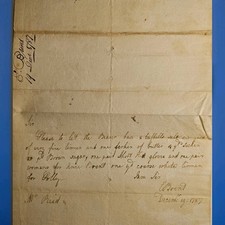
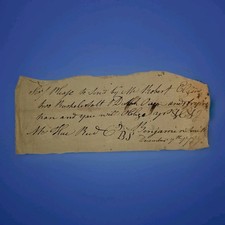
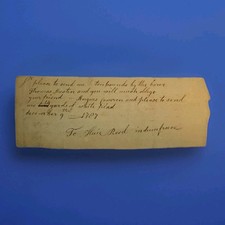
Rare and historically fascinating Revolutionary-era merchant manuscript dated December 9, 1787, written by Angus Cameron and addressed to the prominent Virginia mercantile house of Huie, Reed & Co. in Dumfries, Virginia, one of the most important tobacco ports in early America.
The note reads in part:
“Please to send me ten pounds by the barer Thomas Huston… and please to send me 14 yards of white plaid…”
This small but highly evocative surviving manuscript captures the interconnected world of post-Revolutionary American commerce, Scottish merchant networks, textile trade, maritime activity, and Atlantic economic reconstruction in the years immediately following the American Revolution.
The manuscript is especially notable for its probable connections to several historically significant individuals and commercial circles:
Angus Cameron is believed to be the Scottish-born immigrant and Loyalist-associated settler originally from Breadalbane in the Scottish Highlands. Like many Highland emigrants of the eighteenth century, Cameron emigrated to colonial New York prior to the Revolution and became caught in the immense political and economic upheaval caused by the war. By 1787, displaced Loyalists and Scottish emigrants were rebuilding trade and financial relationships throughout the Atlantic world. Cameron’s request for funds and “14 yards of white plaid” reflects not only ordinary mercantile business, but also the continued cultural and commercial ties connecting Scottish Highland communities with America after independence. The reference to plaid cloth is especially evocative of Highland textile traditions and imported British goods circulating through postwar Chesapeake and Atlantic trade routes.
The manuscript also references Thomas Huston, believed to be the Revolutionary War mariner and Pennsylvania naval officer who served with distinction during the American Revolution. Huston operated aboard several Pennsylvania state naval vessels, including the armed boat Franklin and the galley Warren, and participated in the defense of American waterways and commerce during the conflict. Following the war, like many former naval officers and privateers, Huston transitioned into civilian maritime and mercantile pursuits. His appearance here as the bearer of the note provides a fascinating glimpse into how Revolutionary veterans reintegrated themselves into postwar trade and transportation networks.
Equally important is the destination of the note: Huie, Reed & Co. of Dumfries, Virginia, one of the important Scottish-American mercantile firms operating along the Potomac River in the late eighteenth century. Dumfries was among the leading tobacco export ports in colonial and early federal America, serving as a critical center of Chesapeake commerce before silting eventually diminished the harbor. Merchant houses such as Huie, Reed & Co. controlled extensive trade networks dealing in tobacco, imported textiles, sugar, salt, and Atlantic goods, linking Virginia planters and merchants with Scotland, England, and the wider British Atlantic economy.
Particularly appealing is the surviving reference to:
- “14 yards of white plaid”
which strongly evokes the continued importance of Scottish Highland textile culture and imported cloth trade among Scottish emigrants in post-Revolutionary America.
The document is written on original laid paper bearing a visible “CC” watermark, consistent with late eighteenth century British-export paper stock commonly encountered in American mercantile correspondence of the Revolutionary and Early Federal period.
Together, the document represents a rare surviving intersection of:
- Revolutionary War maritime history
- Scottish Highland immigration
- Loyalist displacement
- Chesapeake tobacco commerce
- Atlantic merchant networks
- and post-Revolution economic reconstruction in the early United States.
Condition:
Fold wear, age toning, edge wear, and small losses consistent with age and handling. Ink remains dark and legible. Watermark visible under light. Overall a very attractive and authentic eighteenth century manuscript piece.
Approximate size:
Long narrow merchant slip format.
A superb addition for collectors of:
- Revolutionary War manuscripts
- Virginia history
- Scottish-American history
- merchant correspondence
- tobacco trade
- maritime history
- and eighteenth century Americana.