When you click on links to various merchants on this site and make a purchase, this can result in this site earning a commission. Affiliate programs and affiliations include, but are not limited to, the eBay Partner Network.
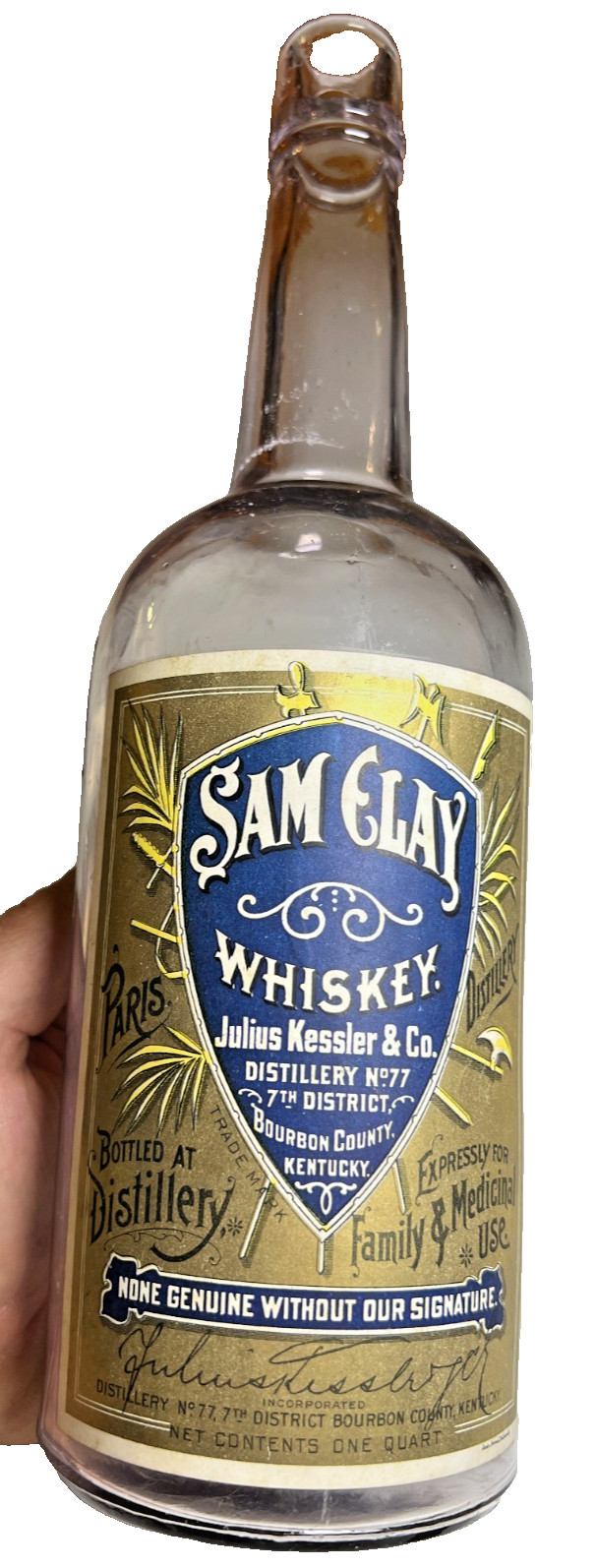
The bottle retains its original label in unusually crisp condition with vivid metallic gold ink, deep blue shield, and strong Julius Kessler facsimile signature. The reverse is embossed, the base is smooth with a center mold dimple, and the glass shows a ring of tiny manufacturing bubbles through the lower neck along with an as-made rough glass patch on the back shoulder.
A beautiful survivor from the final years of Prohibition and the first years following Repeal.
Condition
- 12 1/8 inches tall
- No chips
- No cracks
- Bright, clean, shiny glass
- Outstanding original label
- Embossed on reverse
- Smooth base with center mold dimple
- Ring of factory bubbles in lower neck
- As-made rough glass area on rear shoulder
- Displays beautifully
Date
Circa 1933–1936
Why?
The label carries:
- Distillery Number system
- Modern machine-made bottle
- Smooth base with suction scar
- \"Medicinal Use\" advertising, which exploded during the repeal era when many whiskey brands emphasized medicinal legitimacy after thirteen years of Prohibition.
City & State
Paris, Bourbon County, Kentucky
Paris sits in the heart of Kentucky\'s famous Bluegrass region and has been one of America\'s great bourbon-producing centers since the 1800s.
During the 1930s Paris remained a relatively small agricultural town surrounded by horse farms and bourbon warehouses.
Julius Kessler & Co.
Julius Kessler began building his whiskey business during the late nineteenth century.
Unlike many distillers who sold under their own names, Kessler marketed numerous proprietary brands through wholesalers and druggists.
His company became known for:
- blended whiskey
- bourbon
- medicinal whiskey
- nationwide advertising
- attractive lithographed labels
The company survived Prohibition largely because whiskey could still legally be dispensed by prescription through licensed pharmacies.
Eventually the Kessler brand became one of America\'s largest blended whiskey names and later passed through a succession of major liquor companies. Today\'s Kessler Whiskey traces its lineage to this original business.
Sam Clay Whiskey
Sam Clay was a proprietary Julius Kessler brand.
Compared with Kessler\'s flagship labels, Sam Clay appears far less frequently today.
The striking blue shield with metallic gold background was clearly designed to stand out on pharmacy shelves and liquor counters.
The phrase
\"Expressly for Family & Medicinal Use\"
was a powerful marketing tool.
It suggested purity and wholesomeness while also appealing to consumers who had become accustomed to obtaining whiskey legally through physicians during Prohibition.
Marketing
The label combines several themes:
- Kentucky authenticity
- medicinal legitimacy
- family use
- distillery origin
- personal guarantee through Julius Kessler\'s signature
Notice also the decorative background featuring agricultural motifs and crossed implements that reinforce Kentucky\'s farming heritage.
What was happening then?
If this bottle dates to 1933–1936, America was experiencing enormous change.
Technology
- Commercial air travel was beginning.
- Radios had become household necessities.
- Refrigerators replaced iceboxes.
- The first practical television demonstrations were underway.
- Streamlined automobiles from Ford, Chevrolet, Chrysler and others were transforming American roads.
Medicine
Doctors still prescribed whiskey for:
- poor circulation
- convalescence
- appetite stimulation
- nervous disorders
Antibiotics were not yet widely available.
Politics
Franklin D. Roosevelt had just entered office.
The country was emerging from the Great Depression while ending thirteen years of National Prohibition through the Twenty-first Amendment.
Life in Paris, Kentucky
During the early 1930s:
- Bourbon warehouses returned to production after Prohibition.
- Horse breeding remained the region\'s largest industry.
- Tobacco and livestock dominated surrounding farms.
- Employment slowly improved as distilleries reopened and federal New Deal programs reached rural Kentucky.
Label Transcription
SAM CLAY
WHISKEY
Julius Kessler & Co.
DISTILLERY No. 77
7TH DISTRICT
BOURBON COUNTY
KENTUCKY
Paris
Bottled At Distillery
Trade Mark
Expressly for Family & Medicinal Use
NONE GENUINE WITHOUT OUR SIGNATURE
Julius Kessler (facsimile signature)
INCORPORATED
DISTILLERY No. 77, 7TH DISTRICT, BOURBON COUNTY, KENTUCKY
NET CONTENTS ONE QUART
Printer credit:
Courier-Journal Lith. Louisville
Rarity
Bottle: Uncommon
Bottle with this exceptional label: Rare
Most surviving Sam Clay bottles have:
- damaged labels
- heavy staining
- partial loss
- no label at all
This example has unusually vibrant metallic printing and excellent eye appeal, which substantially increases its desirability.