When you click on links to various merchants on this site and make a purchase, this can result in this site earning a commission. Affiliate programs and affiliations include, but are not limited to, the eBay Partner Network.
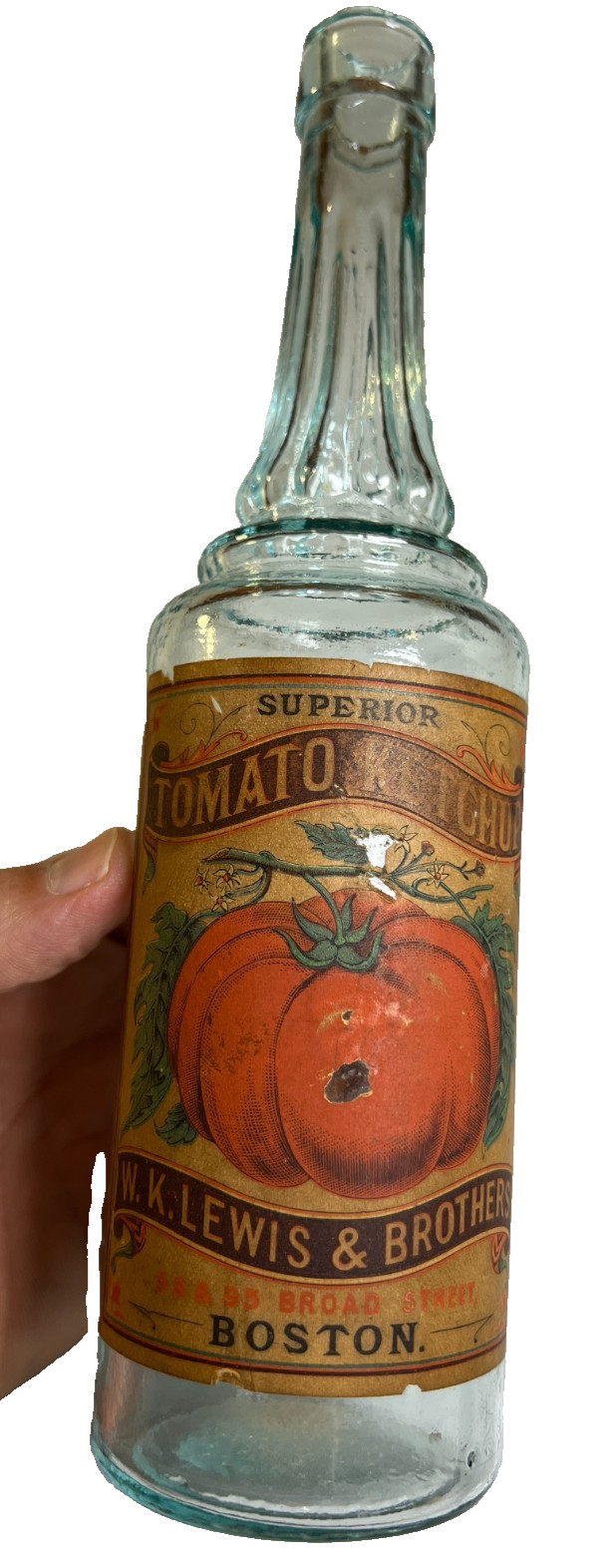
A wonderful and extremely early original-label W. K. Lewis & Brothers Superior Tomato Ketchup bottle from Boston, Massachusetts. This handsome hand-blown aqua example stands 9 3/8 inches tall and retains its bold, colorful pictorial label showing a huge ripe tomato on the vine.
The label reads W. K. Lewis & Brothers, 93 & 95 Broad Street, Boston. Lewis Brothers was a major Boston maker and wholesale dealer in pickles, preserves, ketchups, syrups, and other shelf-stable groceries. The company took this name after 1859 and was operating at the Broad Street address during the Civil War and immediately afterward. This bottle dates approximately 1865–1875, with circa 1870 a very good working date.
This is the era when preserved food became an important modern American industry. The Civil War created enormous demand for food that could be packed, shipped, stored, and consumed far from the farm or kitchen. Salt, sugar, vinegar, bottling, canning, and improved transport helped feed soldiers, cities, ships, railroad travelers, and a rapidly expanding nation. Boston was a major commercial port and food-distribution center, and W. K. Lewis & Brothers was right in the thick of that business—not a little local pickle shop, but a serious manufacturer selling branded goods into a growing national marketplace.
The contents would have been a thick, tangy tomato condiment preserved primarily with vinegar, salt, sugar, and spices. Early ketchup was not yet the standardized, nationally dominant product we think of today. Ketchup had earlier appeared in mushroom, walnut, fish, and other forms; tomato ketchup was still becoming a familiar commercial staple in the mid-nineteenth century. This Lewis bottle belongs to the early generation of bottled tomato ketchup, made before Heinz’s tomato ketchup became the giant of the trade in the later 1870s and beyond.
Its marketing is terrific. “Superior” promises quality and dependability, while the enormous bright-red tomato gives the shopper an immediate picture of what was inside. That lavish color label was expensive, deliberate advertising—meant to make a Lewis bottle stand out on a grocer’s shelf when branded packaged foods were still a relatively new idea.
The bottle itself is as appealing as the label: pale aqua hand-blown glass, a smooth domed base, broad shoulder, high crude applied lip, and a wonderfully long fluted neck with lots of stretch, waviness, and early character. It has the exact look you want in a Civil War-era food bottle.
Condition: The glass is bright, clean, and attractive, with excellent hand-made character. No cracks are seen. The original label survives remarkably well for its age and remains highly displayable, with strong color and wonderful graphics. It does have honest wear: small flea bite along the lip, wear and fading in places, and noticeable losses/scuffs through the central tomato and upper vine area, as clearly shown. A truly scarce and striking survivor—especially desirable for the original pictorial label, early Boston origin, and strong Civil War-era food-preservation story.