When you click on links to various merchants on this site and make a purchase, this can result in this site earning a commission. Affiliate programs and affiliations include, but are not limited to, the eBay Partner Network.
Scarce Dancing Sailor & Banjo Player Historical Flask — Baltimore, Maryland — Circa 1860s
Music on one side, dancing on the other—and nearly 160 years of American glassmaking character packed into one spectacular little flask.
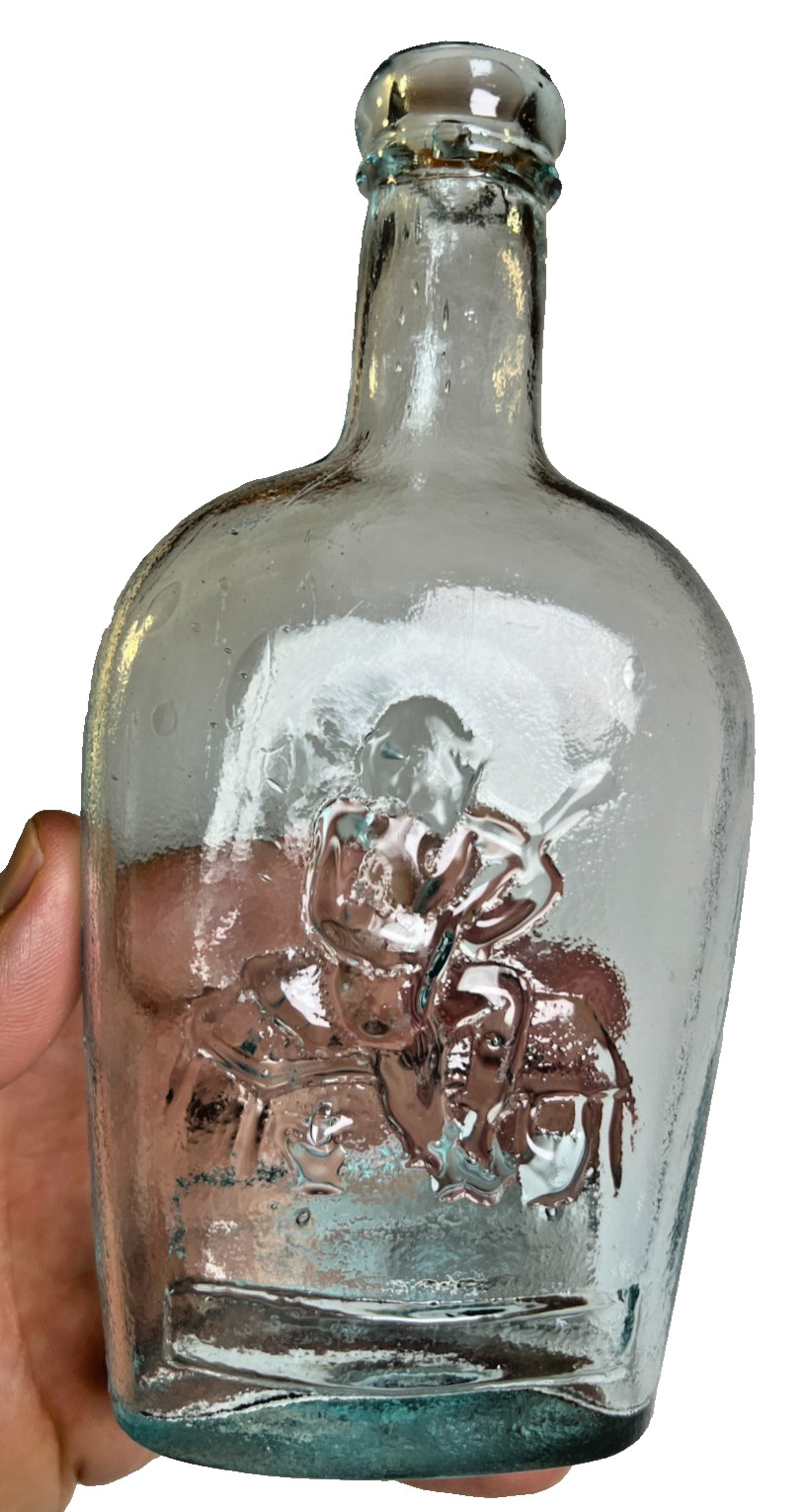
This is the desirable McKearin GXIII-8 half-pint historical whiskey flask, featuring a wonderfully animated dancing sailor on one side and a seated banjo player on the reverse. The flask is generally attributed to the Maryland Glass Works operated by John Lee Chapman in Baltimore, Maryland, and dates to approximately the 1860s, possibly extending into the very early 1870s.
The GXIII-8 is considered a scarce historical-flask pattern and is particularly appealing for its unusual combination of nautical, musical, and popular-entertainment imagery. This example is especially attractive because of its brilliant aquamarine color, exceptionally sharp pictorial impressions, clean condition, applied collared lip, and richly textured glass.
The Dancing Sailor
One face displays a full-length male figure caught in motion, traditionally identified by collectors as a dancing sailor. His bent knees, lifted foot, outstretched arm, and jaunty posture strongly suggest the performance of a sailor’s hornpipe.
The sailor’s hornpipe was already an established form of entertainment by the middle of the 19th century. It was associated with naval life, waterfront taverns, theatrical performances, and the romantic public image of the American seaman. The dance’s quick footwork and energetic movements made it instantly recognizable to period audiences.
The mold engraver successfully translated that movement into glass. The figure does not simply stand in place—he appears to be caught in the middle of a lively step.
The Banjo Player
The reverse depicts a seated musician holding and playing a banjo, creating a wonderfully complementary composition: the musician performs on one side while the sailor dances on the other.
By the 1840s through the 1860s, the banjo had become one of the most recognizable instruments in American popular entertainment. It was heard in theaters, saloons, traveling shows, public halls, and informal gatherings. While the imagery reflects the complicated minstrel-entertainment culture of the period, it also documents the banjo’s developing place in American music.
The instrument, seated posture, clothing, chair, and surrounding details are all unusually crisp on this example. Both pictorial panels remain bold and immediately recognizable rather than weak or washed out.
Baltimore and the Maryland Glass Works
This pattern is generally attributed to the Maryland Glass Works of Baltimore, associated during this period with John Lee Chapman.
Chapman was a prominent Baltimore businessman, glass manufacturer, railroad executive, and civic figure who served as the city’s mayor from 1862 through 1867. His direct connection with Baltimore industry gives the flask considerably more historical interest than an anonymous decorative bottle.
During the 1860s, Baltimore was a busy port and manufacturing center positioned between North and South. The city experienced intense political tension during the Civil War while its waterfront, railroads, factories, taverns, and markets continued to bustle. A pocket-sized whiskey flask decorated with a sailor and musician would have looked perfectly at home in this maritime city.
The lively subject matter may have been intended to appeal to sailors, laborers, travelers, tavern patrons, or anyone attracted to the music and stage entertainment of the day.
Construction and Glass Character
This is an authentic, hand-produced flask with numerous desirable characteristics of mid-19th-century American glassmaking.
It features:
- Brilliant aquamarine glass
- Approximately half-pint capacity
- Hand-applied collared lip
- Distinctive hinge-mold construction
- Long horizontal hinge-mold line across the underside
- Exceptionally sharp pictorial embossing
- Fine whittling and waviness throughout
- Attractive orange-peel surface texture
- Numerous naturally entrapped bubbles
- Subtle irregularity and asymmetry from hand production
The strong horizontal line running across the underside is the flask’s original hinge-mold seam. It is a manufacturing feature created where the hinged mold sections met and should not be mistaken for a crack, pontil scar, or later repair.
The surface has wonderful orange-peel texture and shifting optical distortion. As the flask is turned in the light, the whittling, bubbles, mold texture, and aquamarine color come alive. This is exactly the kind of glass character collectors hope to find—and no two hand-produced examples are completely alike.
Color
The glass is a beautiful, bright aquamarine, appearing nearly clear in some lighting and developing a noticeably richer blue-green tone around the heavier areas of glass, particularly the base, corners, and applied lip.
The heavier base edge produces an especially vivid band of teal-blue aquamarine. When displayed near natural light, the color and orange-peel texture give the flask considerable visual presence despite its compact half-pint size.
Measurements
- Height: Approximately 6⅝ inches
- Width: Approximately 3¼ inches at its widest point
- Capacity: Approximately one-half pint
Measurements are approximate.
Condition
This flask is in exceptionally clean collector condition, especially impressive for a piece dating from the 1860s.
It has:
- No chips
- No cracks
- No bruises
- No flashes
- No stains
- No interior haze
- No repairs
- Bright, clean, shiny glass
- Strong and sharply defined pictorial impressions
The flask retains naturally occurring bubbles, whittling, orange-peel texture, mold irregularities, and other characteristics created during its original manufacture. These are desirable elements of early hand-produced glass and are not considered damage.
A Remarkable Survivor
Survival is what makes this example so compelling. This was not created as a protected display object. It was a small, practical whiskey flask intended to be filled, carried, handled, emptied, and very possibly discarded.
Somehow, it escaped the chips, cracks, bruises, staining, and heavy wear that claimed so many early flasks. Its applied lip remains intact, the glass is brilliantly clean, and both detailed pictorial panels remain exceptionally sharp.
The combination of scarce GXIII-8 classification, Baltimore attribution, musical and nautical imagery, strong aquamarine color, hinge-mold construction, crisp embossing, and outstanding condition makes this an excellent addition to an advanced collection of historical flasks, Baltimore glass, early American bottles, nautical antiques, or banjo and musical memorabilia.