When you click on links to various merchants on this site and make a purchase, this can result in this site earning a commission. Affiliate programs and affiliations include, but are not limited to, the eBay Partner Network.
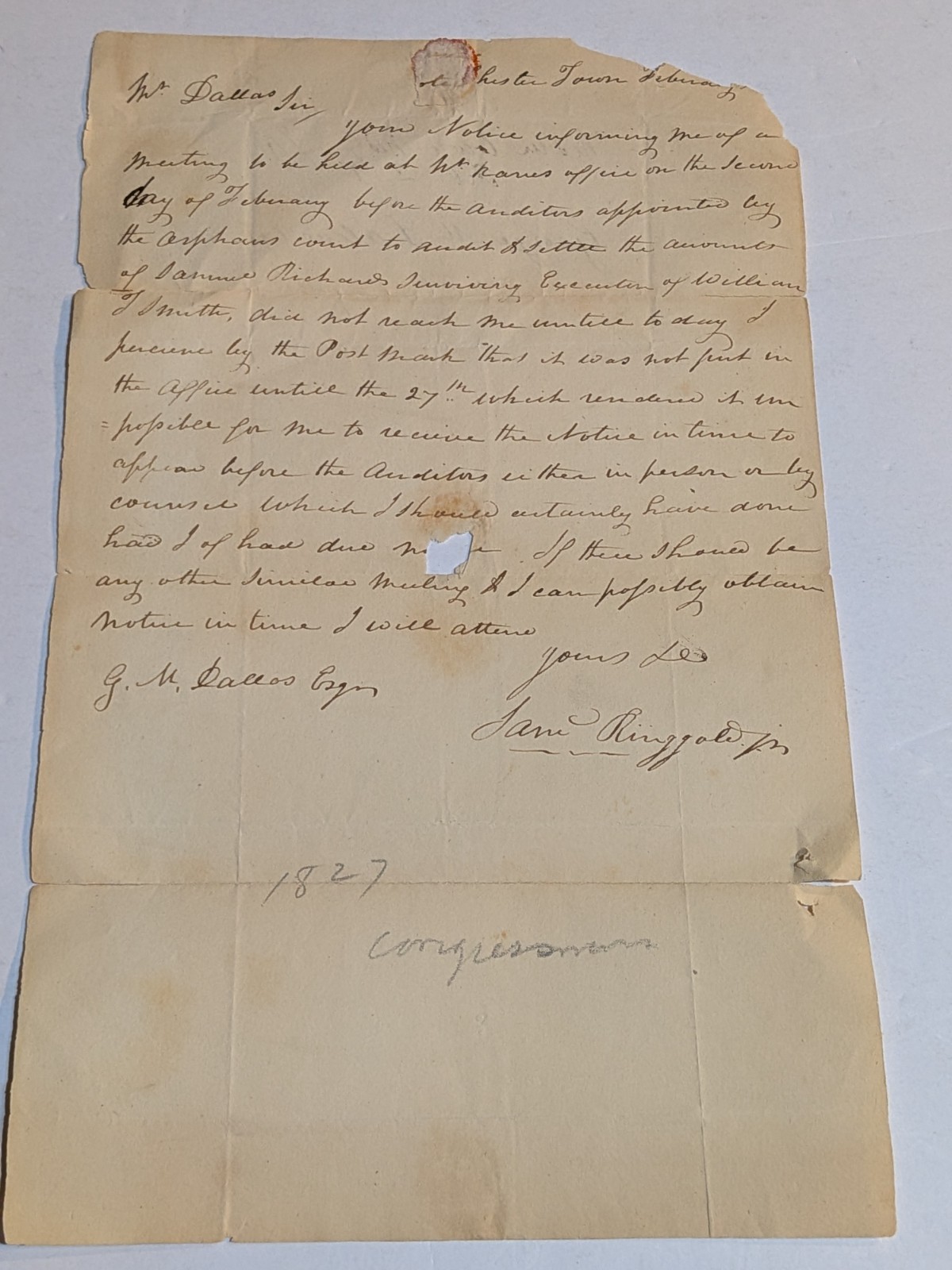
1827 James Ringgold Jr Letter to George M. Dallas (Vice President) Politics.Original 1827 handwritten letter from James Ringgold Jr. of Chestertown, Maryland, addressed to George M. Dallas, who later served as Vice President of the United States under President James K. Polk. The letter discusses missed notice for an Orphans Court audit involving the estate of William L. Mutter, reflecting early American legal and administrative practice.
Includes the front address panel to “George M. Dallas Esq., Philadelphia,” with period postal markings. Paper shows age toning, folds, a small hole, and edge wear typical of early 19th‑century correspondence.
A genuine piece of early American political and legal history, desirable for collectors of presidential‑era figures, Maryland ephemera, and pre‑Civil War manuscript material.
James Ringgold Jr.
James Ringgold Jr. was a Maryland attorney and civic figure active in Kent County (Chestertown) during the early 19th century. He appears in legal correspondence, estate matters, and Orphans Court proceedings throughout the 1820s–1830s. Members of the Ringgold family were prominent in Maryland law, politics, and military service, making his letters desirable early‑American legal and regional history material.
George M. Dallas
George Mifflin Dallas (1792–1864) was a major American statesman who later served as the 11th Vice President of the United States (1845–1849) under President James K. Polk. Before becoming Vice President, he was a U.S. Senator from Pennsylvania, Mayor of Philadelphia, U.S. Minister to Russia, and a key Democratic Party figure. Correspondence addressed to Dallas from his pre‑VP career is strongly collectible. Dallas, Texas was named in honor of George Mifflin Dallas, who served as Vice President of the United States (1845–1849) under President James K. Polk. The city was founded in the 1840s, and early settlers chose his name because he was a nationally prominent political figure at the time.