When you click on links to various merchants on this site and make a purchase, this can result in this site earning a commission. Affiliate programs and affiliations include, but are not limited to, the eBay Partner Network.
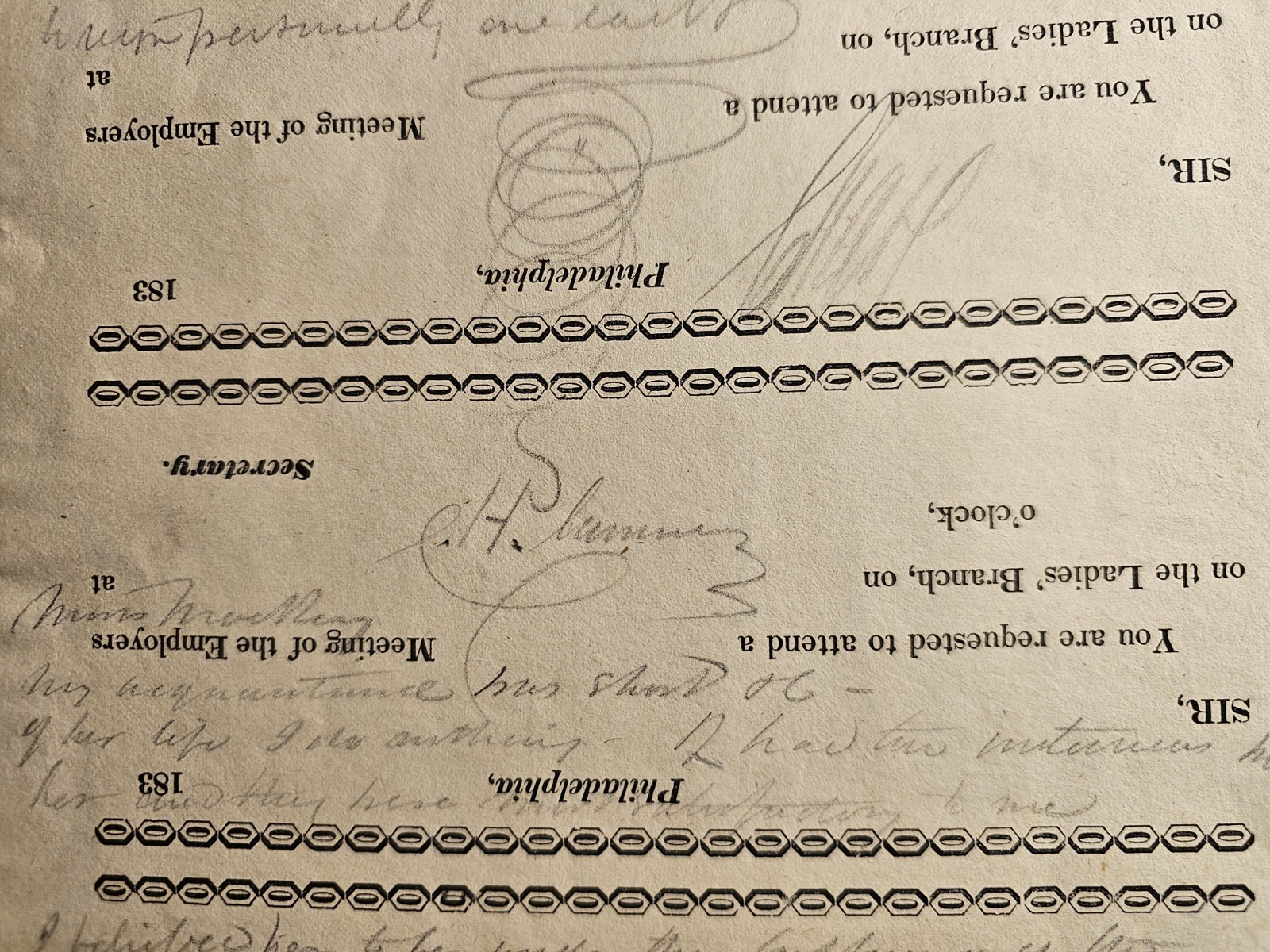
Offered here is an original early 19th-century Philadelphia religious manuscript written on the reverse of an unused printed circular dated “Philadelphia, 183_” (final digit trimmed). The printed form appears to be a meeting notice for a “Meeting of the Employers” with reference to a “Ladies’ Branch,” typical of reform-era voluntary societies active in the 1830s.
The reverse contains several paragraphs of carefully written theological reflection in pencil, likely composed circa 1835–1845. The manuscript discusses the nature of Christian “Union,” rejecting institutional merger of denominations and instead advocating:
• A “Union of belief in the one faith of the Gospel”
• Salvation through belief and submission to Christ
• “A holy life being the evidence of that belief”
• “Union of fraternal recognition” among believers
• “Union of cooperation” and “Union of action”
• The Bible as the governing authority
• Reference to “the millennial, the immediate approach of Christ”
The tone is measured, reflective, and doctrinal rather than revivalistic. The theology aligns strongly with Second Great Awakening–era evangelical Protestant thought, particularly the interdenominational reform movements active in Philadelphia during the 1830s–1840s. The language reflects debates of the period concerning Christian unity across denominational lines, a major issue in the era of voluntary societies, missionary cooperation, and the Presbyterian Old School / New School division (1837).
Importantly, the manuscript does not contain prophetic calculations or date-setting language. Its millennial reference reflects the broader evangelical eschatological climate of the time rather than sensational Advent preaching.
The handwriting is an educated mid-19th-century cursive hand. A faint pencil signature appears at the lower margin, likely reading “J. H. Hummer,” though no firm attribution is made.
Condition:
Single printed circular sheet with manuscript on reverse. Edge trimming affects the final printed date digit. Light age toning and handling consistent with period paper. Pencil writing remains legible.
This is a strong example of reform-era American Protestant manuscript material, combining:
• 1830s Philadelphia printed ephemera
• Contemporary theological manuscript
• Millennial-era Christian unity rhetoric
• Second Great Awakening context
A desirable piece for collectors of early American religion, Philadelphia history, evangelical reform movements, or millennial-era theology.